A centrifugal compressor in a Liquefied Natural Gas (LNG) plant experienced a catastrophic blade fracture during operation at cryogenic temperatures. The subsequent expert analysis revealed that the nickel superalloy failed due to undetected micro-porosities in the casting. This technical article details how the combination of industrial tomography and finite element simulation allowed for reconstructing the failure and validating the fatigue model, establishing a critical workflow for the energy industry. 🔬
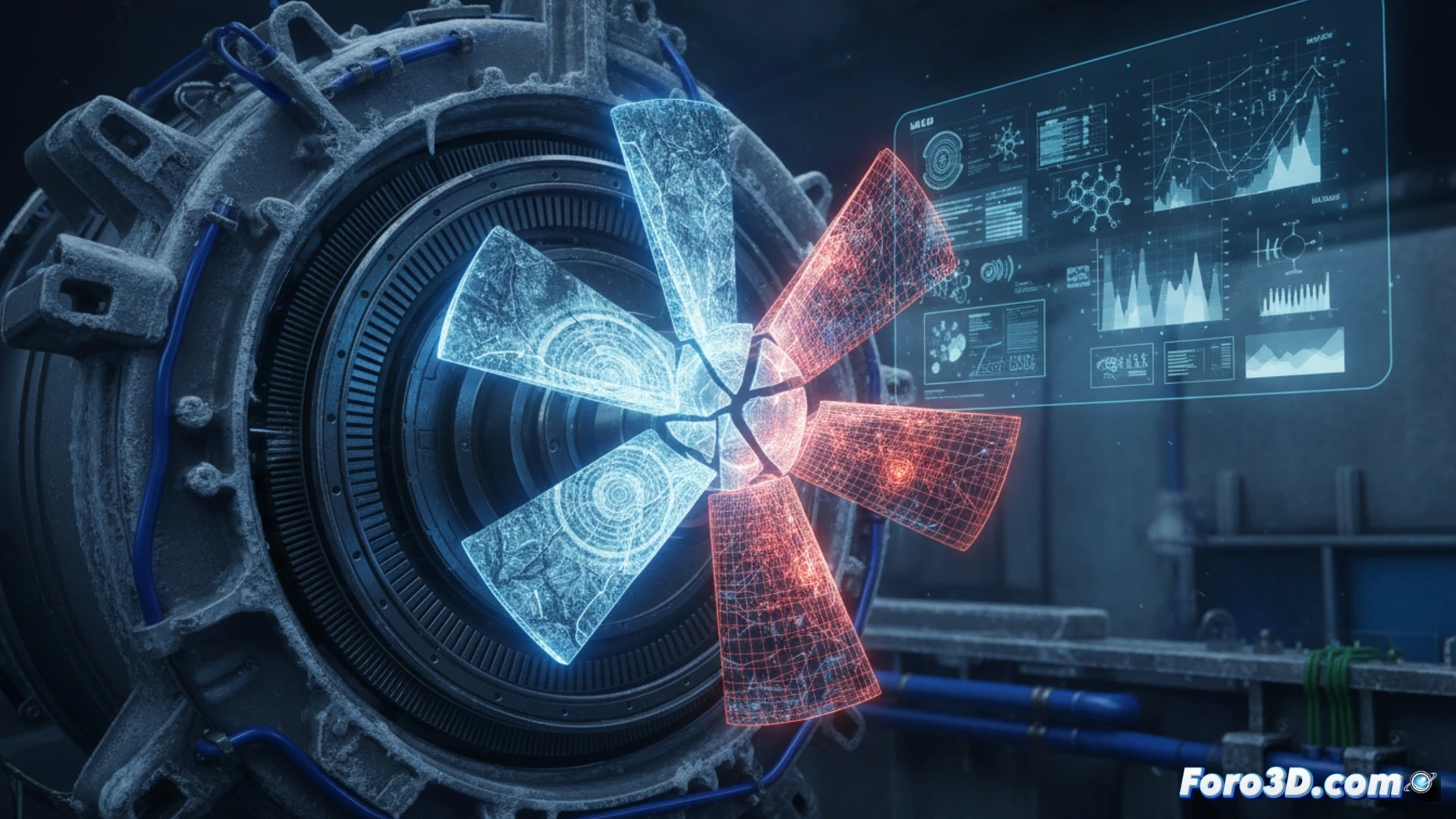
Workflow: from volumetric scanning to simulation in nCode ⚙️
The process began with a high-resolution industrial tomography scan of the fractured blade using an X-ray system. The volumetric data was imported into Volume Graphics to segment the internal micro-porosities, smaller than 50 microns, located in the stress concentration zone. Subsequently, a high-fidelity hexahedral mesh was generated incorporating these imperfections as real geometric entities. The model was exported to Siemens Simcenter to apply the cryogenic and rotational loads of the operating cycle. Finally, nCode performed the multiaxial fatigue simulation using the Smith-Watson-Topper criterion, correlating the crack initiation zones with the detected porosities. The correlation between the actual fracture and the stress model showed a deviation of less than 3% in the estimated life.
Lessons for predictive inspection in critical components 🛠️
This case demonstrates that industrial tomography is not just a non-destructive inspection tool, but a cornerstone for fatigue simulation with real defects. Integrating volumetric data into nCode allows for adjusting safety margins in superalloy designs subjected to extreme conditions. For simulation engineers, the message is clear: ignoring micro-porosities in the mesh can underestimate the risk of catastrophic failure in cryogenic environments. The methodology presented here positions itself as a standard for future expert analyses in the LNG sector.
As a simulation engineer, when validating a cryogenic fatigue FEM model with 3D tomography, which convergence criterion between the actual crack observed in the fractured blade and the numerical prediction do you consider most relevant for determining the accuracy of the expert analysis?
(PS: Material fatigue is like yours after 10 hours of simulation.)