The occupational risk analysis for a sales representative reveals a lethal combination of factors: forced postures while driving, overexertion from handling samples, and cumulative fatigue from irregular schedules. Applying material fatigue simulation to the human body, we can model this wear and tear as a process of progressive damage. 3D technology allows us to visualize how repetitive stress on intervertebral discs and muscle tissues leads to chronic injuries, offering a predictive tool for personalized prevention.
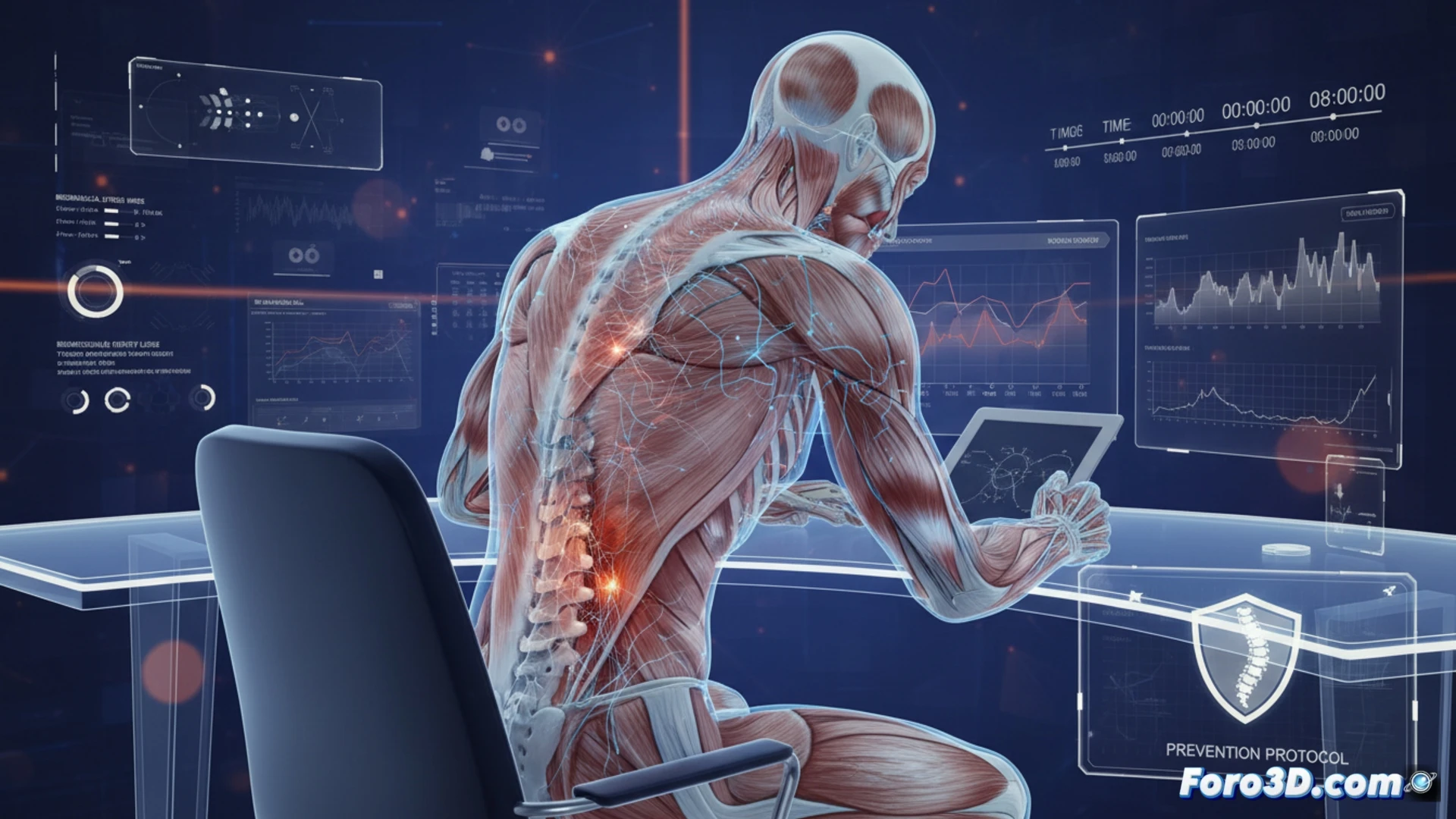
3D modeling of lumbar and cervical stress from prolonged driving 🚗
By simulating the biomechanics of the sales representative in a 3D environment, the spine is discretized as a finite element system. Forced postures during driving (pelvic tilt and cervical flexion) generate stress peaks in the L4-L5 and C5-C6 vertebrae. The simulation software calculates the equivalent plastic deformation in the intervertebral discs, accumulating load cycles for each hour of travel. The resulting stress maps predict critical fatigue points where micro-injury becomes a hernia or disc protrusion, allowing adjustment of the seat, armrests, and break times to reduce the rate of cumulative damage.
Predictive prevention: from overexertion to ergonomic protocol 🛡️
Extrapolating material fatigue to occupational ergonomics transforms risk prevention. When loading and unloading samples, the 3D model quantifies the torsional moment in the erector spinae muscles and hysteresis fatigue in the shoulder tendons. This data allows for the design of task rotation protocols and weight limits tailored to each worker's accumulated stress history. The simulation not only anticipates injuries but also validates interventions such as the use of passive exoskeletons or the redistribution of samples in the vehicle, reducing the probability of long-term biomechanical failure.
How can the accumulation of fatigue damage in the soft tissues of a sales representative due to prolonged forced postures while driving be accurately modeled in 3D?
(PS: Material fatigue is like yours after 10 hours of simulation.)