The catastrophic failure of a main fan in an indoor wind tunnel during a skydiving session caused the ejection of metal fragments against the duct. Our 3D pipeline integrated structural deformation data, fluid dynamics, and geometric reconstruction to determine the root cause: fatigue from asymmetric load cycles. This article details the forensic process using Siemens Star-CCM+, GOM Inspect, and Autodesk Inventor.
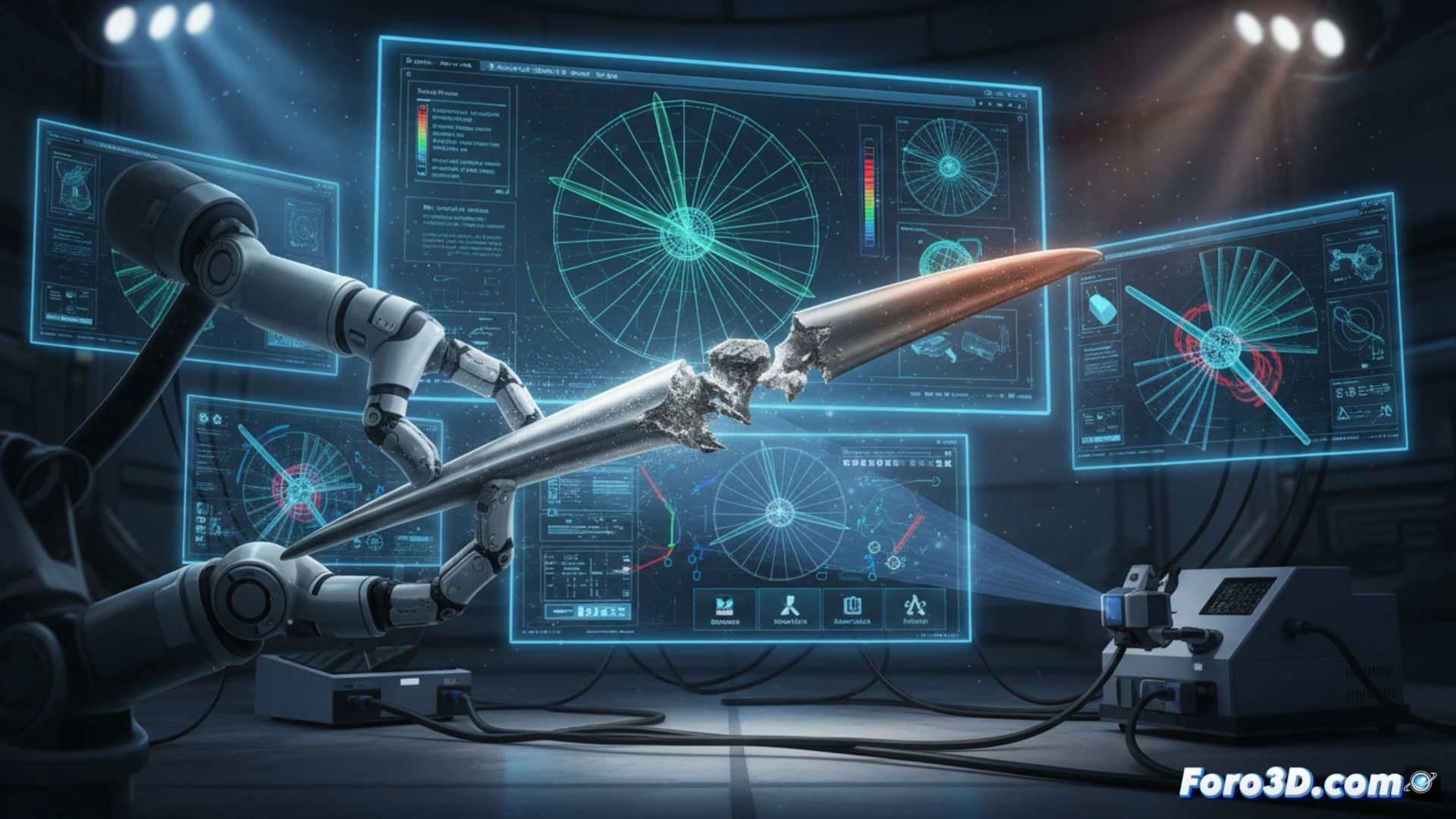
CFD Modeling and Post-Failure Deformation Measurement 🌀
Point clouds of the damaged duct and residual blades were imported from GOM Inspect into Autodesk Inventor to reconstruct the deformed geometries. Using Star-CCM+, the airflow was simulated at 160 km/h, detecting recirculation zones that generated non-uniform pulsating loads on each blade. Residual stress analysis revealed stress concentrations at the root of the blades opposite the impact zone. Impact marks on the duct were correlated with the blade passing frequency, confirming that the failure initiated after 1.2 million cycles of asymmetric bending. Stress-strain graphs showed clear hysteresis in the material, indicating low-cycle fatigue.
Lessons on Asymmetric Loading in Turbine Design ⚙️
This case demonstrates that symmetric fatigue models underestimate actual wear in wind tunnels. The combination of steady-state CFD with modal analysis in Inventor allowed identifying that the duct geometry amplified vibrations in a critical range. For future designs, it is recommended to integrate real-time deformation sensors and hexahedral meshes in Star-CCM+ that capture pressure gradients in the wake. The 3D reconstruction with Cinema 4D facilitated forensic visualization for the safety report.
Considering the documented fragment ejection and catastrophic failure, which 3D forensic analysis methodology allows differentiating between a crack initiated by pure asymmetric fatigue and one propagated due to manufacturing defects in the turbine blade alloy?
(PS: Material fatigue is like yours after 10 hours of simulation.)