The collapse of a drone logistics tower has put simulation engineers on the spot. The cascading failure of the automated shelving was not a random accident, but the result of a predictable physical phenomenon: harmonic vibration fatigue. Hundreds of synchronized rotors generated frequencies that, coinciding with the natural resonance of the aluminum supports, caused micro-cracks leading to total failure. The 3D pipeline to analyze this disaster combines Navisworks, SAP2000, and Unreal Engine 5. 🚁
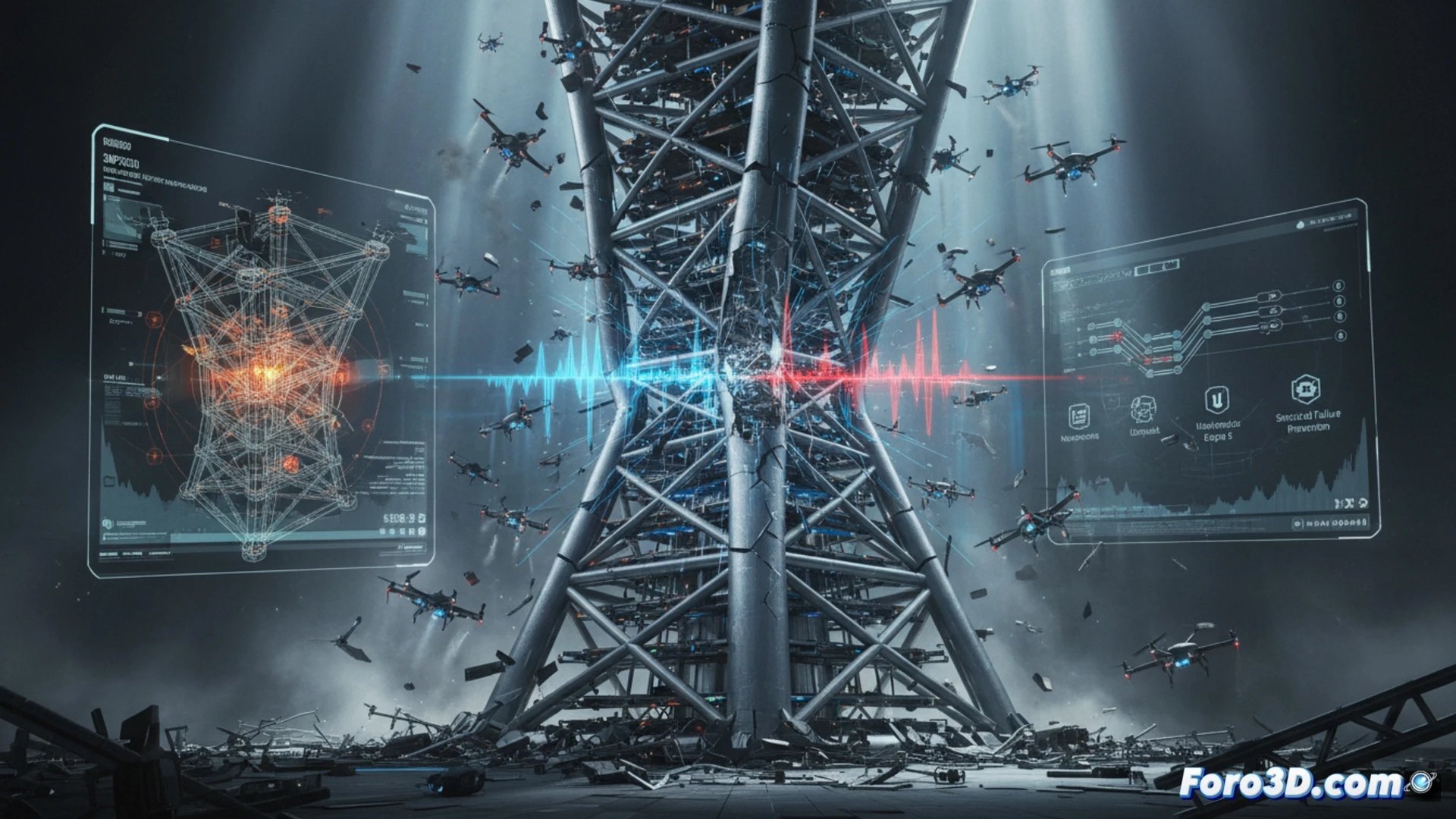
Simulation pipeline: from Navisworks to SAP2000 and Unreal Engine 5 🔧
The process begins in Navisworks, where the BIM model of the tower is integrated to identify the exact geometry of the joints and shelving. This model is exported to SAP2000, where a modal and fatigue analysis is applied. The key is to model the cyclic load of the rotors as a superimposed sinusoidal function. By calculating the natural frequency of aluminum (typically between 15 and 25 Hz for extruded profiles), it is detected that the synchronization of 200 drones generated a harmonic peak of 22.3 Hz, exceeding the material's fatigue limit. Finally, the results are visualized in Unreal Engine 5, where a heat map over the 3D geometry shows the critical stress concentration points, allowing engineers to redesign the supports with tuned mass dampers.
Lessons for structural design in the era of autonomous logistics 📐
This case demonstrates that material fatigue is not just a problem for bridges or airplanes. In environments with drone fleets, frequency synchronization must be a mandatory design parameter. The BIM-SAP2000-UE5 pipeline not only allows diagnosing the failure but also proposing solutions such as replacing aluminum 6061 with alloys having higher internal damping or staggering the rotor cycles. The open question is whether current building codes are prepared to regulate these new harmonic loads in logistics infrastructure.
How can harmonic fatigue induced by the resonance of multiple drones in a honeycomb structure be modeled in SAP2000, considering BIM interaction to predict progressive collapse before it occurs?
(PS: Material fatigue is like yours after 10 hours of simulation.)