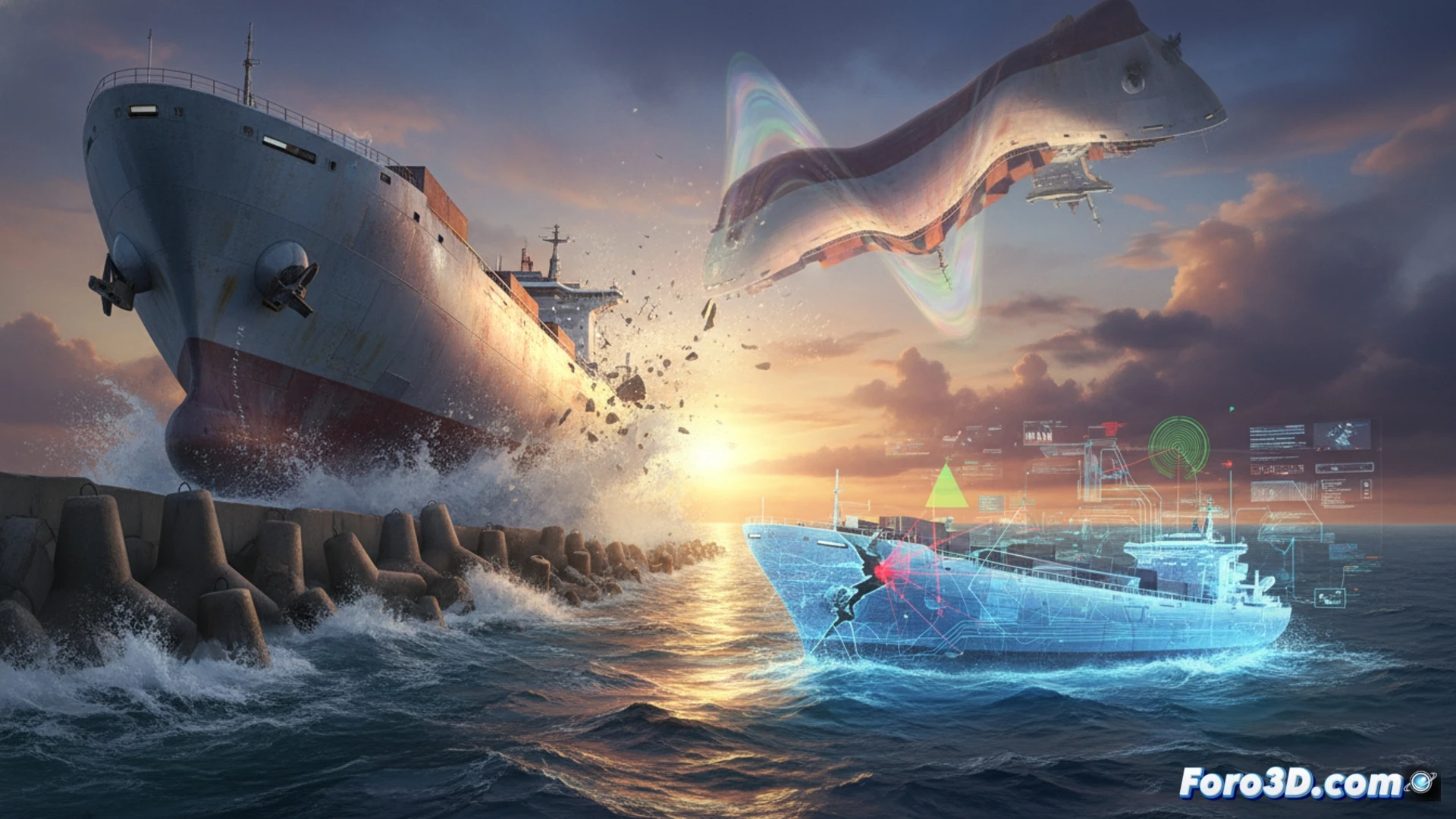
A state-of-the-art autonomous vessel collided with a breakwater during a docking maneuver. The investigation revealed two concurrent causes: an atmospheric mirage known as Fata Morgana, which distorted the horizon line, and a critical failure in the LIDAR and radar sensor fusion system. The vessel's digital twin, replicating the exact conditions of that day, failed to predict the error because the atmospheric model did not include anomalous refraction. This incident reopens the debate on the reliability of real-time simulations for autonomous navigation.
Technical Analysis: Sensor Fusion and Visual Simulation in Unreal Engine and Leica Cyclone 🌊
The vessel's digital twin was built by integrating data from Leica Cyclone for the point cloud of the port and hull, and Unreal Engine for environment rendering. The sensor fusion system prioritized radar readings over LIDAR in low visibility conditions. The Fata Morgana generated a layer of hot air that curved the trajectory of radar waves, creating a false echo of a phantom vessel. The LIDAR, correctly detecting the breakwater, was discarded by the fusion algorithm as an anomaly. Unreal Engine rendered the correct scene, but the digital twin did not update its collision model because the master sensor input (radar) indicated clear space. The failure was not in the hardware, but in the prioritization logic of the data fusion.
Lessons for the Design of Maritime Digital Twins ⚓
The collision demonstrates that a digital twin is only as reliable as the variables it introduces into its simulation. Ignoring optical phenomena like Fata Morgana or failing to model the specific degradation of each sensor under extreme atmospheric conditions turns the twin into a virtual mirage. For the next generation of autonomous vessels, the digital twin must include atmospheric refraction models and a voting system among sensors that does not discard conflicting readings, but evaluates them as potential risk indicators. The lesson is clear: a perfect simulation is useless if it does not also simulate how its own sensors fail.
Is it possible for a digital twin designed to predict the behavior of an autonomous vessel to fail catastrophically if its sensor readings are inaccurate, as in the case of a Fata Morgana distorting the perception of the actual distance to the breakwater?
(PS: My digital twin is currently in a meeting, while I am here modeling. So technically, I am in two places at once.)