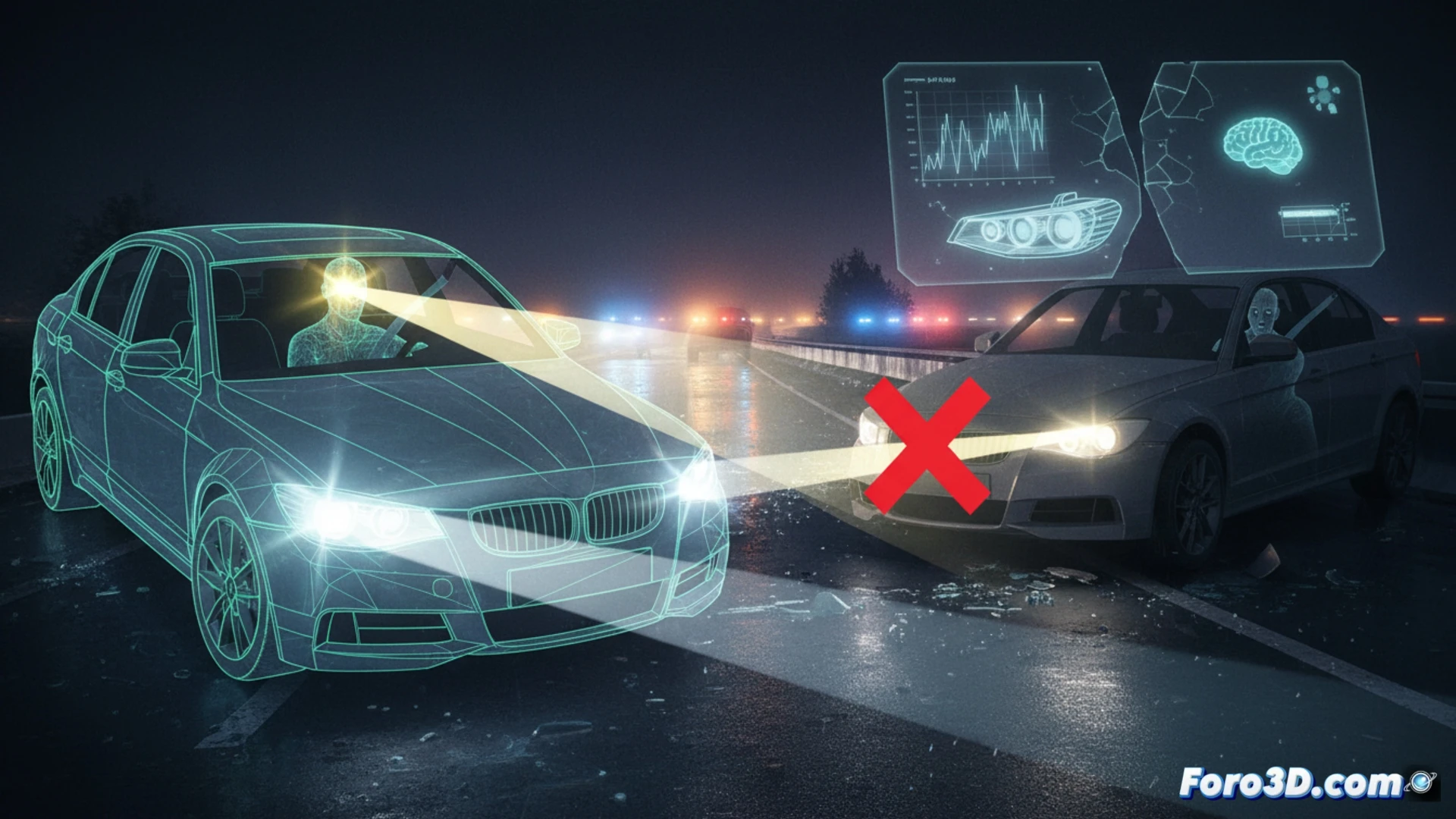
A nighttime accident on a secondary road left a driver temporarily blinded by the lights of an oncoming vehicle. The initial investigation pointed to human error, but forensic reconstruction using 3D tools revealed a deeper cause: a failure in the adaptive LED headlight algorithm, which failed to properly dim the light beam, causing critical glare.
Technical workflow: from optics to kinematics 🛠️
The forensic team used a multidisciplinary workflow to dismantle the dynamics of the incident. First, the behavior of the light beam was simulated in OpticStudio, modeling the headlight's LED matrix and its lens system. It was discovered that the control algorithm did not correctly segment the beam at the moment of the crossing, creating a hot spot in the opposing driver's field of view. With VRED, the nighttime environment and the actual lighting pattern on the road were visualized. Subsequently, PC-Crash reconstructed the accident kinematics, validating trajectories and speeds. Finally, Blender integrated all the data into an animation showing how the glare prevented seeing an obstacle on the road, confirming the causality of the lighting failure.
Implications for ADAS regulations ⚠️
This case demonstrates that adaptive lighting systems must not only comply with intensity standards, but also with algorithms that respond to real traffic scenarios. 3D reconstruction is consolidated as a key tool for auditing the software of intelligent headlights. The industry must update ADAS validation protocols to include glare testing under vehicle crossing conditions, preventing a poorly calibrated algorithm from becoming an active hazard on the road.
How 3D simulation is enabling the modeling of intelligent headlight glare to prevent nighttime accidents before manufacturing
(PS: at Foro3D our cars have more polygons than horsepower)