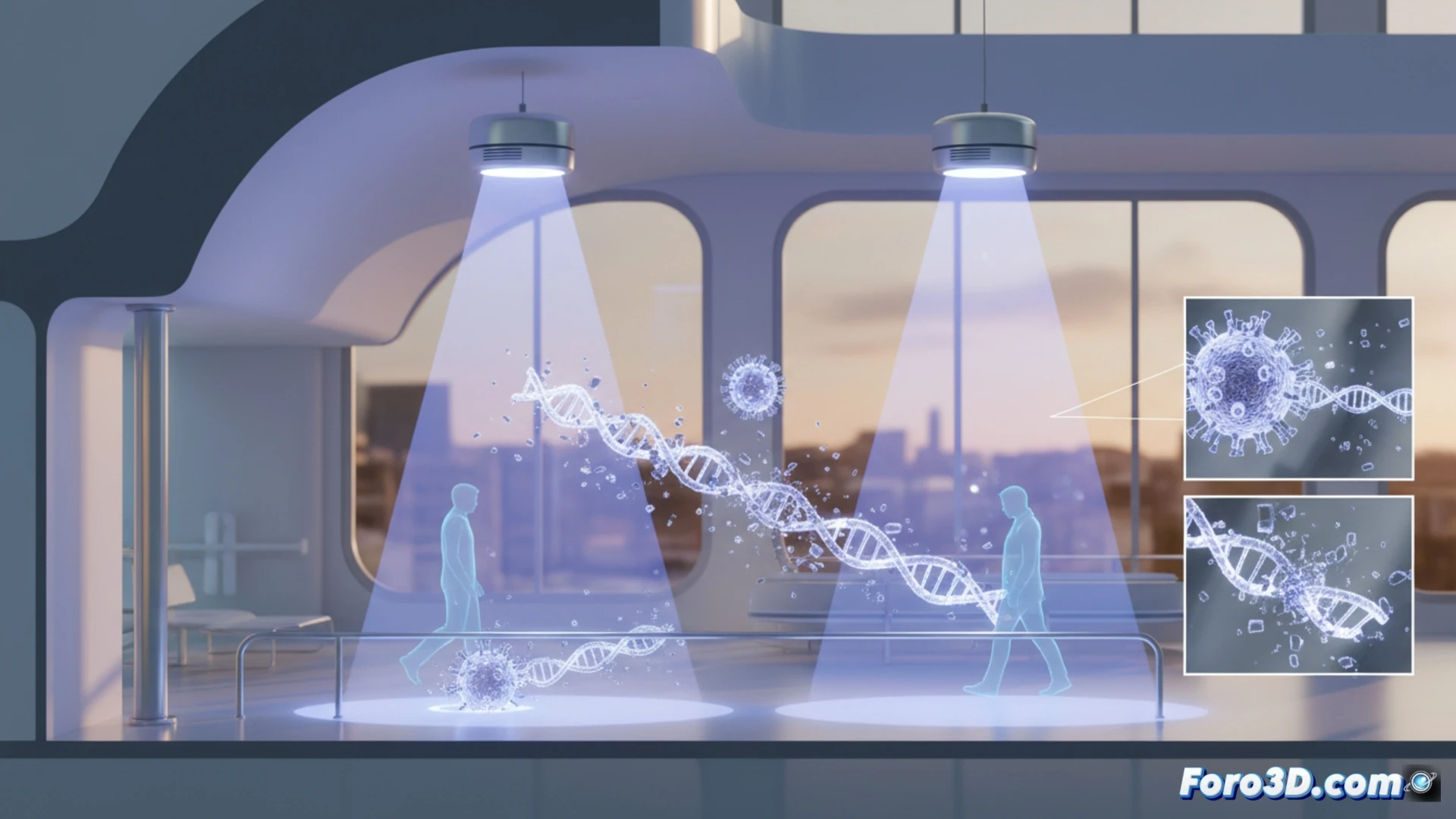
Far-UVC 222nm technology represents a qualitative leap in the fight against airborne and surface pathogens. Unlike traditional UV systems, this specific wavelength is safe for continuous human exposure, as it does not penetrate the outer layers of the skin or the cornea of the eye. This allows its installation in crowded environments such as hospitals, airports, and offices, where disinfection must be constant. Its mechanism of action is direct: the radiation breaks the molecular bonds of DNA and RNA in viruses and bacteria, rendering them instantly inactive.
3D modeling and microbial load maps 🧬
To optimize the implementation of Far-UVC 222nm, it is crucial to integrate this technology with three-dimensional models of enclosed spaces. Using simulation software, we can recreate the volume of a room and calculate the actual irradiance received by each surface. This generates dynamic heat maps that identify ultraviolet shadow zones, where pathogens could persist. By overlaying historical epidemiological transmission data, the model predicts how reducing the microbial load impacts infection rates. For example, in a rendered virtual classroom, one can visualize in real time how the installation of Far-UVC luminaires reduces the concentration of infectious aerosols by 99.9% in less than 10 minutes.
Data visualization for public health 📊
The true strength of this technological convergence lies in the visual communication of effectiveness. By generating animated bar charts comparing infection rates with and without Far-UVC, or by showing a digital twin of a hospital where green (safe) areas expand, epidemiologists can justify investments and adjust protocols. This three-dimensional representation of microbiological safety transforms abstract data into a tangible planning tool, allowing health managers to design environments where disinfection does not interrupt human activity.
How can 3D simulation optimize the layout of Far-UVC 222nm lamps to maximize surface disinfection and reduce shadows in high-traffic public spaces, such as hospitals or schools?
(PS: visualizing obesity in 3D is easy; the hard part is making it not look like a map of solar system planets)