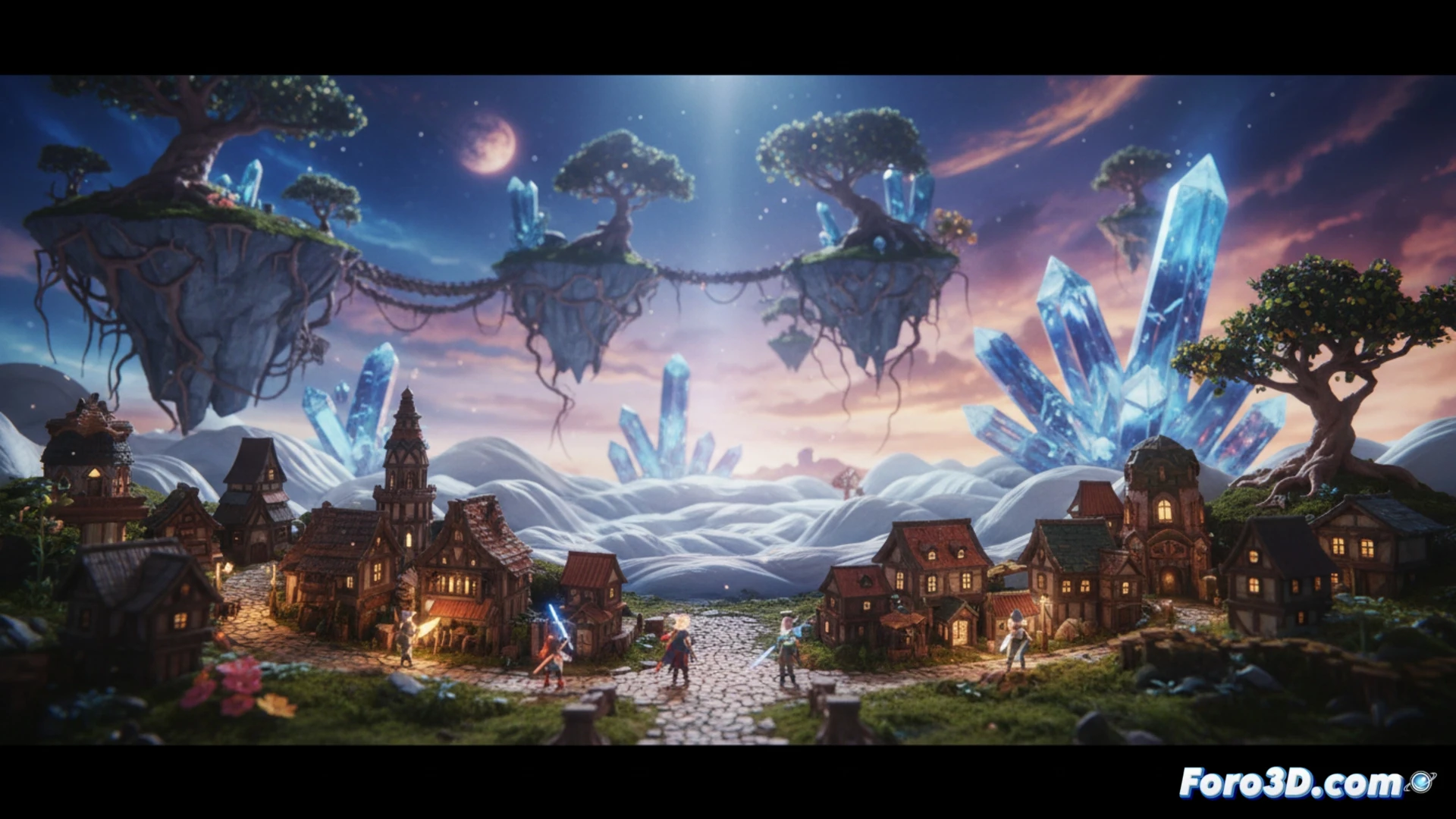
The studio Mistwalker, led by the legendary Hironobu Sakaguchi, has once again challenged graphical conventions with Fantasian Neo Dimension. Instead of opting for a commercial graphics engine like Unreal Engine, they developed a proprietary engine specifically designed to integrate two worlds: the physicality of real dioramas and the flexibility of 3D modeling. The result is a visual style that evokes the settings of the classic JRPG era, but with an organic depth and texture that no pure digital rendering can replicate.
Technical Pipeline: Photogrammetry, Physical Modeling, and Hybrid Rendering 🎨
The creative process began far from the computer, in a model-making workshop. Mistwalker's art team physically built each scene using materials such as clay, wood, resin, and acrylic paint. Once completed, these dioramas were photographed and scanned using photogrammetry, a technique that captures the geometry and textures of the real object from multiple shots. The resulting data was imported into the proprietary engine, where it was optimized for real-time rendering. The characters, on the other hand, were modeled entirely in 3D using programs like Maya or Blender. The engine then calculated the dynamic lighting and shadows of the characters onto the scanned backgrounds, adjusting the color temperature to ensure a seamless integration between the real and the digital. This pipeline avoided the use of generic procedural textures, giving every corner of the game a unique imperfection and detail.
Lessons for RPG Development: The Value of Imperfection 🛠️
Mistwalker's gamble demonstrates that technical innovation does not always require massive engines or complex physics. By using real dioramas, the studio eliminated the cost of designing textures and geometries from scratch for each background, reducing the production time for environmental assets. However, the real challenge was the integration pipeline: calibrating the virtual camera to match the perspective of the physical model and synchronizing the character's lighting with the light captured in the scan. For other developers, this technique offers an alternative path to photorealism: a tactile, imperfect, and handcrafted realism that connects emotionally with the player in a way that polished CGI cannot.
What was the biggest technical challenge Mistwalker faced when integrating the physical dioramas with the CGI models in Fantasian Neo Dimension, and how did they manage to maintain visual consistency between both styles?
(PS: optimizing for mobile is like trying to fit an elephant into a Mini Cooper)