A foundry worker suffered second-degree burns despite wearing a seemingly intact fire-resistant suit. The incident triggered a digital forensic investigation where the 3D pipeline combined Thermal Desktop to simulate radiative heat transfer, CLO 3D to model the textile geometry, and a Keyence VHX microscope to detect microcracks in the fabric's aluminum coating.
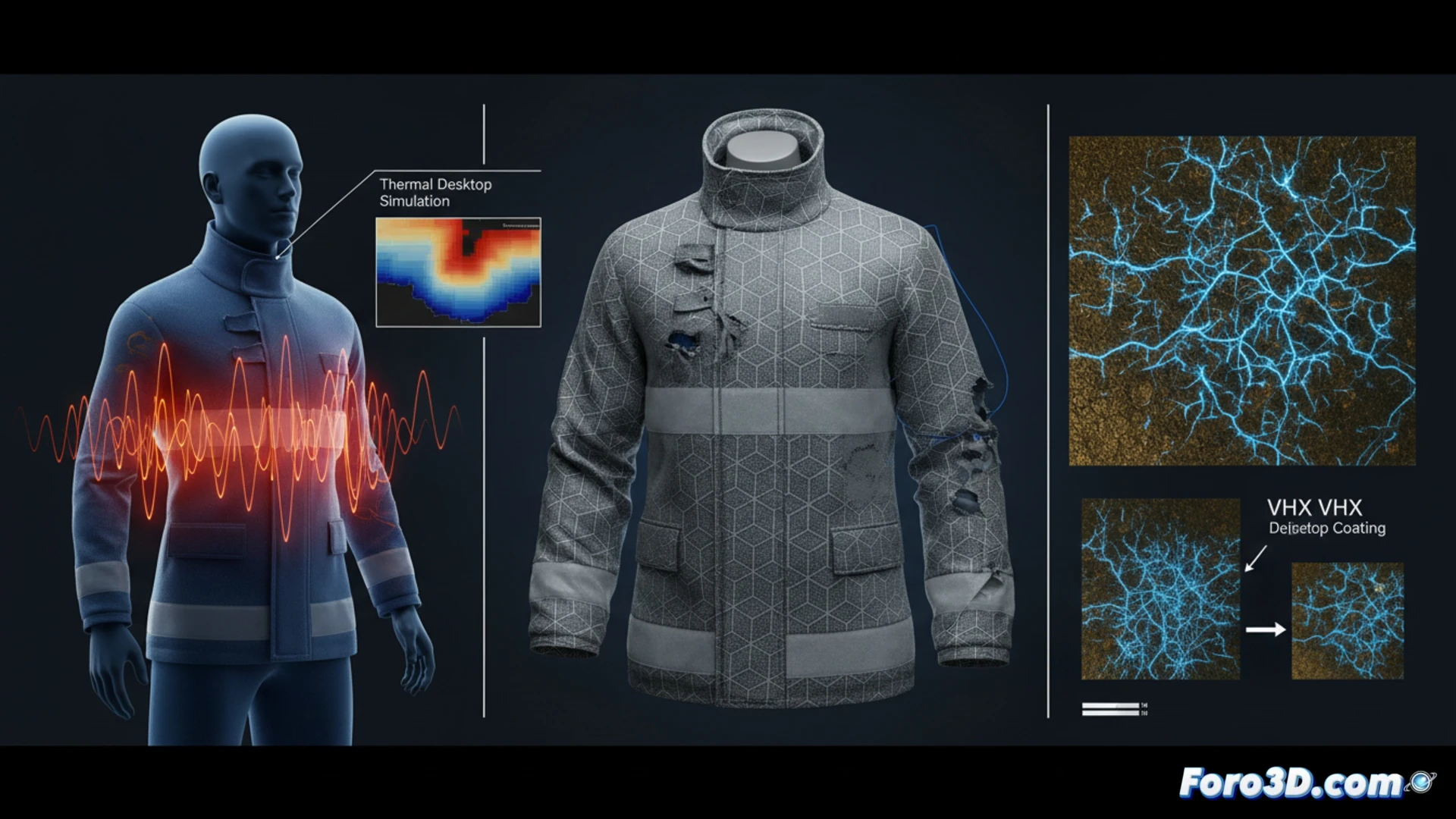
Validation pipeline: from radiation to microscopic failure 🔥
The analysis began in Thermal Desktop, where exposure to 1200 degrees Celsius was modeled. The simulation revealed localized temperature peaks in areas where the reflective coating was supposed to disperse heat. With CLO 3D, the deformation of the suit on a digital avatar was reproduced, identifying areas of mechanical stress that could have compromised the aluminum layer. Confirmation came with the Keyence VHX 3D microscope, which captured high-resolution images showing submillimeter cracks in the coating, invisible to the human eye but lethal to the thermal barrier.
Lessons for technical textile design 🧵
This case demonstrates that textile safety depends not only on the base fabric but also on the integrity of its coatings at a microscopic scale. Integrating thermal simulation tools and 3D microscopy into the design workflow allows predicting failures before they occur in the field. The forensic rendering in KeyShot visually documented the heat path, turning an accident into an engineering lesson for future PPE.
What do you think about this advancement? 💬