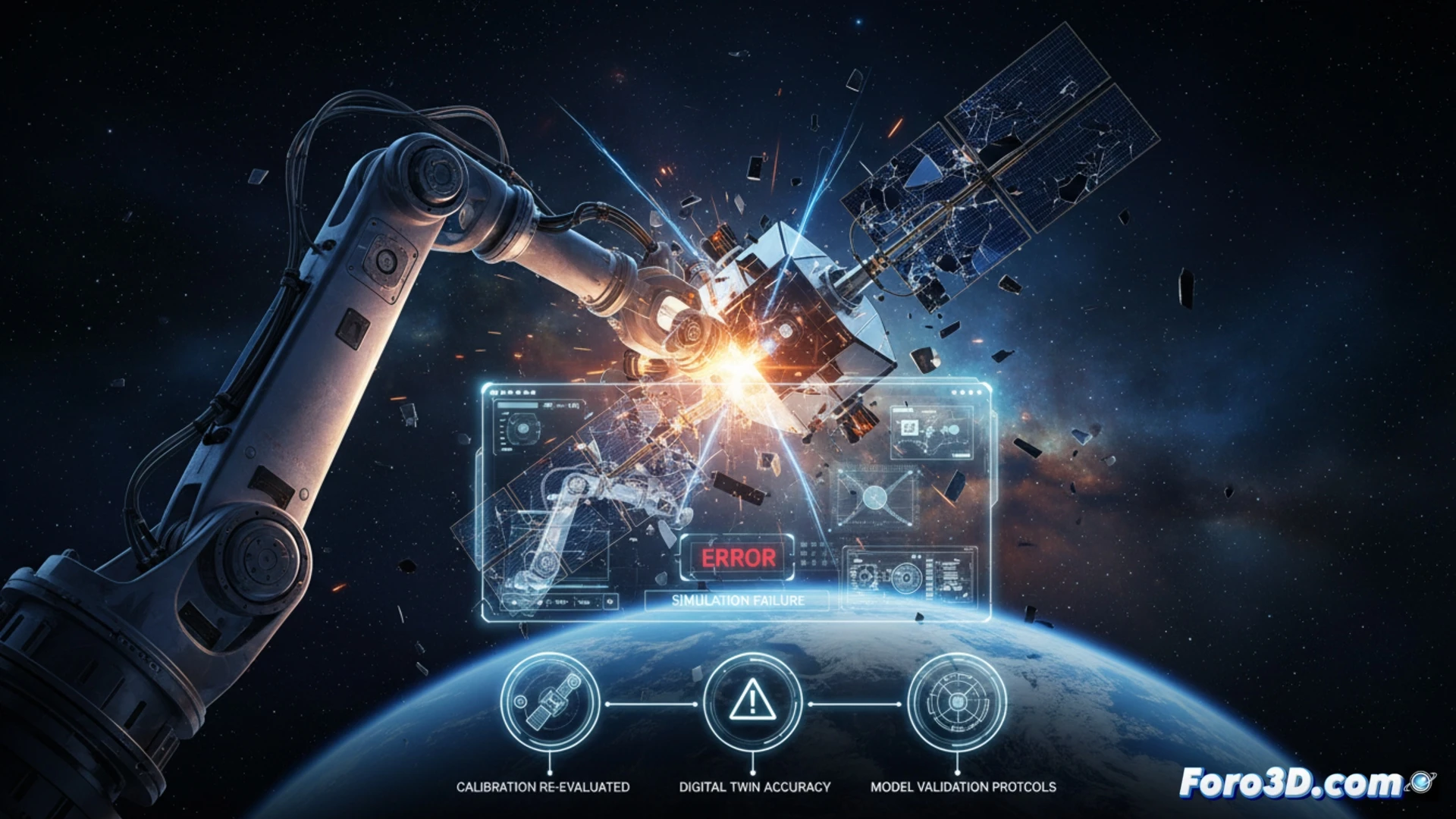
A robotic arm in a satellite assembly plant experienced a critical failure during a high-precision assembly operation. The incident, attributed to a deviation in the positioning sensors, caused a direct collision between the end effector and the satellite structure. This case exposes the fragility of robotic systems when simulation does not accurately replicate the physical conditions of the environment.
RoboGuide, Cyclone, and PolyWorks in Error Detection 🤖
The failure investigation relied on three key tools. RoboGuide (Fanuc) allowed recreating the programmed trajectory and isolating the exact moment when the torque sensor deviation exceeded safety thresholds. Leica Cyclone facilitated the 3D scanning of the post-collision scene, generating a point cloud that evidenced a 0.8 mm discrepancy between the robot's real position and its digital twin. PolyWorks executed the metrological inspection by comparing the dimensions of the damaged satellite against the CAD model, confirming that the assembly tolerance (0.2 mm) was exceeded. Without this triad of simulation, scanning, and inspection, the error's origin (unmodeled wear in the axis 4 encoder) would have gone unnoticed.
Towards Digital Twins with Metrological Calibration 🔧
This incident demonstrates that robotic simulation cannot be limited to idealized kinematics. The integration of real-time metrological data, such as that offered by PolyWorks, and validation through 3D scanning with Cyclone, are essential for detecting submillimetric deviations before a collision. The future of satellite assembly demands that digital twins incorporate component fatigue and sensor drift, transforming simulation into a predictive system rather than just a reactive one.
What key lessons in simulation and calibration can be drawn from a robotic failure in satellite assembly to prevent precision errors in critical space automation operations?
(PS: Simulating robots is fun, until they decide not to follow your orders.)