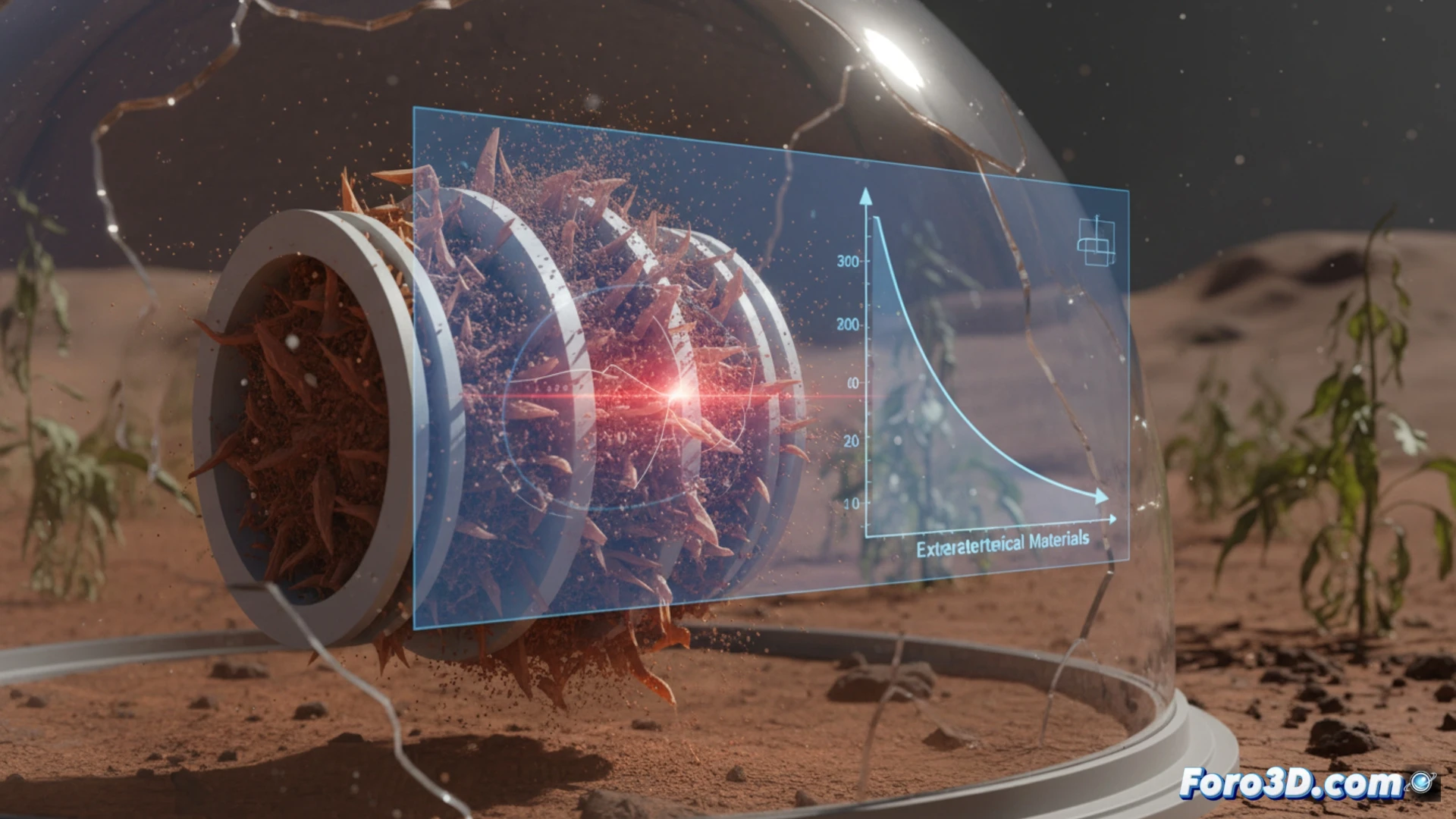
The ambitious project of a bio-greenhouse on Mars has encountered an unexpected obstacle. The regolith filtration system, made of 3D-printed technical ceramics, suffered a catastrophic blockage. Martian dust particles, with their extremely angular morphology, clogged the filter's micropores through a phenomenon known as bridging. This failure, identified using advanced simulation tools, demonstrates that material fatigue in extraterrestrial environments requires a much more rigorous predictive approach than that used on Earth.
Fatigue analysis: from CAD modeling to particle dynamics 🔬
The research process began in SolidWorks, where the exact geometry of the ceramic filter and its porous structure were modeled. Subsequently, the data were imported into Flow-3D to simulate particle dynamics. Here, the software did not treat the dust as a homogeneous fluid, but as discrete elements with angular shapes. The simulation revealed that the particles did not deposit uniformly, but instead created microscopic structural arches (bridges) that sealed the inlet pores. To confirm the failure, VGSTUDIO MAX was used to perform a tomography analysis of the actual filter, comparing the clogged areas with the model's predictions. The result was a perfect match, validating the simulation as a critical tool for predicting material fatigue under extreme particle loads.
Bridging as a warning for frontier engineering ⚠️
This case underscores an uncomfortable truth for simulation engineers: traditional fatigue models, based on spherical particles or Newtonian fluids, are insufficient for environments like Mars. Regolith morphology demands a discrete element analysis that accounts for angular contact and friction. The failure was not due to wear, but to an instantaneous blockage that no earthbound test had foreseen. The lesson is clear: 3D particle simulation is not a luxury, but a necessity for designing reliable systems under extreme conditions.
Which rolling contact fatigue simulation parameters were most critical for predicting the bridging failure in Martian regolith filters under low-gravity and extreme abrasiveness conditions?
(PS: Material fatigue is like yours after 10 hours of simulation.)