A patient has suffered severe tissue necrosis due to a 3D-printed prosthetic socket that did not account for soft tissue deformation under load. The clinical case reveals that the digital model, built from a static scan, ignored the biomechanics of skin-prosthesis contact. Subsequent analysis, using Materialise Mimics for segmentation and ANSYS Biomechanics for finite element simulation, showed that localized pressure far exceeded the vascular tolerance threshold, causing ischemia and irreversible cell damage.
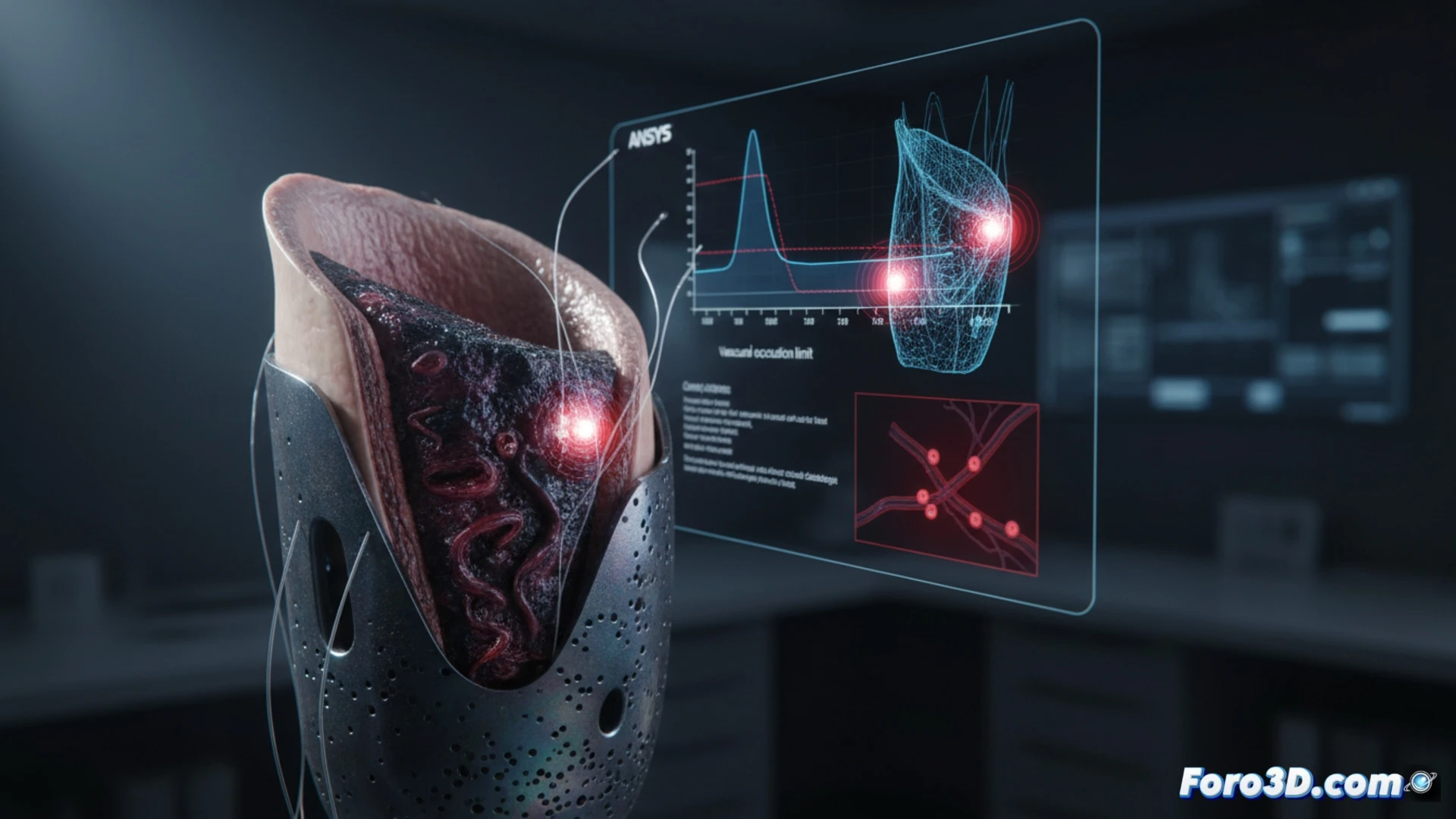
Forensic pipeline: biomechanical validation with Mimics, ANSYS, and MeshLab 🛠️
The analysis workflow began with importing the original stump scan into Mimics to reconstruct bone and soft tissue geometry. An initial mesh was exported to MeshLab for topological cleaning and noise reduction. Subsequently, the mesh was loaded into ANSYS Biomechanics, where physiological loading conditions (gait and sitting) were applied. The FEA simulation revealed that, when applying an axial load of 700N, the skin deformed up to 8mm, concentrating pressure in a 2cm square area where the static model indicated uniform contact. The critical error was modeling the socket as a rigid surface without coupling with tissue compliance.
Technical lesson: skin is not a rigid surface 🩺
This case underscores that medical 3D printing cannot rely solely on scanned surface anatomy. Biomechanical validation prior to manufacturing is mandatory, not optional. It is recommended to integrate an FEA simulation step into the standard pipeline, using viscoelastic properties of soft tissues (Young's modulus and Poisson's ratio obtained from literature or in vivo tests). Additionally, the design should include relief zones and materials with a hardness gradient to distribute load. Ignoring tissue deformation is not only an engineering error but a preventable clinical risk.
What is the role of finite element analysis (FEA) in preventing tissue necrosis in the design of 3D-printed prosthetic sockets, and how could it be accessibly integrated into the workflow of small additive manufacturing workshops?
(PS: 3D prosthetics are so customized they even have a fingerprint.)