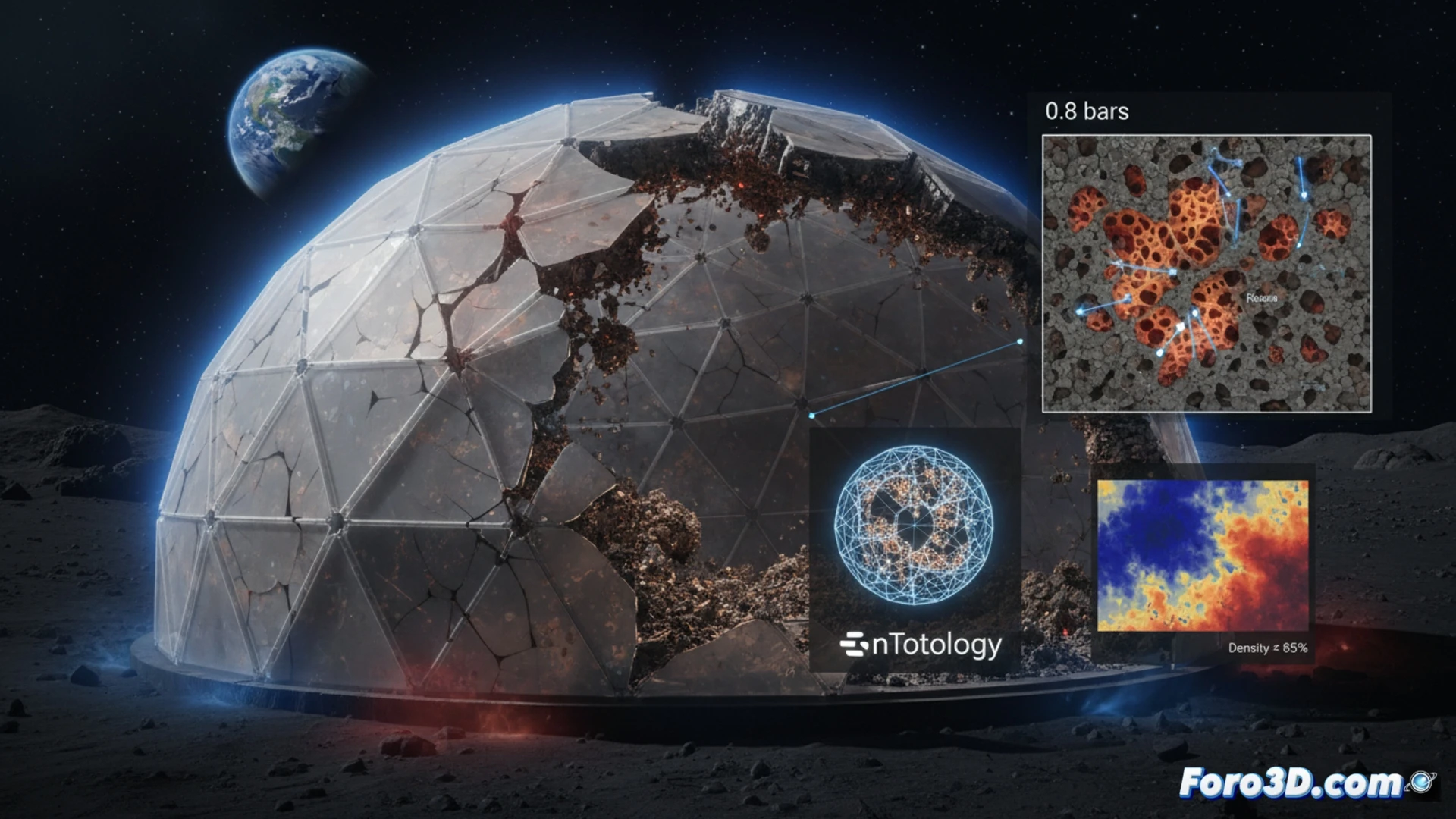
During a laboratory pressurization test, a dome manufactured by laser sintering of simulated lunar regolith collapsed catastrophically at 0.8 bars of internal pressure. Subsequent analysis, performed using 3D tomography and meshing in nTopology, revealed that the main cause was not a macroscopic defect, but a heterogeneous distribution of internal porosity. Variations in the particle size distribution of the regolith powder generated zones with relative densities below 85%, creating preferential paths for the initiation of fatigue cracks under sustained load.
Fatigue simulation in Siemens NX: the role of particle size distribution 🔬
The integration of nTopology with Siemens NX allowed modeling the mechanical behavior of the structure based on real porosity data extracted from 3D laser scanning. In the finite element simulation, internal pressurization cycles representative of a lunar habitat (0.5 to 1.0 bars) were applied. The results showed that zones with fine particle size (less than 45 microns) exhibited accelerated pore coalescence, reducing fatigue life by 60% compared to zones with controlled particle size. The Siemens NX fatigue module identified that the maximum principal stress was concentrated at the edges of interconnected pores, exceeding the yield strength of the sintered material even under nominal loads.
Lessons for process control in extraterrestrial habitats 🚀
The failure demonstrates that simple sintering does not guarantee structural integrity if the particle size distribution is not controlled in real time. Systems such as the Zoller & Fröhlich LaserControl could be integrated into the printing process to monitor beam penetration depth and adjust power according to local particle size. Predictive simulation in nTopology, fed with porosity data, should become a prerequisite for any certification of in-situ printed lunar habitats, thus preventing an apparently minor variation in the powder from condemning a critical structure.
In a scenario of progressive pressurization of a lunar dome manufactured with sintered regolith, is it possible to analytically predict the critical pressure threshold at which the inherent porosity of the material initiates unstable crack propagation, or is a numerical finite element model with mesoscopic fracture criteria necessary to capture the interaction between pores?
(PS: Material fatigue is like yours after 10 hours of simulation.)