A fastening failure in a shielded medical isotope container was analyzed through a multidisciplinary simulation combining Siemens Simcenter, Maya (Dynamics), and Artec Studio. The goal was to replicate the G-forces generated during severe turbulence in air transport to identify the exact point of friction-induced degradation. The study revealed that material fatigue at the anchor points, not the shielding strength, was the critical link in the safety chain.
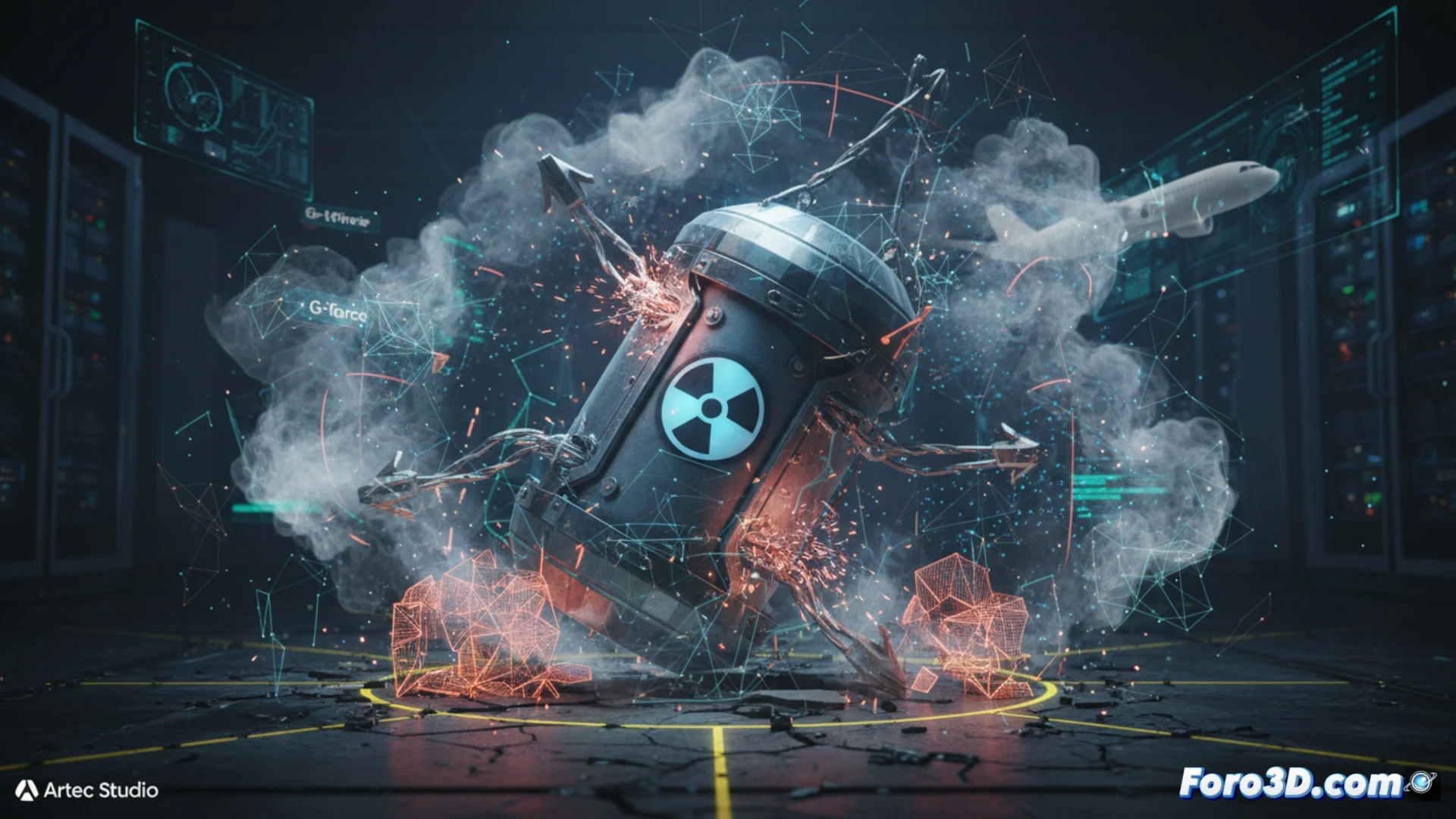
Workflow: scanning, dynamics, and structural fatigue 🔬
The process began with Artec Studio to capture the actual geometry of the shielded container, generating a high-fidelity mesh that included surface micro-imperfections. This model was imported into Maya, where dynamic loads were applied simulating a standard turbulence profile (peaks of +3.5G to -2.0G). The kinematic results were transferred to Siemens Simcenter for a finite element analysis focused on friction fatigue. A stress concentration zone was identified in the locking mechanism, where the friction coefficient fell below the safe threshold after 120 load cycles, causing progressive slippage of the container.
Implications for radiological safety ⚠️
This case demonstrates that material fatigue in fastening systems is an underestimated risk in the transport of radioactive materials. The combination of precision 3D scanning and dynamic simulation allows detecting failures that static tests do not reveal. For the industry, this requires revising certification regulations, incorporating dynamic load cycles and friction wear analysis as a mandatory requirement, not just the initial structural strength of the shielding.
What advantages does integrating computational fluid dynamics (CFD) and finite element analysis (FEA) simulations offer when modeling friction failure in a shielded medical isotope container?
(PS: Material fatigue is like yours after 10 hours of simulation.)