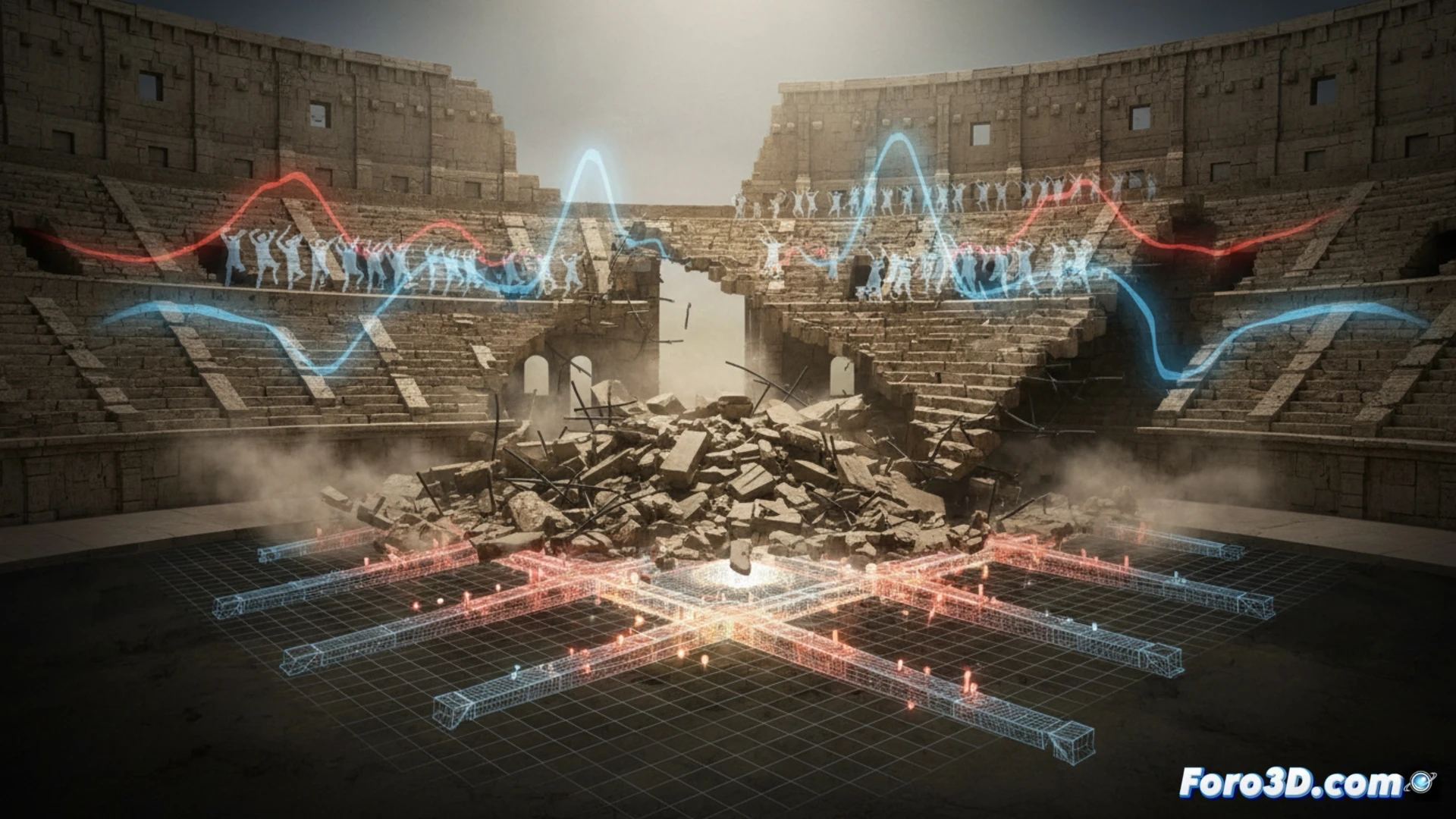
The collapse of a stand in a coliseum is not always due to static overload or an obvious material defect. Sometimes, the enemy is invisible: resonance. When the frequency of a rhythmic event, such as jumping or dancing, coincides with the natural frequency of the structure, vibrations amplify catastrophically. Recreating this phenomenon in 3D allows forensic engineers to understand the exact failure mechanism.
Forensic Reconstruction and Modal Analysis Using Finite Elements 🏗️
The forensic process begins with 3D laser scanning of the coliseum remains. Millions of points are captured to generate an accurate point cloud of the collapsed stands and adjacent areas. Using this real geometry, a finite element model (FEM) is built in software such as ANSYS or Abaqus. Modal analysis calculates the natural frequencies and vibration modes of the original structure. By simulating a periodic dynamic load, such as a force of 200 N at 2.4 Hz (typical frequency of jumps at events), the model reveals whether resonance occurs. The 3D visualization shows how the vibration amplitude grows in the cantilevers of the stands, exceeding the yield strength of the steel or the resistance of the concrete, until identifying the exact point of crack initiation.
Virtual Lessons for Catastrophe Prevention 🛡️
3D simulation not only explains the past; it is a vital tool for future design. By identifying the critical frequency of the structure, engineers can redesign the stands by adding tuned mass dampers or stiffening the cantilevers to shift the natural frequency outside the range of human excitation. The virtual recreation of the failure serves as a visual warning for architects and stadium managers, demonstrating that a simple choreographed dance can bring down an engineering work if the physics of vibrations is not respected.
How can a harmonic resonance phenomenon, imperceptible to attendees, cause the structural failure of a stand without prior warning of deformation or visible fatigue?
(PS: Simulating a collapse is easy. The hard part is not crashing the program.)