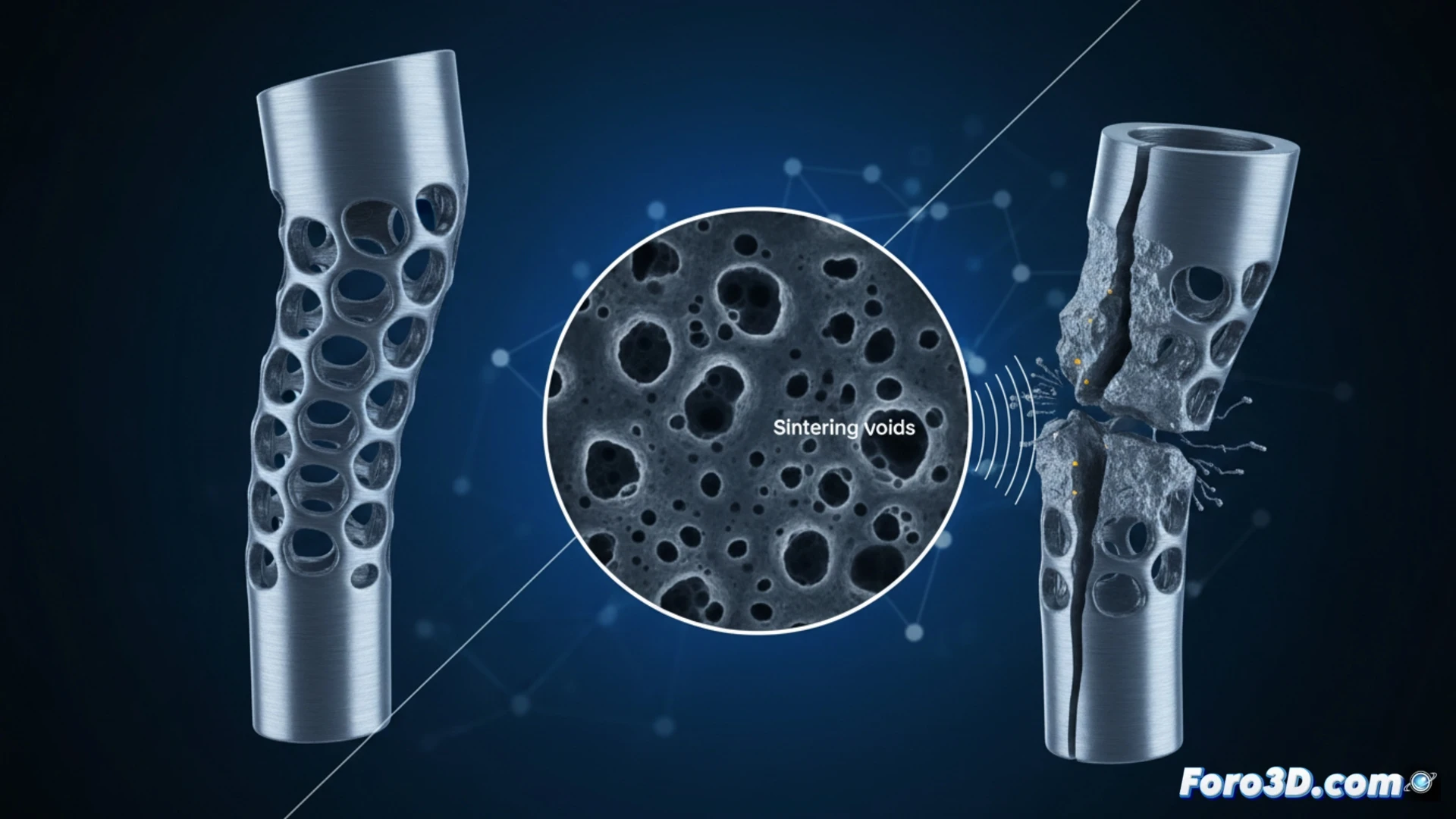
A hip prosthesis made of titanium via 3D printing structurally failed six months after implantation. Micro-CT analysis revealed the root cause: multiple internal sintering voids that acted as stress concentrators. This case illustrates a critical problem in additive manufacturing of medical implants, where residual porosity compromises the material's fatigue strength, leading to premature fracture under physiological cyclic loads.
Segmentation and meshing: from micro-CT to Ansys 🛠️
The simulation process begins with importing micro-CT DICOM data into Simpleware ScanIP or Materialise Mimics. In these platforms, the actual geometry of the failed prosthesis is segmented, isolating the fracture region and internal voids. Next, a high-fidelity volumetric mesh capturing the porosity is generated. This mesh is exported to Ansys Mechanical, where a material fatigue model (Goodman or Soderberg criterion) is defined using titanium Ti-6Al-4V properties. The simulation applies a load cycle equivalent to human gait (800 to 2500 N), revealing that the voids reduce the component's service life by 70% compared to the ideal defect-free design.
Lessons for critical implant design ⚠️
The comparison between the ideal CAD model and the actual scan is striking. While the theoretical design withstood over 10 million cycles, the porous prosthesis failed in less than 500,000. This case demonstrates that fatigue simulation cannot rely solely on perfect geometries. Incorporating micro-CT data into the workflow with Simpleware and Ansys enables prediction of real failures, establishing a new quality control standard for 3D-printed orthopedic implants.
How does the presence of micro-sintering voids in 3D-printed titanium hip prostheses affect fatigue life prediction, considering physiological cyclic loads and geometric defect variability?
(PS: Material fatigue is like yours after 10 hours of simulation.)