A tidal turbine detached from the seabed, dragging a section of fiber optic cables with it. The incident, which occurred in a tidal current park, activated an engineering forensic protocol. To determine the root cause, the team combined high-resolution sonar sweeps with underwater photogrammetry, generating a digital model of the seabed and the structural debris.
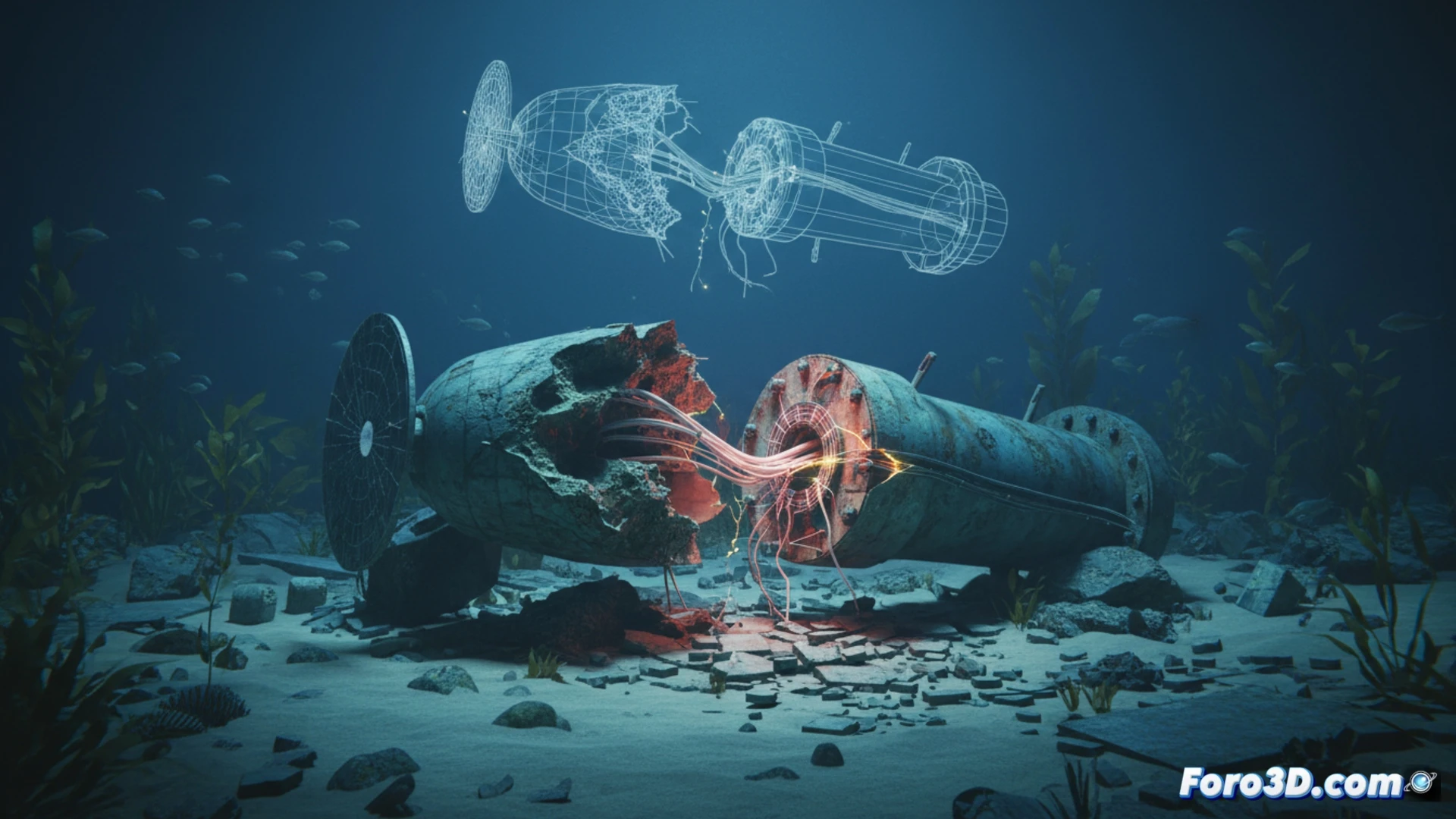
Technical workflow: from point cloud to fatigue simulation 🌊
The raw sonar data and underwater images were processed in EIVA NaviModel and Agisoft Metashape, creating a precise point cloud of the failure area. Based on this, the complete turbine geometry and the bolt connection to the seabed were modeled in Maya. The next step was to export this model to OrcaFlex, where historical recorded hydrodynamic loads were applied. The simulation revealed that galvanic corrosion, accelerated by the junction of steel and copper alloys in the bolts, had reduced the load-bearing cross-section by 40%, causing failure due to cyclic fatigue during a tidal peak.
Lessons for material fatigue simulation ⚙️
This case demonstrates that underwater photogrammetry is not just a documentation tool, but a source of input data for fatigue models. The combination of galvanic erosion and mechanical stress is a critical scenario often underestimated in marine anchor designs. The methodology employed allows validating material degradation hypotheses with high precision, establishing a new standard for forensic analysis in marine renewable energy infrastructure.
As a forensic engineer, when reconstructing in 3D the failure sequence of the underwater turbine due to galvanic erosion, what material fatigue simulation parameters did you consider critical to differentiate stress corrosion damage from cyclic mechanical wear induced by the tide?
(PS: Material fatigue is like yours after 10 hours of simulation.)