An ultra-high molecular weight polyethylene (UHMWPE) ballistic shield failed under a low-velocity fragment impact. Visual inspection showed no full penetration, but internal delamination of the laminates was present. This article details the forensic workflow used to determine whether a press pressure error during manufacturing was the root cause of the delamination.
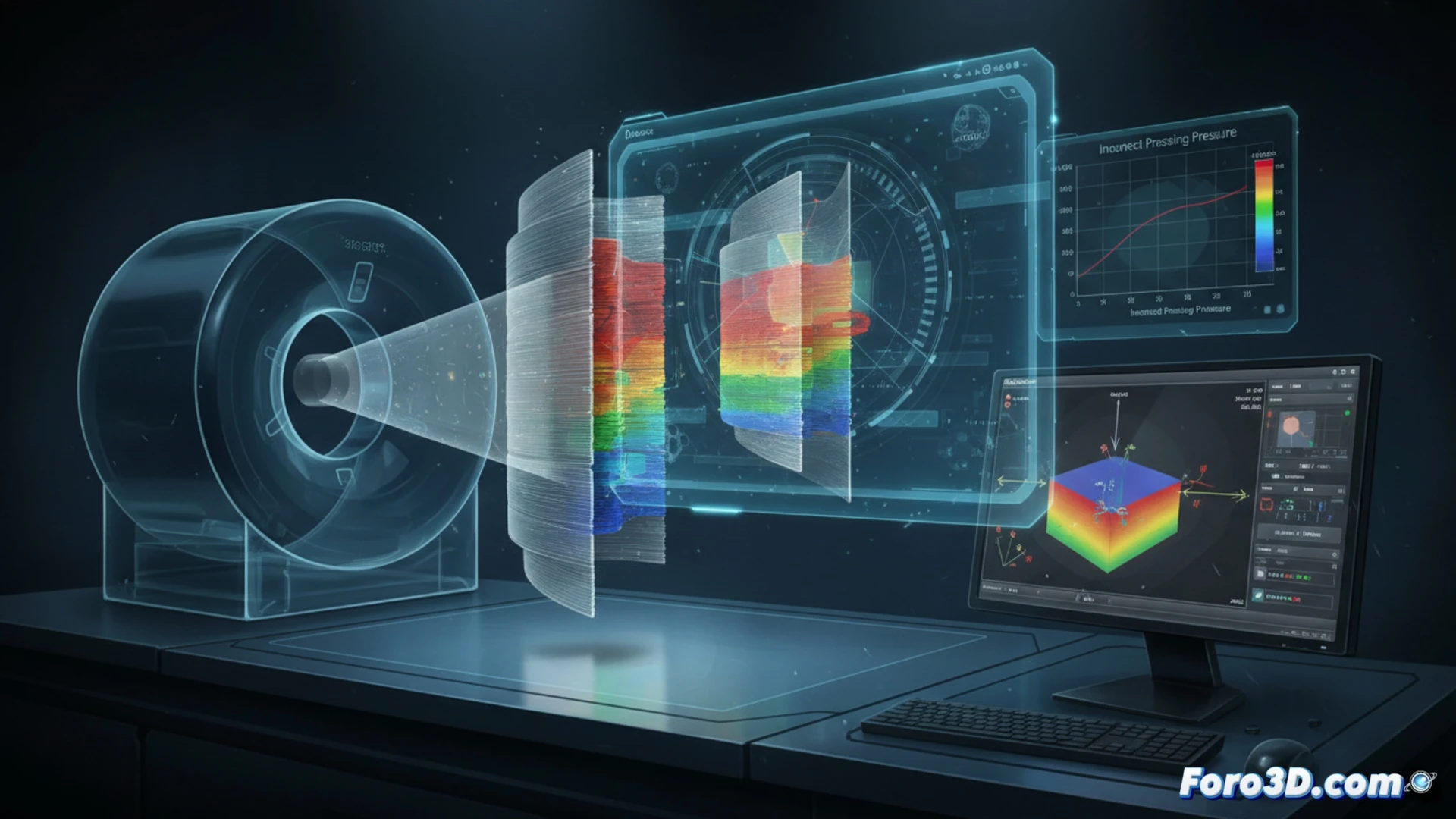
3D Pipeline: Micro-CT scanning and segmentation in Volume Graphics 🛡️
The first step was to subject the damaged shield to a micro-CT scan to obtain a high-resolution volumetric point cloud. In Volume Graphics, regions of low cohesion were segmented, identifying areas where material density was below 85% of the nominal value. These areas, visible as elongated porosities between layers, were isolated in a 3D model. Subsequently, a finite element mesh with degraded mechanical properties of those regions was exported. GOM Inspect analysis confirmed that residual deformations matched the impact geometry, validating the segmentation.
Simulation in Abaqus and validation of the pressure hypothesis 🔬
In Abaqus, the fragment impact on the model with low-cohesion zones was simulated. The stress distribution showed localized peaks at the edges of the segmented regions, generating crack propagation that exactly replicated the observed delamination. When compared with a control simulation using an ideal shield (without defects), the failure did not occur. This confirmed that insufficient press pressure created weak points, and not a defect in the base material. The workflow demonstrates how integrating micro-CT and simulation allows auditing of manufacturing processes.
How the discontinuities detected by micro-CT at the interface of the UHMWPE laminates correlate with the delamination initiation zones predicted by the finite element model in Abaqus for a low-velocity fragment impact.
(PS: Material fatigue is like yours after 10 hours of simulation.)