The mainsail of an America's Cup yacht disintegrated during a wind gust, leaving the crew without control at a critical moment of the regatta. The initial expert analysis pointed to a catastrophic structural failure, but the true cause was hidden at the nanoscale. Forensic analysis using nanoscale-resolution 3D microscopy and fatigue simulation has revealed that the problem lies in delamination between the carbon fabric and the graphene coating, a failure directly attributable to a deficient chemical curing process.
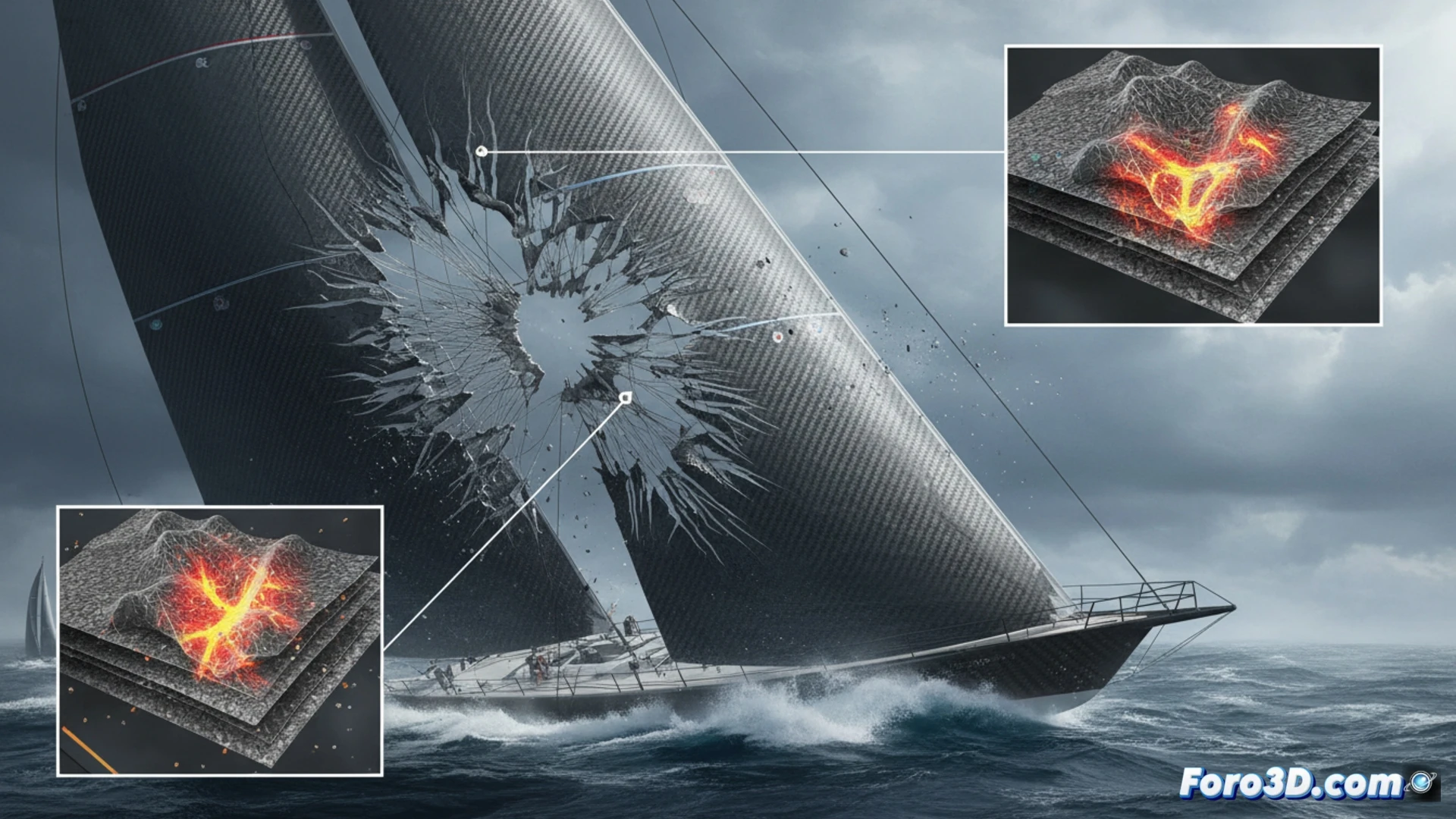
Nanometric expert analysis with Keyence and GOM Inspect 🔬
To locate the origin of the delamination, engineers used the Keyence VK-X confocal microscope, capable of generating topographic maps with 0.5 nanometer resolution. Samples from the fracture edge showed areas where the graphene layer had separated from the carbon fiber substrate without fracturing, evidencing poor interfacial adhesion. Subsequently, GOM Inspect software processed the 3D point clouds to quantify the volume of cavities and calculate residual stress at the interface. The data was exported to MATLAB, where the epoxy curing kinetics were modeled, demonstrating that a 3-degree Celsius drop in polymerization temperature during manufacturing prevented complete resin crosslinking, reducing the composite's stiffness by 18% and generating stress concentration points.
The lesson of graphene in high-performance composites ⚙️
This case demonstrates that the promise of graphene as a structural reinforcement critically depends on interface chemistry. Incomplete curing not only reduces overall stiffness but also turns the graphene coating into a brittle layer that detaches under cyclic loading. For the competitive sailing industry, this implies that quality control protocols must include non-destructive interfacial adhesion tests at the nanoscale. Fatigue simulation in MATLAB accurately predicted the failure point, validating that 3D expert analysis is the definitive tool for certifying the integrity of these composite materials before facing the ocean.
What was the failure mechanism at the nanoscale that caused the catastrophic fracture of the carbon-graphene mainsail during the wind gust in the America's Cup, and how could it be prevented through the design of the graphene sheet arrangement in the carbon matrix?
(PS: Visualizing materials at the molecular level is like looking at a sandstorm with a magnifying glass.)