Precision agriculture demands disposable and eco-friendly sensors, but the first rain reveals a critical weakness in paper circuits: the expansion of cellulose fibers breaks the nanosilver ink. This technical article analyzes the phenomenon through 3D microscopy, stress simulation in SolidWorks, and predictive modeling in MATLAB, determining the humidity threshold that destroys conductivity.
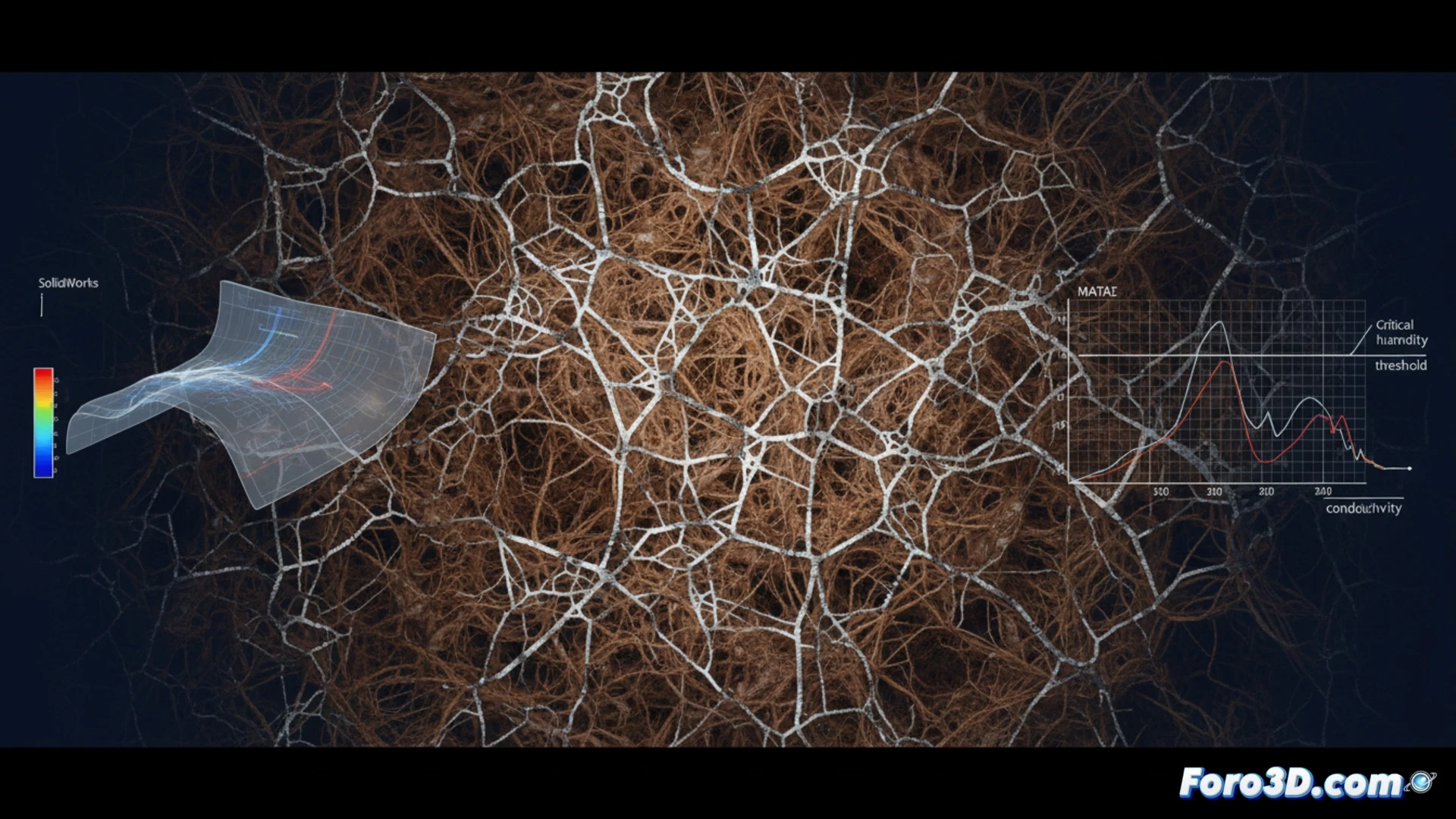
Real Deformation Measurement with Keyence VK Analyzer 🌧️
Using the Keyence VK-X series laser profilometer, nanosilver-coated paper samples were scanned before and after exposure to controlled humidity. The 3D topographic maps revealed an average height increase of 12 micrometers in the cellulose fibers, accompanied by microcracks in the conductive layer. Surface roughness increased by 40%, indicating that the expansion is not uniform. These real deformation data were imported into SolidWorks to calibrate the finite element model, where an anisotropic hygroscopic expansion load was applied. The results showed that the maximum stress concentrates at the edges of the ink traces, exceeding the elastic limit of the nanosilver when relative humidity exceeds 85%.
Predicting the Failure Point: Conductivity as a Critical Variable ⚡
The mathematical model in MATLAB correlated fiber expansion with electrical conductivity, generating an exponential degradation curve. It was determined that functional failure occurs when moisture-induced deformation exceeds 3.5% of the original fiber length, at which point resistivity spikes by 200%. This prediction allows for redesigning sensors with serpentine ink patterns or partial encapsulations to absorb stress. The presented methodology demonstrates that combining 3D metrology, mechanical simulation, and statistical analysis is key to developing reliable biodegradable materials.
How to model the anisotropic expansion of paper induced by humidity in 3D simulations to predict the exact failure point in disposable circuits before the first rain occurs
(PS: Visualizing materials at the molecular level is like looking at a sandstorm with a magnifying glass.)