The collapse of a thermal storage tank in a solar thermal plant has revealed a serious discrepancy between predicted fatigue models and operational reality. The 3D forensic analysis of the internal walls, combined with CFD simulations, demonstrated that the chemical attack at the air-salt interface was ten times higher than estimated. The cause: an initially unmodeled oxidation reaction, which turned a critical point into a zone of catastrophic failure.
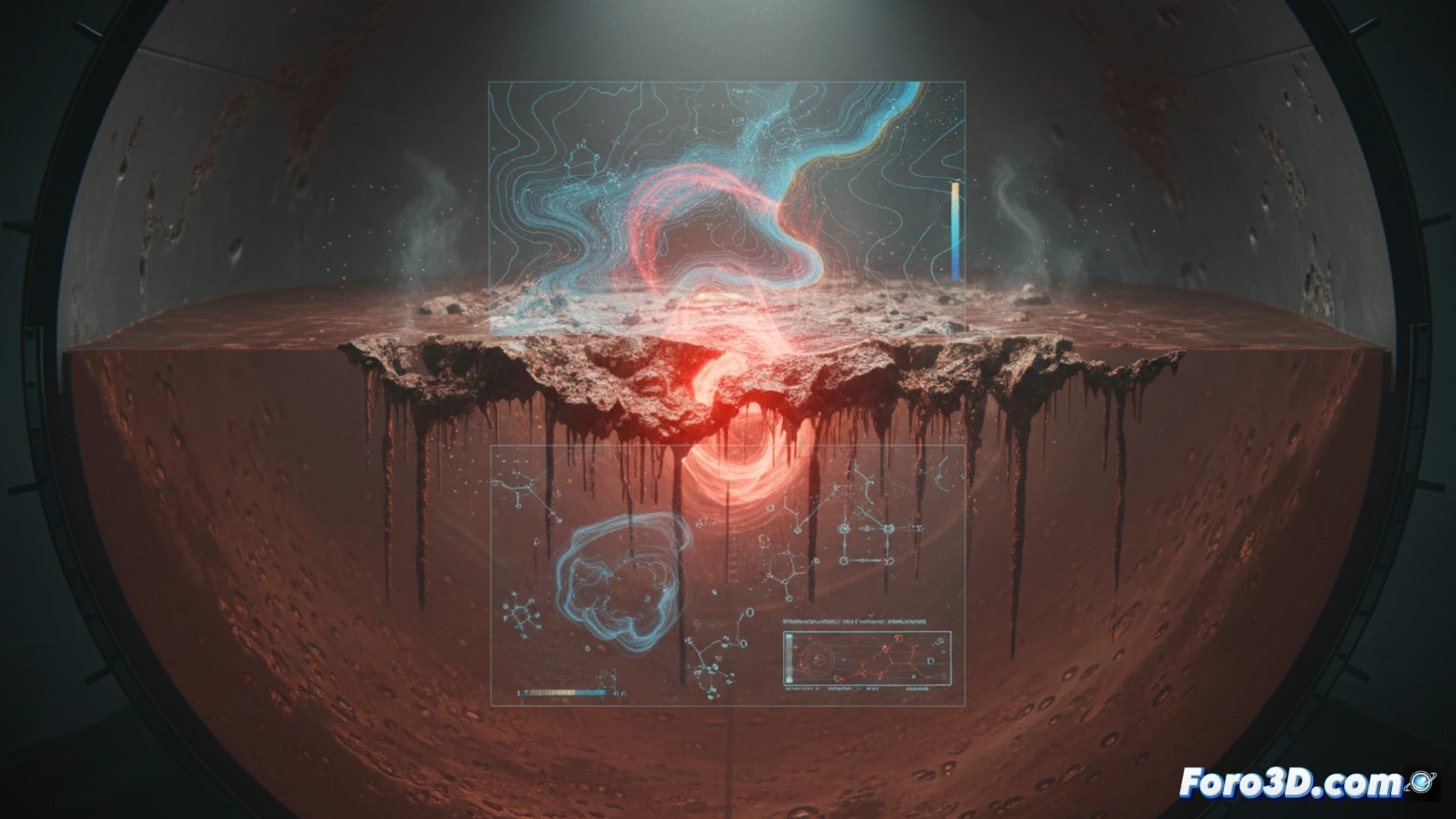
3D Modeling and CFD to Identify the Failure Point 🔍
The engineering team used SolidWorks to reconstruct the exact geometry of the collapsed tank, paying special attention to the waterline. On this model, simulations were run in ANSYS Fluent to analyze fluid behavior and heat transfer at the interface. Initial results showed parameters within expectations. However, upon introducing a kinetic model of accelerated oxidation for the air-molten salt contact region, corrosion rates skyrocketed. While the tank bottom showed uniform degradation, the interface zone exhibited a tenfold greater thickness loss, later confirmed by Leica Infinity laser scanning.
Lessons for Material Fatigue Simulation ⚙️
This case underscores a crucial lesson for material fatigue simulation: traditional homogeneous corrosion models are insufficient when reactive interfaces exist. Ignoring specific oxidation at the waterline, where air oxygen catalyzes degradation, leads to underestimating asset lifespan. In solar thermal plants, modeling this reaction is not only recommended but essential to prevent catastrophic failures and optimize inspection intervals at critical thermal storage points.
Considering that conventional fatigue models did not predict a corrosion rate ten times higher at the waterline, what simulation methodology or specific environmental factor at the liquid-vapor interface should be incorporated to accurately predict the lifespan of these tanks in future designs?
(PS: Material fatigue is like yours after 10 hours of simulation.)