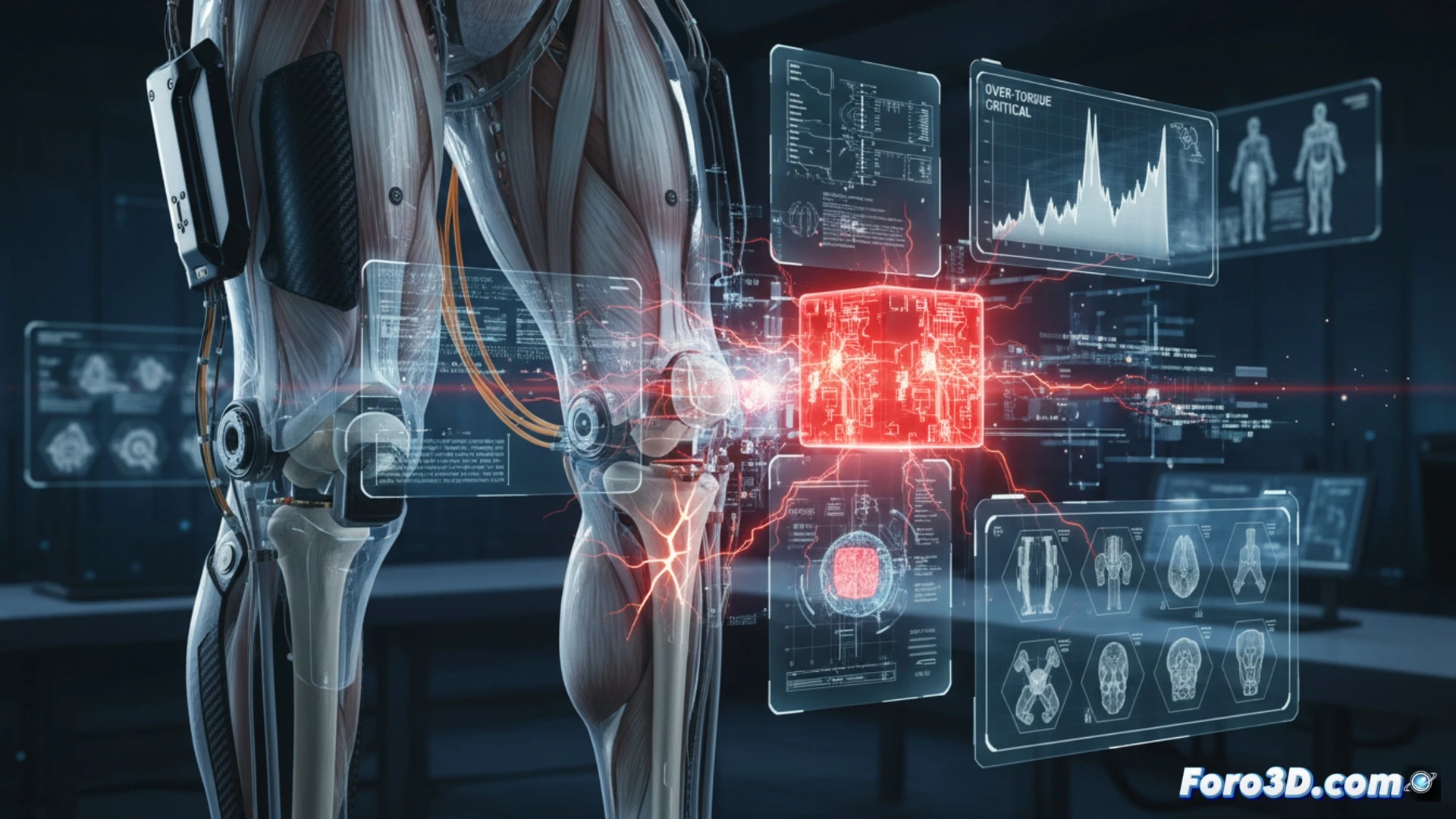
A patient suffered a bone fracture during a rehabilitation session with a robotic exoskeleton. The apparently inexplicable incident was analyzed through a three-dimensional kinematic reconstruction of the device. Engineers cross-referenced the captured motion data with the patient's biomedical records, discovering a critical over-torque in the knee joint. The cause: a resistance sensor that was sending erroneous readings to the control system.
Technical workflow: from point cloud to simulation 🛠️
The team used Artec Studio to scan the exoskeleton and generate a precise mesh of the damaged mechanism. This model was imported into Autodesk Fusion 360, where the joint kinematics were reconstructed and the loads applied during assisted gait were simulated. For the biomechanical analysis, the patient's motion data was processed in OpenSim, calculating the actual joint moments. The discrepancy between the expected torque (according to the sensor reading) and the actual torque (simulated) revealed the failure. Finally, Blender was used to visualize the incident sequence, overlaying the bone deformation with the exoskeleton kinematics.
Lessons for medical device safety ⚠️
This case demonstrates that virtual validation is indispensable before any prolonged clinical use. The combination of 3D scanning, biomechanical simulation, and forensic animation allows for the detection of design or sensor failures that put the patient at risk. For exoskeleton developers, integrating a real-time updated digital twin could prevent future fractures. 3D technology not only reconstructs the past but also protects the future of assisted rehabilitation.
What implications does the fact that the 3D reconstruction of the failure revealed a faulty sensor as the cause of the bone fracture have for the design of future rehabilitation exoskeletons?
(PS: If you 3D print a heart, make sure it beats... or at least that it doesn't cause copyright issues.)