Immersion cooling in dielectric fluid promised a thermal revolution for data centers, but a recent wave of cascading failures has revealed a critical blind spot. After submerging high-performance servers in non-conductive oil, the equipment began experiencing massive short circuits. Forensic analysis revealed that microscopic metal debris, dislodged by vibration and heat itself, migrated through the fluid and settled on motherboards, creating conductive bridges invisible to the naked eye.
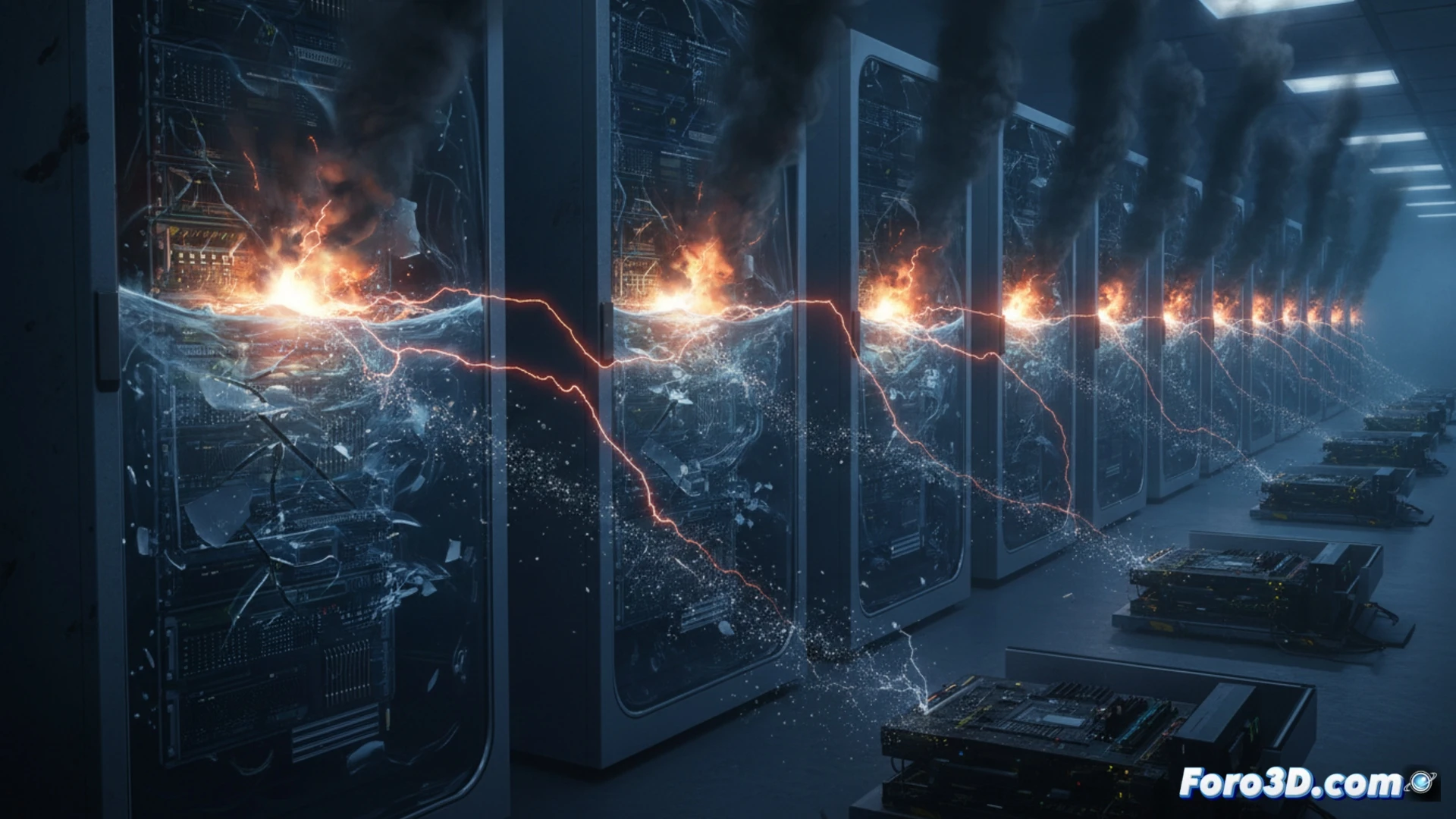
3D Visualization of the Electromigration Phenomenon in Fluids 🧊
To understand the failure mechanism, the engineering team implemented a state-of-the-art digital pipeline. First, Altium Designer was used to model the exact layout of the copper traces on the affected motherboards. Subsequently, computed tomography data from the failed servers was imported into Dragonfly, where the metallic particles suspended in the oil were segmented. Using VGSTUDIO MAX, a porosity and density analysis was performed, identifying debris accumulation in critical areas near VRMs and processor pins. Finally, in NVIDIA Omniverse, computational fluid dynamics (CFD) was simulated to trace the trajectory of these particles under the coolant flow. The simulation showed that the particles, acting as ions in an electrolyte, followed streamlines converging in areas of high potential difference, accelerating the electromigration process and forming conductive dendrites that closed the circuit.
Redesigning the Encapsulation to Avoid the Domino Effect 🔧
The solution lies not in abandoning immersion, but in redesigning the interface between silicon and fluid. Simulation data suggests that applying conformal coatings of parylene polymer to motherboards before immersion could insulate copper traces from direct contact with particles. Additionally, integrating magnetic filters into the oil recirculation circuit, along with a rack design that minimizes turbulence, would drastically reduce debris migration. This approach, validated through digital twins in Omniverse, promises to turn dielectric immersion into a robust and reliable technology for the next generation of data centers.
What specific electrochemical mechanisms trigger galvanic corrosion in the contacts of dielectric immersion racks, and how do these affect the integrity of 3D interconnections in semiconductors?
(PS: integrated circuits are like exams: the more you look at them, the more lines you see)