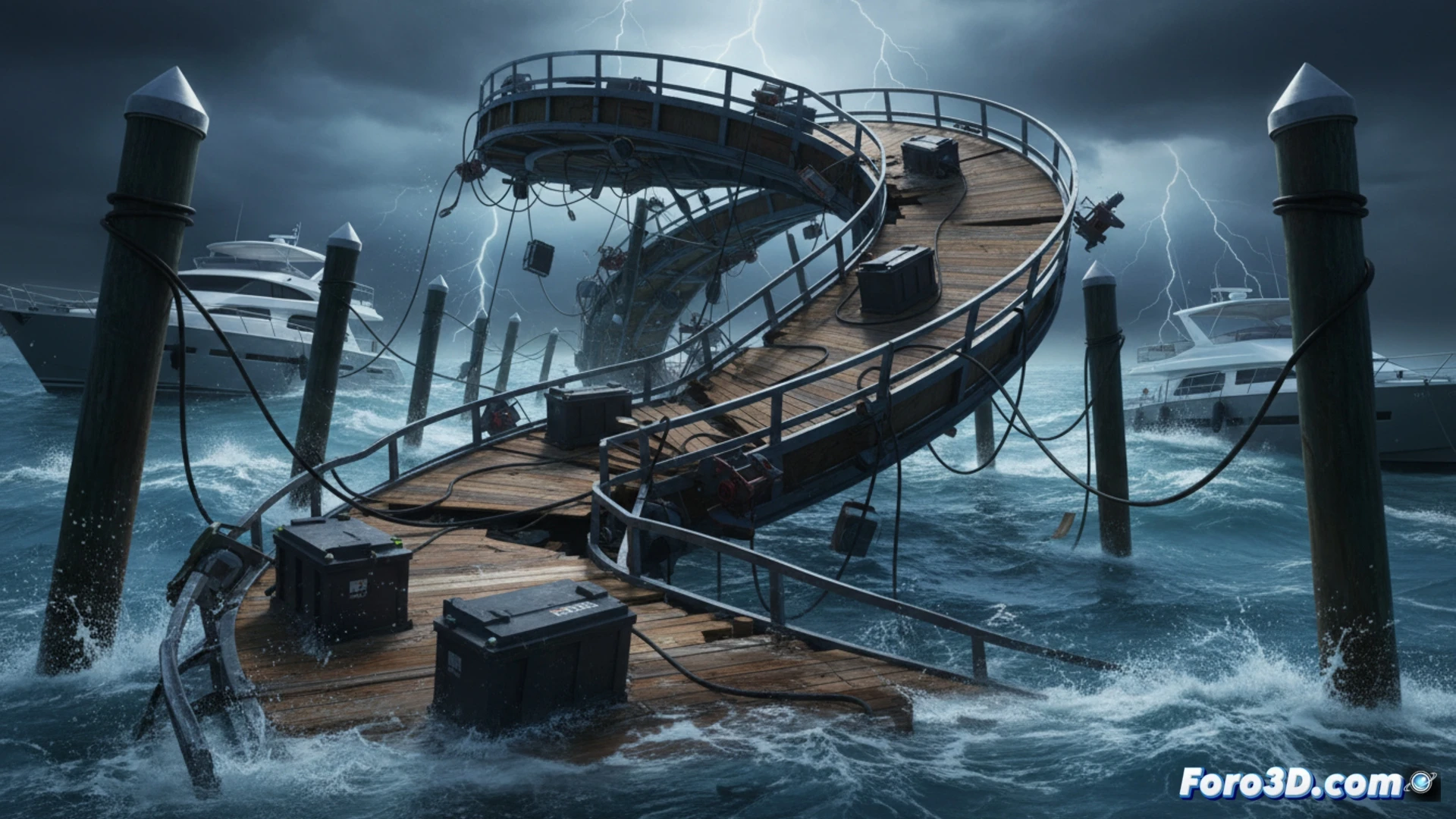
Last March, a floating pontoon equipped with high-power chargers for electric yachts suffered a structural failure during an extreme high tide. The mooring system detached from its guide piles, causing a controlled drift of the infrastructure. The incident, although without casualties, has put port engineers on alert. Initial investigations pointed to an overload, but 3D forensic analysis has revealed a more complex cause related to dynamic torsion.
Simulation in SolidWorks and surveying with Leica Infinity 🛠️
The forensic engineering team used Bentley OpenRoads to model the port geometry and currents. With high-precision topographic data captured by Leica Infinity, the exact position of the guide piles before and after the failure was reconstructed. The key to the analysis came with SolidWorks Simulation. By inputting the dynamic loads of the maximum current and the weight of the yacht batteries (concentrated at the charging points), the software revealed a critical point: the induced torsion exceeded the resistance of the retaining rollers. The torsional moment, combined with the rise in water level, deformed the pontoon profile, forcing the rollers out of their guides. The simulation showed that the failure was not due to sinking, but to a rotation induced by the asymmetry of the lateral loads.
Lessons for floating port infrastructure ⚓
This case study underscores the need to simulate extreme dynamic loads on floating infrastructure, especially those housing heavy charging systems. Torsion, often overlooked in favor of vertical analysis, emerges as a critical risk factor under high tide and lateral current conditions. The combined use of precision surveying and finite element simulation not only allowed the root cause to be identified but also offers a methodology for redesigning mooring systems, incorporating rollers with higher torsional resistance and redundant safety guides to prevent future port catastrophes.
Could a compensated torsion anchoring system, similar to that of pontoon bridges, prevent structural fatigue in electric pontoons during extreme high tides?
(PS: Simulating catastrophes is fun until the computer crashes and you are the catastrophe.)