A housing unit built using 3D concrete printing suffered a partial structural collapse, revealing a critical failure in the transition zone between layers. The incident triggered a technical investigation that combined high-precision laser scanning with numerical simulation. The main objective was to determine whether the setting time between printing passes was excessive, preventing proper chemical and mechanical bonding between the material beads. This article breaks down the analysis and modeling process.
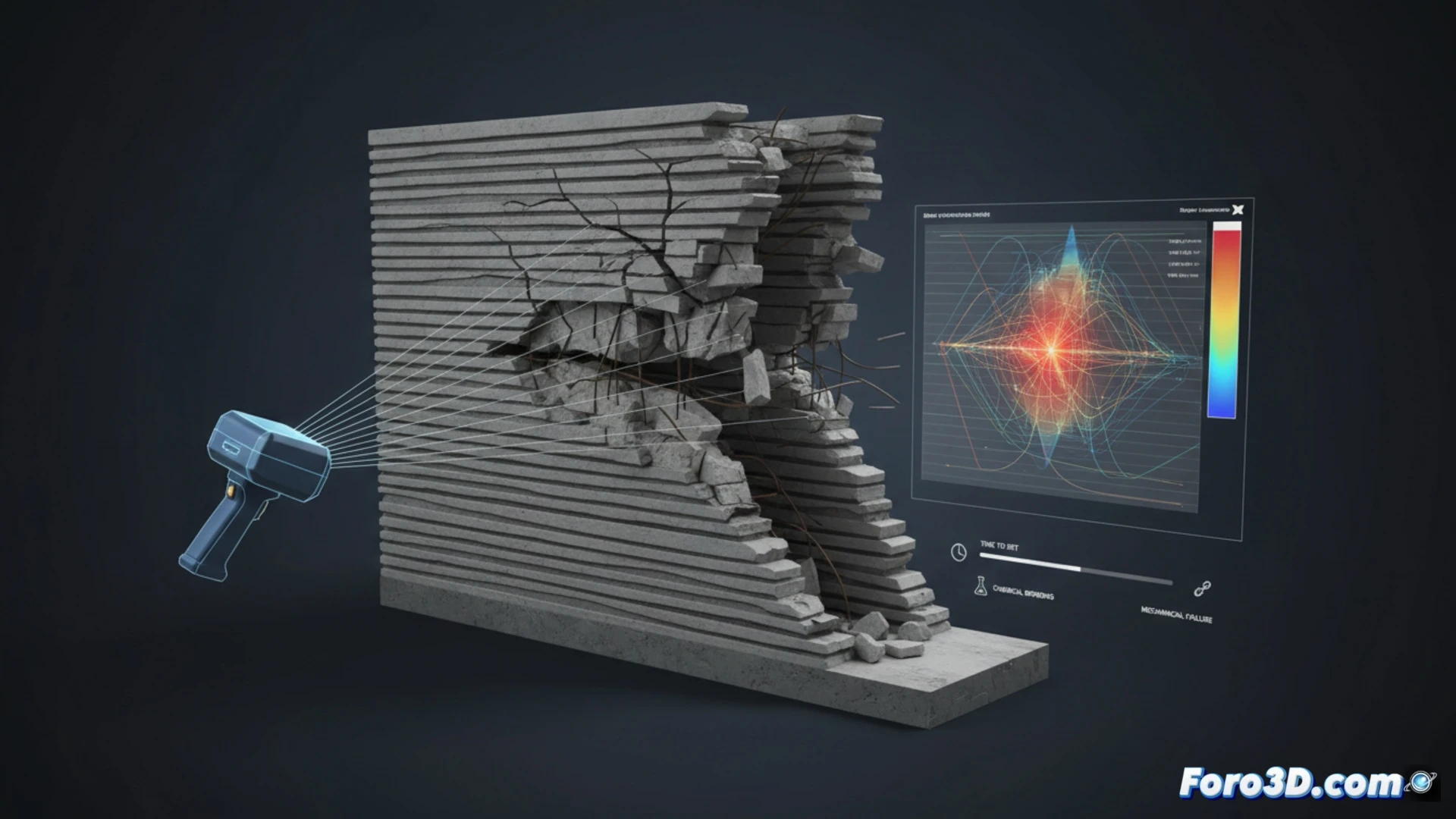
Analysis with GOM Inspect and CloudCompare to detect delamination 🏗️
The first step was capturing the collapsed geometry using laser scanning, generating a dense point cloud. Using CloudCompare, this cloud was compared with the original CAD model to identify surface deviations. The separation zones between layers showed a systematic gap of between 0.8 mm and 1.5 mm, indicating a lack of fusion. Subsequently, in GOM Inspect, a cross-sectional analysis was performed to measure the actual interface thickness. The results revealed that the upper layers had almost no adhesion, with 12% porosity at the joint, compared to 2% for a proper bond. This data was exported as boundary conditions for the finite element model.
Fatigue modeling in ABAQUS: setting time as a critical variable ⏳
In ABAQUS, a cohesive model of the interface between layers was built, incorporating the roughness and gap data obtained. Three setting time scenarios were simulated: 30 minutes (correct), 90 minutes (critical), and 150 minutes (failure). The stress-strain simulation showed that, for the 150-minute case, the maximum adhesion stress was reduced by 67% compared to the optimal scenario. The graphs show a brittle fracture at the interface, with no appreciable plastic deformation. The lesson is clear: controlling the time window between layers is not just a logistical issue, but the most determining parameter for the fatigue and durability of a 3D printed structure.
How to accurately model the viscoelastic behavior of the interface between 3D printed concrete layers to predict fatigue under cyclic loads and avoid adhesion failures like the one observed in the partial collapse of the housing unit
(PS: Material fatigue is like yours after 10 hours of simulation.)