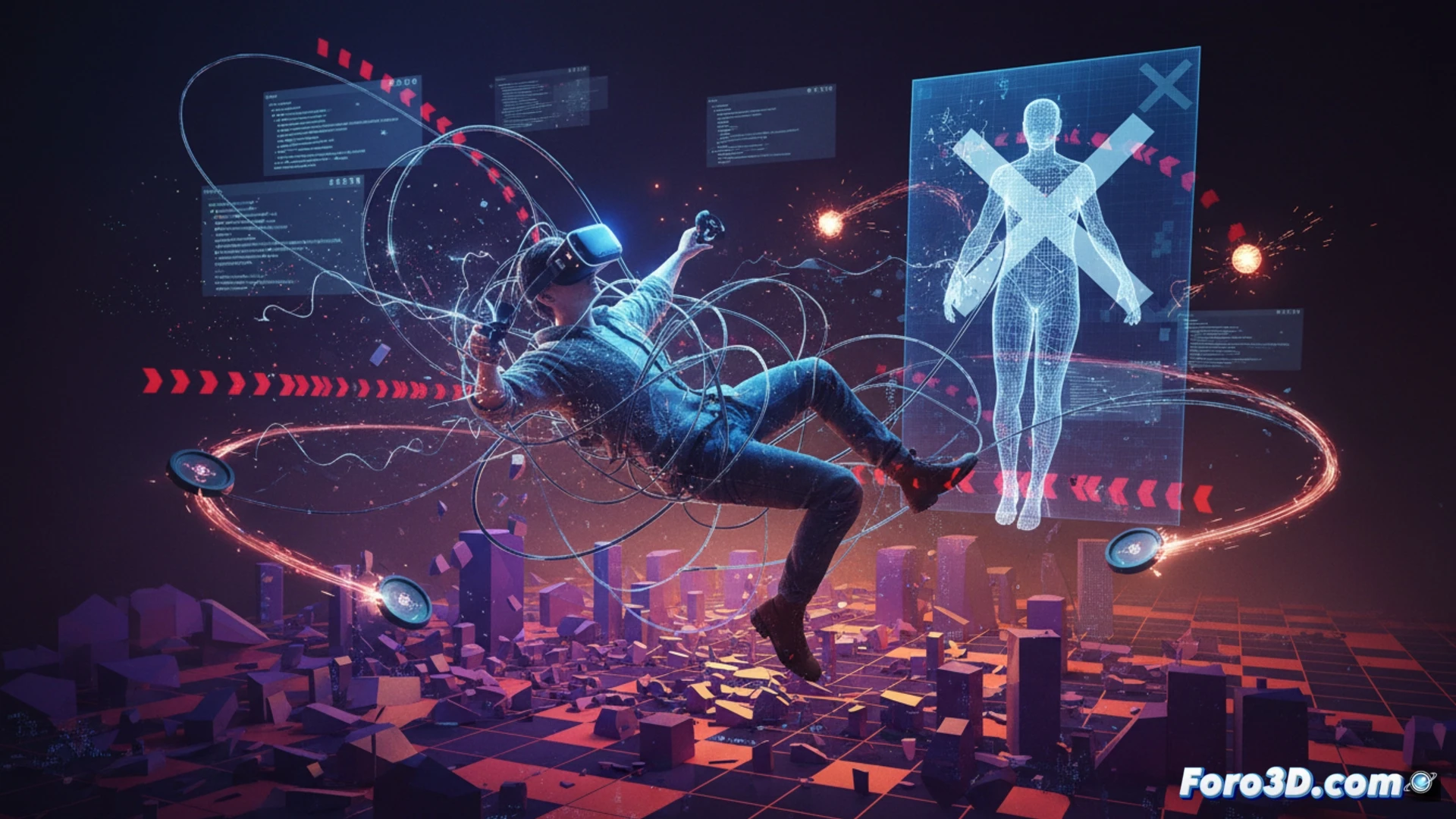
A recent digital forensic analysis has revealed that a domestic accident in virtual reality was caused by a lethal combination of excessive latency and a tracking error in the virtual boundary system. The 3D recreation of the incident, carried out with raw sensor data in Unreal Engine 5, demonstrates that SteamVR's Guardian system registered a phantom displacement of the user, eliminating the virtual barrier just before the impact. The study, which used modeling tools like Maya and Blender to reconstruct the physical space, confirms that the safety window closed 200 milliseconds before the user attempted to stop.
The technical analysis of latency and tracking error 🛠️
The failure originated in the optical tracking system of the SteamVR base stations. During a rapid rotation of the torso, a reflection on a shiny surface within the play area generated a false reference point. This tracking error caused the virtual position of the hands to shift 15 centimeters relative to their real location. The boundary system, designed to react to the virtual position of the headset, interpreted that the user had moved towards the center of the area, deactivating the warning mesh (chaperone). The accumulated latency between the error detection and the system readjustment was 180 ms, enough time for the user, trusting the virtual barrier, to take a real step towards a wall. The recreation in Unreal Engine 5, fed with movement logs, shows the exact moment the safety mesh disappears from the field of view.
Design lessons for safe VR environments 🧠
This accident underscores a critical weakness in the safety architecture of current VR. Relying exclusively on a virtual boundary system that operates on imperfect tracking data is an unnecessary risk. The solution lies not only in improving SteamVR's update frequency but in implementing redundant systems. I propose designing a safety watchdog at the graphics engine level in Unreal Engine 5 that, upon detecting a discrepancy between user inertia and tracking data, activates an immediate audio warning. Furthermore, using Blender and Maya to physically simulate the real space and map risk zones before the session could mitigate these failures, creating an invisible collider that the system cannot deactivate.
Considering that the chaperone failure deceived your brain in VR and the fall was faithfully recreated in Unreal Engine 5, what implications does this have for the design of safety systems in virtual reality experiences where the boundary between the virtual and the physical becomes dangerously blurred?
(PS: and if you get dizzy with VR headsets, you can always blame the coffee)