A carbon fiber flywheel, designed for power grid stabilization, exploded upon reaching 50,000 RPM. The failure, classified as catastrophic, generated fragments that scattered within a 50-meter radius. To determine the root cause, a forensic workflow was implemented combining high-precision photogrammetry with finite element simulation, seeking evidence of internal delamination and manufacturing defects in the composite.
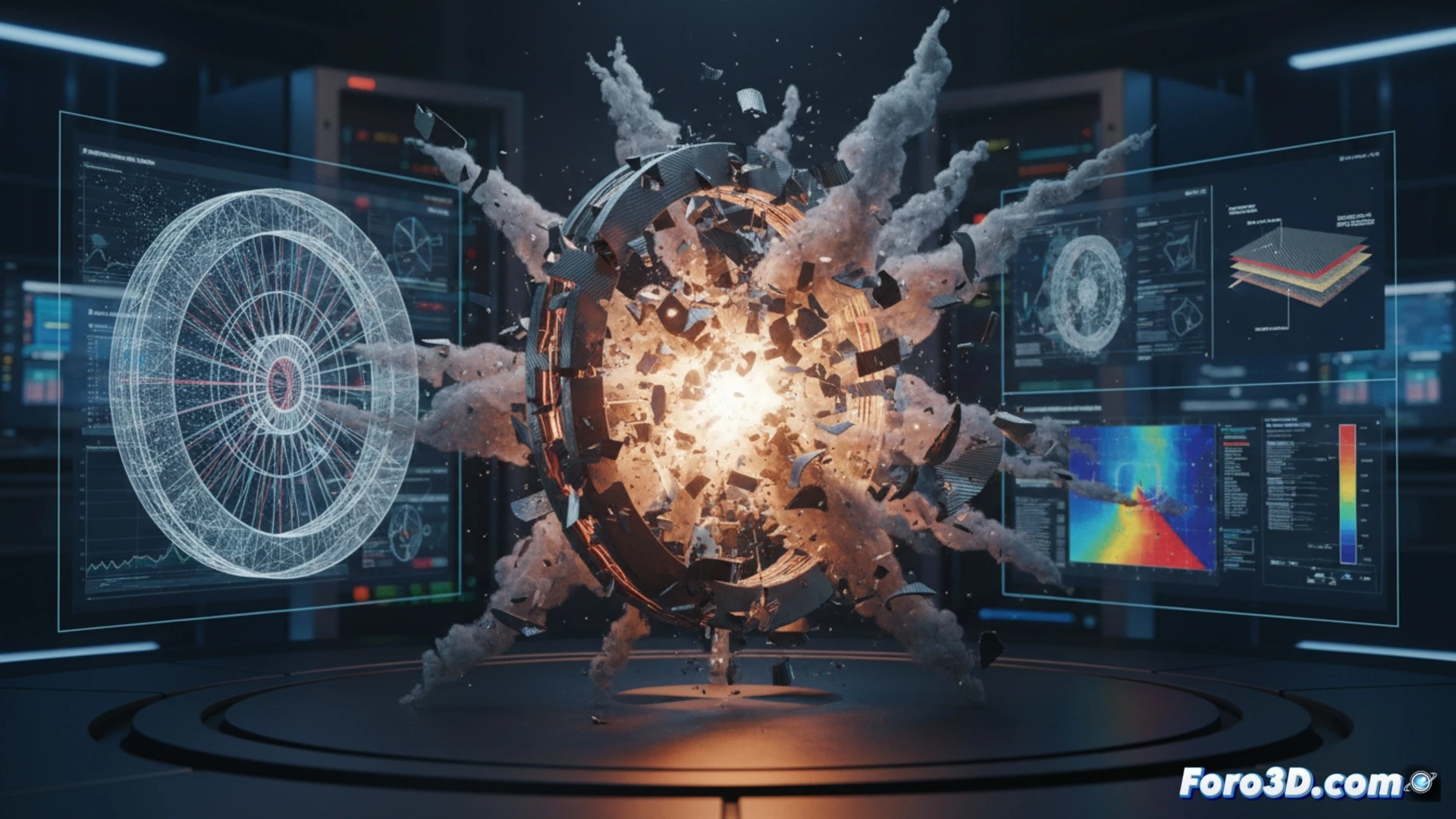
Forensic workflow: Scanning, meshing, and explicit dynamics 🔬
The forensic engineering team used RealityCapture to reconstruct in 3D each recovered fragment of the flywheel. Over 2,000 high-resolution images were processed to generate dense point clouds, which were imported into Leica Cyclone for alignment and metric analysis. Subsequently, the polygonal models were transferred to Abaqus, where an explicit dynamics simulation was run. The mesh, composed of hexahedral elements and a cohesive zone to simulate the fiber interface, replicated the rotation at 50,000 RPM. The simulation revealed that a microscopic air bubble, trapped during the composite winding, acted as a stress concentrator, initiating progressive delamination that culminated in the explosive fracture. The simulated failure pattern matched with 94% accuracy the fracture lines observed in the actual fragments.
Lessons in fatigue simulation and quality control ⚙️
This case underscores the importance of integrating 3D reconstruction with fatigue simulation to validate failure hypotheses. The combination of RealityCapture and Abaqus not only identified the manufacturing defect but also allowed quantifying the crack propagation speed and the energy released in the explosion. For the energy storage industry, this workflow becomes a critical tool for auditing winding processes and improving safety margins in high-speed rotating systems.
What specific finite element simulation methodology was used to predict crack propagation in the carbon fiber flywheel and how was it validated with the 3D reconstruction of the fragments after the explosion?
(PS: Material fatigue is like yours after 10 hours of simulation.)