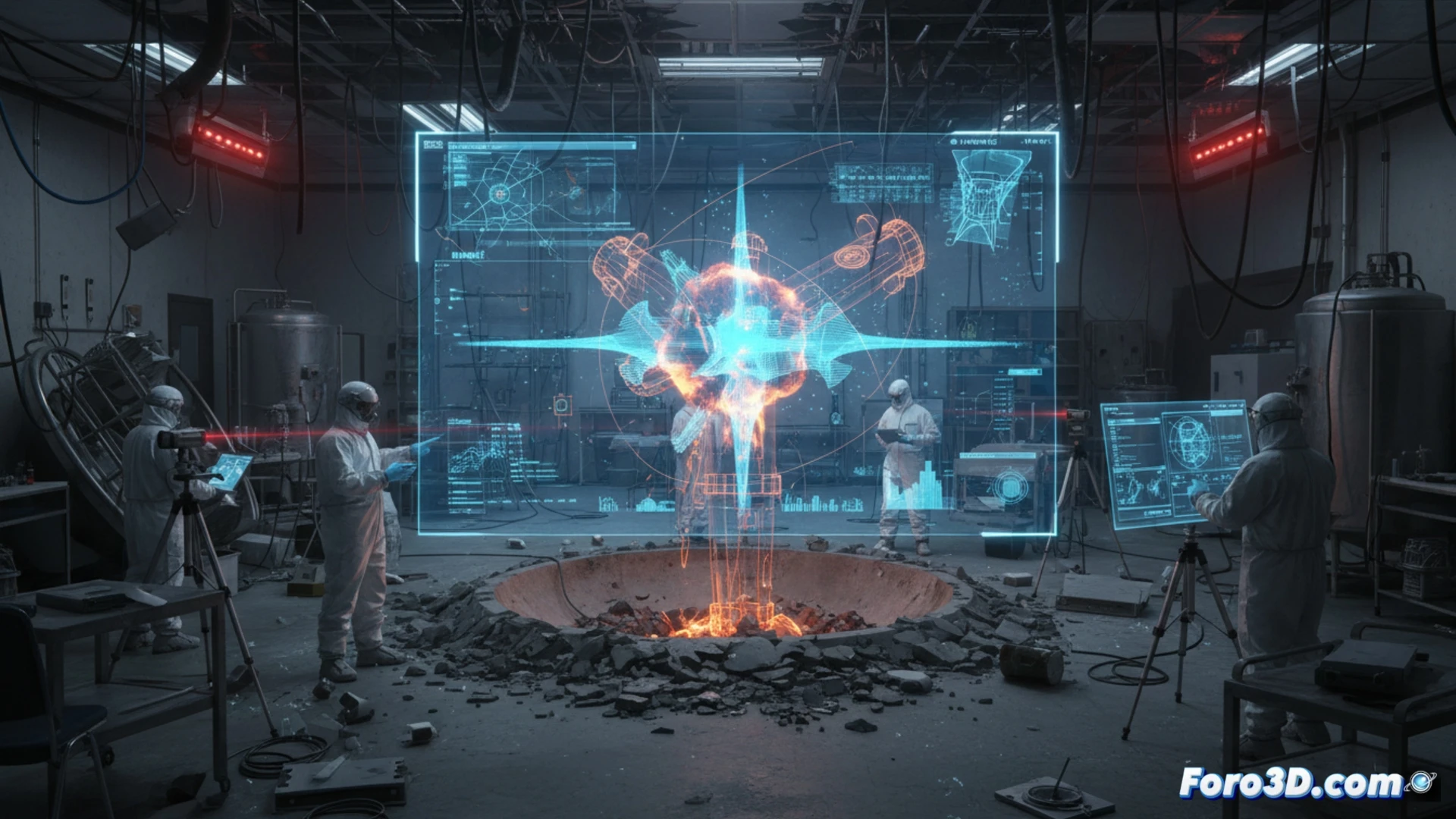
A state-of-the-art bioreactor collapsed during a critical cell proliferation phase in a cultivated meat laboratory. The detonation generated a shockwave that shattered the clean room. The forensic team used RealityCapture to generate a point cloud of the crater and PC-Rect to rectify structural deformations. The objective: to locate the exact epicenter of the overpressure and determine whether the failure was mechanical or due to internal cavitation.
Forensic workflow: photogrammetry and finite element simulation 🔬
The process began with capturing 240 images of the affected area, processed in RealityCapture to obtain a textured 3D model with submillimeter precision. On this mesh, PC-Rect was applied to correct distortions in the bioreactor walls, revealing microfractures prior to the burst. Subsequently, the geometry was imported into LS-DYNA, where fluid dynamics and gas expansion at 8 bars were simulated. The finite element solver reproduced the shockwave propagation, identifying the break point at the reactor's upper flange. Finally, Cinema 4D integrated the simulation data with the actual ruins to generate a before-and-after visualization, showing how the structure gave way in milliseconds.
Lessons for industrial biotechnology safety ⚠️
This incident demonstrates that stress monitoring in bioreactors cannot be limited to thermal sensors. The combination of high-precision photogrammetry and multiphysics simulation allows anticipating failure points under overpressure conditions. The model generated in LS-DYNA will serve as a reference for redesigning relief valves and containment systems in future cell culture plants. Without this reconstruction, the exact cause of the explosion would have remained buried in the rubble.
Is it possible to model in 3D the dispersion of biological material and pressurized gas to determine whether the bioreactor's failure point coincided with the thermal epicenter of the explosion?
(PS: Simulating catastrophes is fun until the computer melts down and you are the catastrophe.)