On Monday at 4:40 p.m. local time, a violent explosion shook a fireworks factory in Changsha, Hunan Province, leaving 21 dead and 61 injured. Nearly 500 rescuers were immediately deployed, while two black powder storage areas posed an imminent risk of secondary detonation. Authorities evacuated surrounding areas and used robots and sprinkler systems to neutralize hazards. President Xi Jinping ordered a thorough investigation to clarify the causes of the accident.
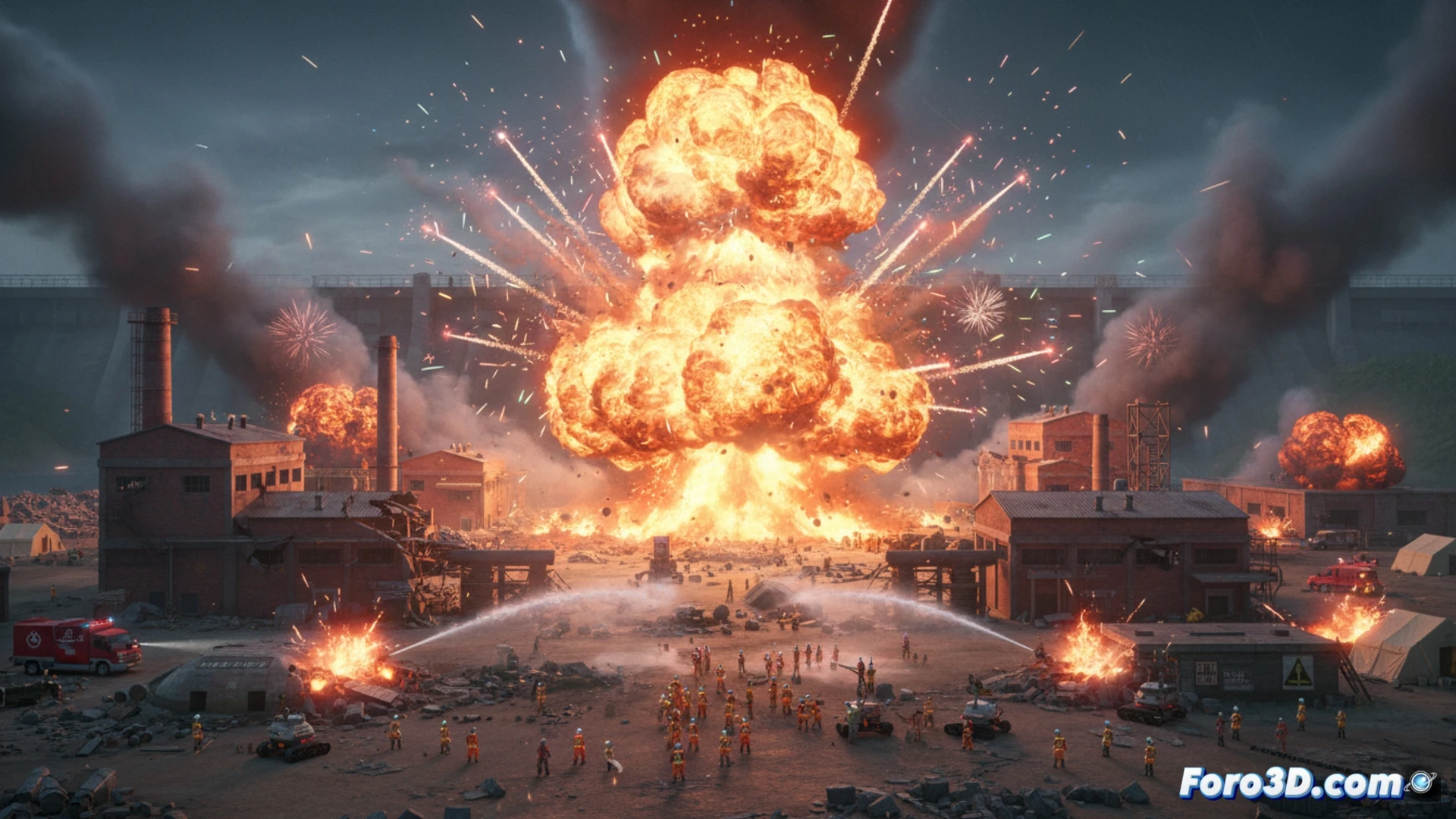
Digital reconstruction of the shockwave and powder dispersion 💥
To understand the dynamics of the disaster, we have developed a digital twin of the industrial facility. The 3D simulation models the sequence of the initial explosion, calculating the speed and pressure of the shockwave based on the stored powder load. It visualizes how the detonation affected adjacent structures and how the black powder storage areas, identified as critical hotspots, may have amplified the blast. The animation shows the tactical deployment of the 500 rescuers, segmented into search and extinguishing units, while three autonomous robots venture into the rubble to locate victims. The infographic details the priority evacuation zones and the safety perimeter established by emergency teams.
Lessons for prevention: the value of catastrophe modeling 🛡️
The tragedy in Hunan underscores the need to anticipate failures in high-risk industries. Our 3D reconstruction not only documents the event but also allows for testing response protocols: from spraying and humidification to reduce powder volatility to optimizing evacuation routes. By integrating real data from the accident, these digital twins become key tools for safety engineers and emergency managers, helping to prevent a spark in the wrong place from turning into a national catastrophe.
Would you export the results to GIS format?