The explosion of a compressed air tank in an industrial workshop not only caused structural damage but also generated fragments that acted as shrapnel. The forensic team used a 3D workflow to reconstruct the disaster. By mapping the trajectories of the debris with BlastFX and CloudCompare, the exact point where the fracture began was identified, a critical step in understanding the failure mechanism.
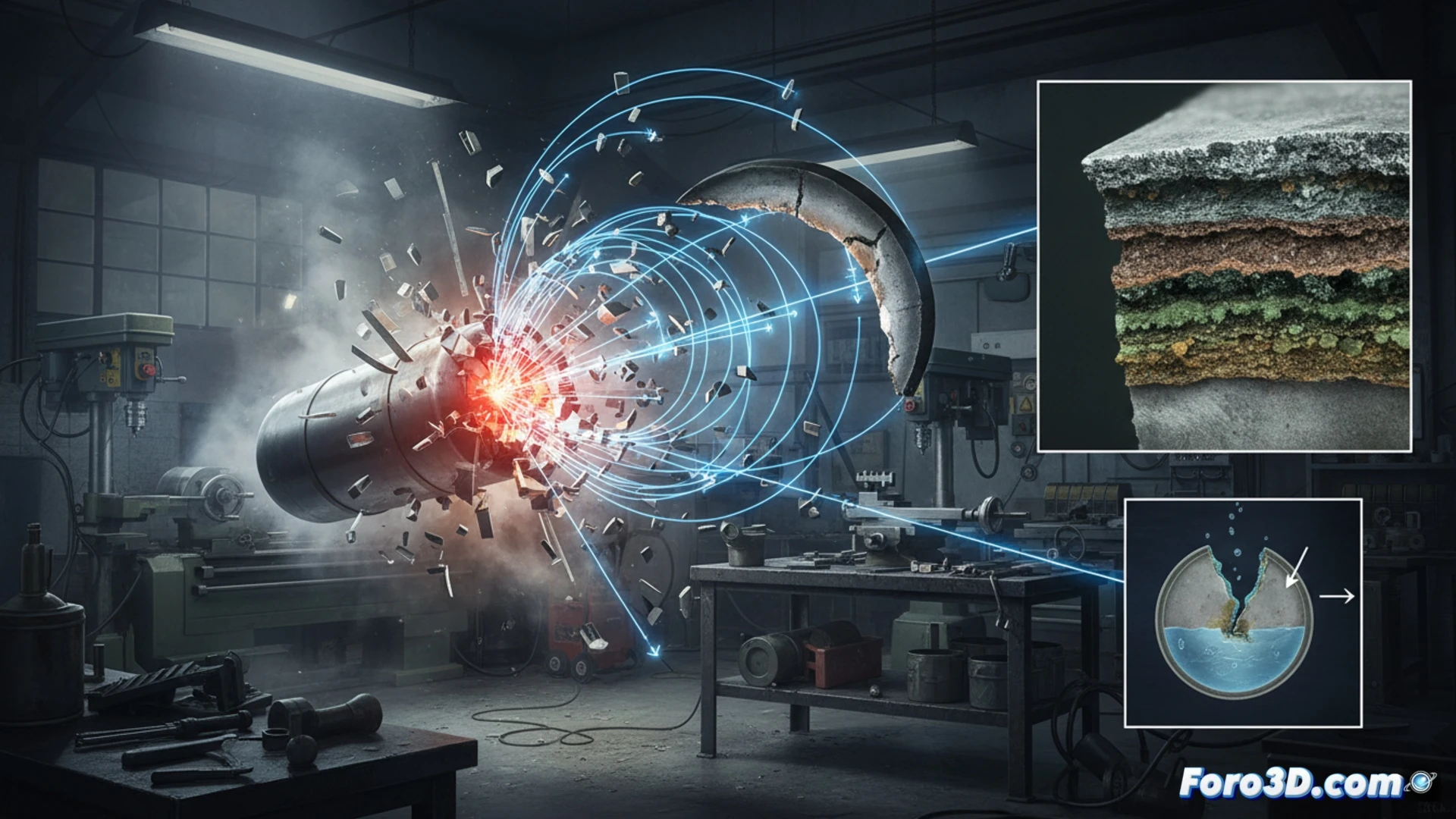
Forensic workflow: from ballistic trajectory to microanalysis 🔍
The process began with scanning the workshop and cataloging the fragments. BlastFX simulated the ballistic trajectories, while CloudCompare aligned the point cloud of the debris with the boiler model. This allowed locating the origin of the rupture in the lower area of the tank. Subsequently, a sample was taken from the fracture edge for Micro-CT analysis. The images revealed cavities and rust deposits. Geomagic Design X was used to generate a CAD model of the fractured surface, correlating microscopic irregularities with the crack progression.
The lesson of condensate: preventing industrial catastrophes ⚠️
The culprit was not a manufacturing defect, but the failure to drain accumulated condensation water at the bottom of the boiler. The water, in contact with the steel and air impurities, generated galvanic corrosion that thinned the tank wall to the breaking point. This case demonstrates that 3D technology is not only useful for animation or design, but for saving lives by exposing maintenance failures that a visual inspection could never detect.
Is it possible to predict the location and trajectory of shrapnel generated by a boiler explosion using 3D computational fluid dynamics (CFD) simulations to anticipate failures due to localized corrosion?
(PS: Simulating catastrophes is fun until the computer crashes and you are the catastrophe.)