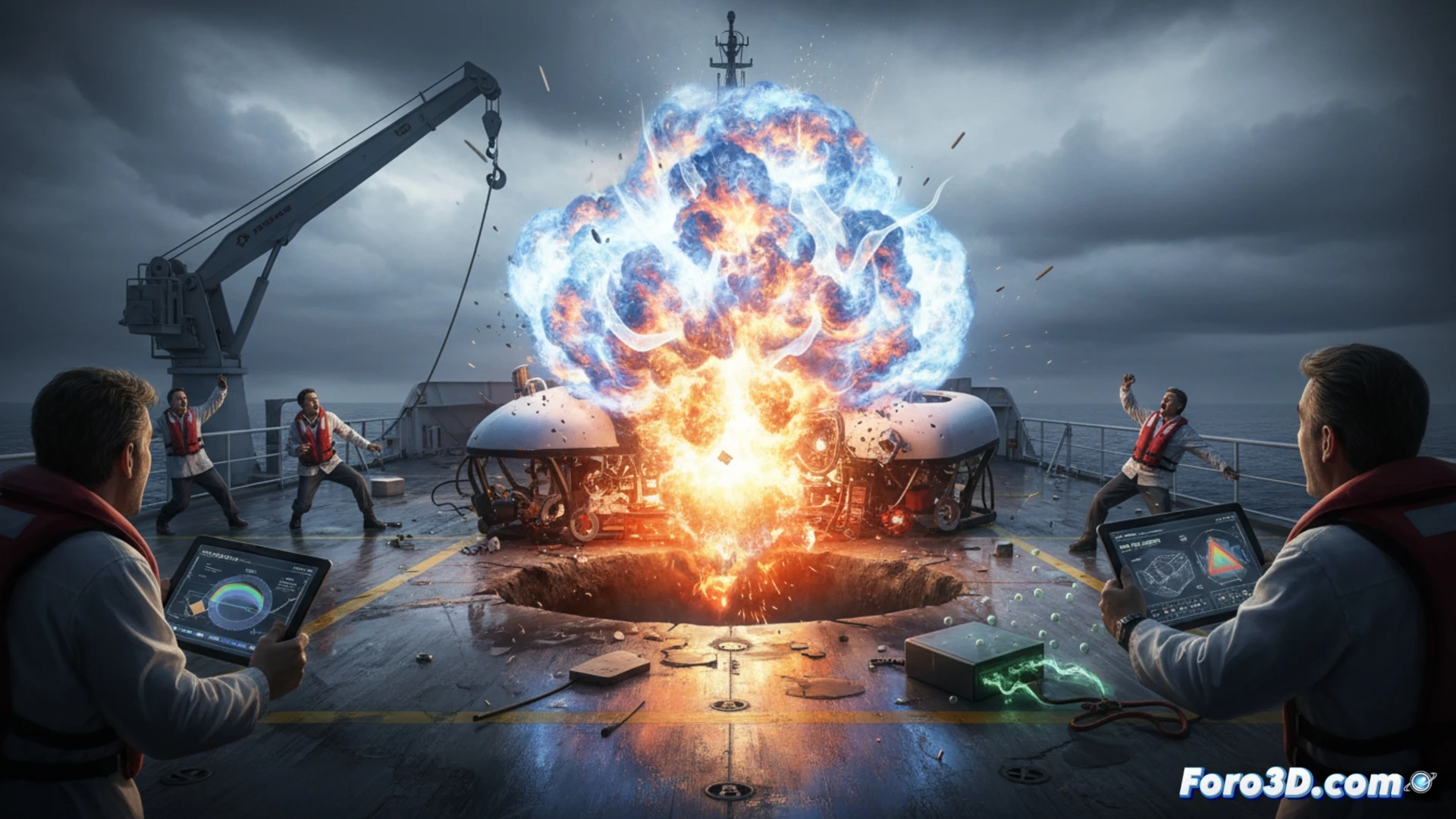
The recovery of a scientific AUV turned into a catastrophe when the drone exploded on deck, causing injuries and material damage. Initial hypotheses pointed to a structural failure, but analysis of the wreckage using underwater photogrammetry and CFD modeling revealed a more subtle truth: the accumulation of hydrogen from degassing lithium batteries, triggered by a faulty relay, created an explosive mixture in the sealed compartment.
Accident Reconstruction: CFD, CAD, and Photogrammetry 💥
To understand the accident dynamics, the AUV's sealed compartment was modeled in SolidWorks, replicating the internal geometry and seals. Using Star-CCM+, the hydrogen release during the charging cycle was simulated, considering the typical degassing rate of Li-ion cells damaged by pressure. The CFD simulation showed that the gas, lighter than air, accumulated at the top of the compartment, precisely where the power relay was located. Photogrammetry of the wreckage confirmed localized deformation in that area and carbonization of the relay, indicating that an internal spark, caused by a sulfated contact, was the ignition source. The hydrogen concentration reached 6% by volume, within the explosive range.
Lessons for Autonomous Underwater Vehicle Design ⚙️
This case demonstrates that AUV safety cannot be limited to pressure resistance. Battery degassing must be considered a real risk, even in new equipment. Proposed improvements include: passive ventilation of the sealed compartment, hydrogen sensors with automatic power cutoff, and sealed relays or those with contacts in an inert atmosphere. CFD simulation not only reconstructs the past but also allows for designing fail-safe systems before the next catastrophe occurs.
What safety and design protocols should be implemented in AUVs that use hydrogen batteries to prevent the risk of explosion during recovery operations from becoming an announced catastrophe.
(PS: Simulating catastrophes is fun until the computer melts down and you are the catastrophe.)