The Rosalind Franklin rover, the crown jewel of ESA's ExoMars mission, has survived a decade of technical delays, a global pandemic, and, above all, the most severe geopolitical fracture of the modern space era. Following the Russian invasion of Ukraine, ESA broke its alliance with Roscosmos, leaving the rover without a rocket or descent module. Now, an agreement with NASA to use a SpaceX Falcon Heavy and American braking engines completely reconfigures the mission's map of technological dependencies, scheduled for late 2028. 🚀
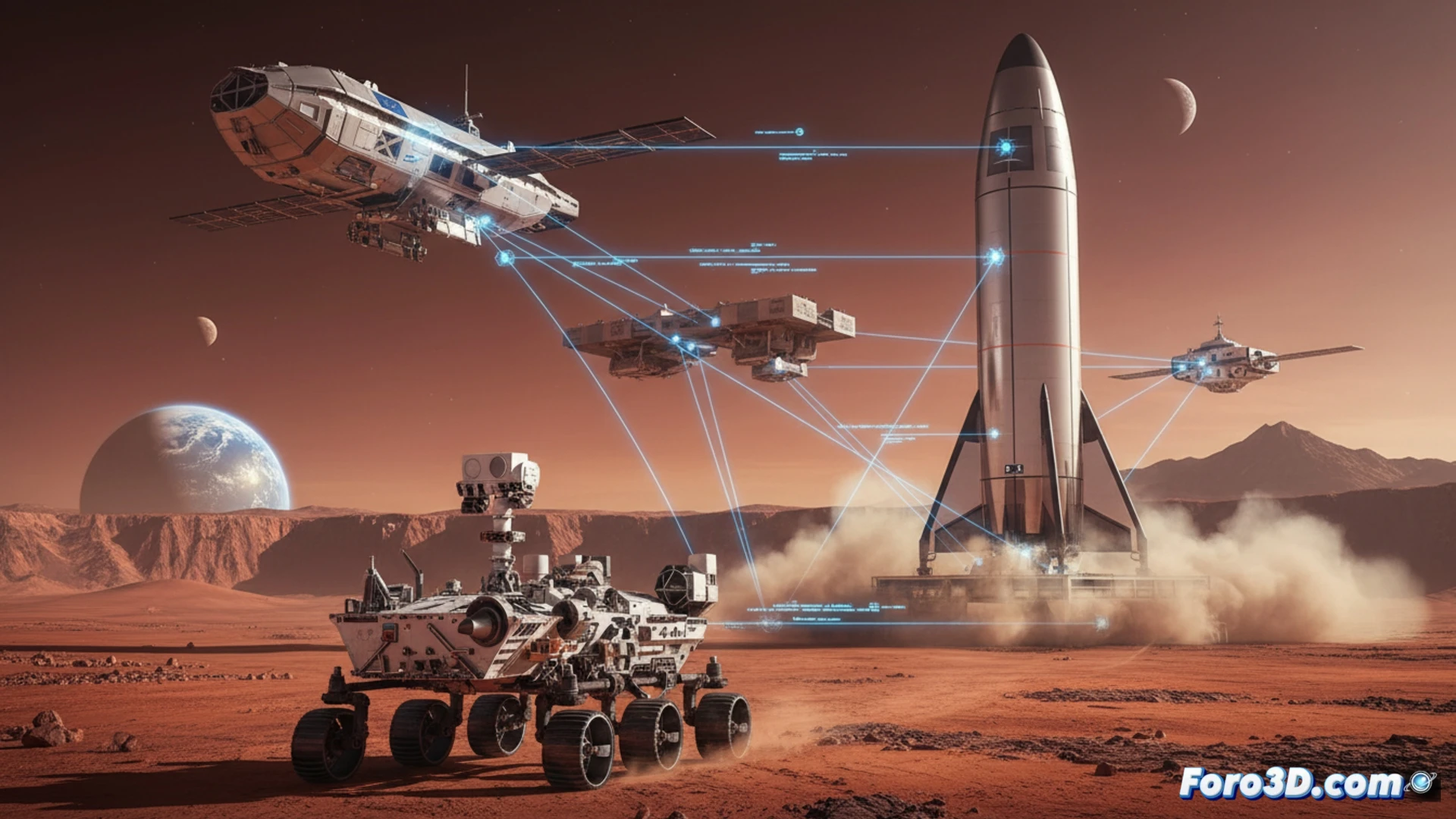
Logistics Re-engineering: From Russian Dependence to American Hardware 🌍
The original ExoMars supply chain was an example of bilateral cooperation: Russia provided the Proton rocket and the Kazachok descent module, while ESA built the rover and the TGO orbiter. The 2022 invasion of Ukraine abruptly broke this flow. ESA had to find a replacement for every critical piece. The SpaceX Falcon Heavy replaces the Proton, but implies a different launch profile and greater structural stress. The braking engines and radioisotope heater units, previously supplied by Russia, will now be manufactured by NASA. This change forced a complete audit of mechanical and electrical interfaces, a process that has added three additional years of delay. Visualizing this network in 3D shows how a single node (Roscosmos) collapsed the entire system, forcing a reconfiguration that has doubled costs and compelled ESA to integrate technology from a rival geopolitical ally (the USA) to survive.
The Price of Autonomy: Lessons for the Aerospace Supply Chain 🔧
The odyssey of the Rosalind Franklin demonstrates that the space supply chain is a direct reflection of political alliances. Dependence on a single supplier, especially from a country with divergent geopolitical interests, is an existential risk for any mission. ESA has paid the price for not having redundancy in its launchers and landing modules. Now, by subcontracting to SpaceX and NASA, Europe exchanges one dependence for another, albeit more secure in the short term. The lesson is clear: the next generation of interplanetary missions must design their supply chain with multiple and sovereign suppliers, or they will remain trapped on the terrestrial geopolitical chessboard.
How the redesign of the ExoMars 2028 supply chain, following the exclusion of Russian components, affects Europe's geopolitical dependence on new suppliers like NASA and the American private industry
(PS: visualizing the global supply chain is like following a trail of breadcrumbs... in 3D)