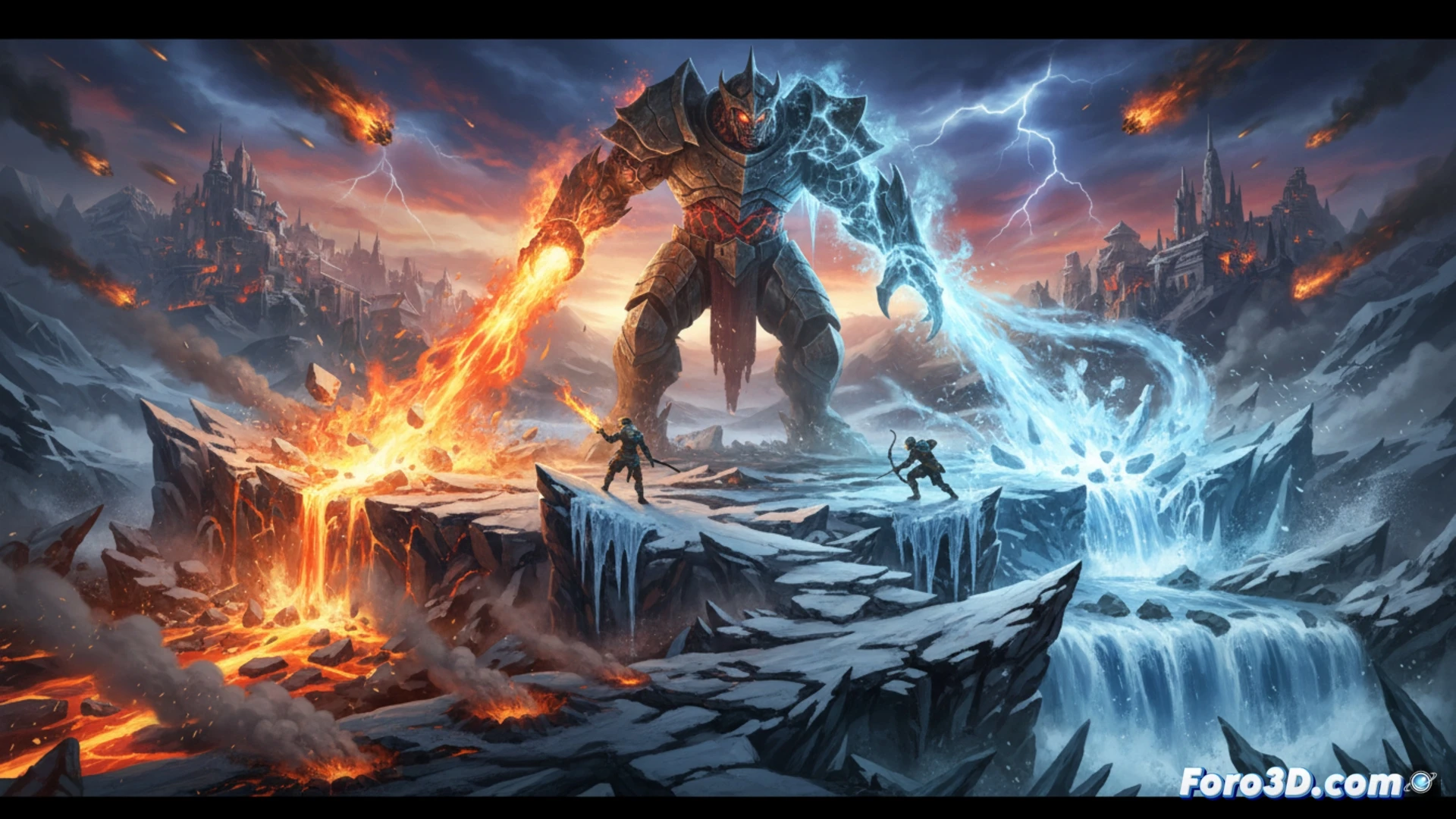
The development of Eternal Strands represents a milestone in the integration of massive physics systems with dynamic environments. Using Unreal Engine 5, the team has achieved that the weather is not mere scenery, but an active gameplay engine. The propagation of fire and realistic freezing of ice modify the scene's geometry in real time, forcing level designers to rethink navigation and interaction with scalable giant enemies.
Technical Pipeline: From Houdini to UE5 with Substance 3D 🛠️
The secret behind these effects lies in a hybrid pipeline. While UE5's physics engine manages real-time simulation (collisions, destruction, and chain reactions), elemental effects like fire whirlwinds or ice explosions are pre-calculated in Houdini. There, fluid and particle simulations are generated, which are then exported as mesh sequences or VDBs. Subsequently, Substance 3D handles creating procedural textures that respond to weather wear, allowing a burned wall or a frozen surface to maintain visual coherence without sacrificing performance.
Scalability and Reactive Level Design 🎮
The scalable giant enemy system directly benefits from this architecture. While climbing a colossus, the player can trigger localized fires that affect the monster's AI, or freeze its limbs to open new climbing routes. This transforms level design into a living puzzle, where weather and physics act as problem-solving tools. For developers, mastering this workflow between Houdini, Substance 3D, and UE5 is key to creating worlds that respond organically to each player decision.
Considering the use of Unreal Engine 5 to simulate massive weather physics in Eternal Strands, which optimization strategy do you consider most critical for maintaining stable performance on current-generation consoles without sacrificing the destructible interactivity of the environment?
(PS: 90% of development time is polishing, the other 90% is fixing bugs)