In the abyssal depths of the Clarion-Clipperton Zone, over 4,000 meters deep, resides a creature that defies the passive nature of its phylum. Asbestopluma sp., nicknamed the Wine Glass, is a carnivorous sponge identified as a potential species in 2024. Its goblet-shaped structure is not only elegant but also a deadly trap. For the field of scientific visualization, this discovery represents a technical challenge: recreating an organism that has developed an active capture system in an environment of total darkness and extreme pressure.
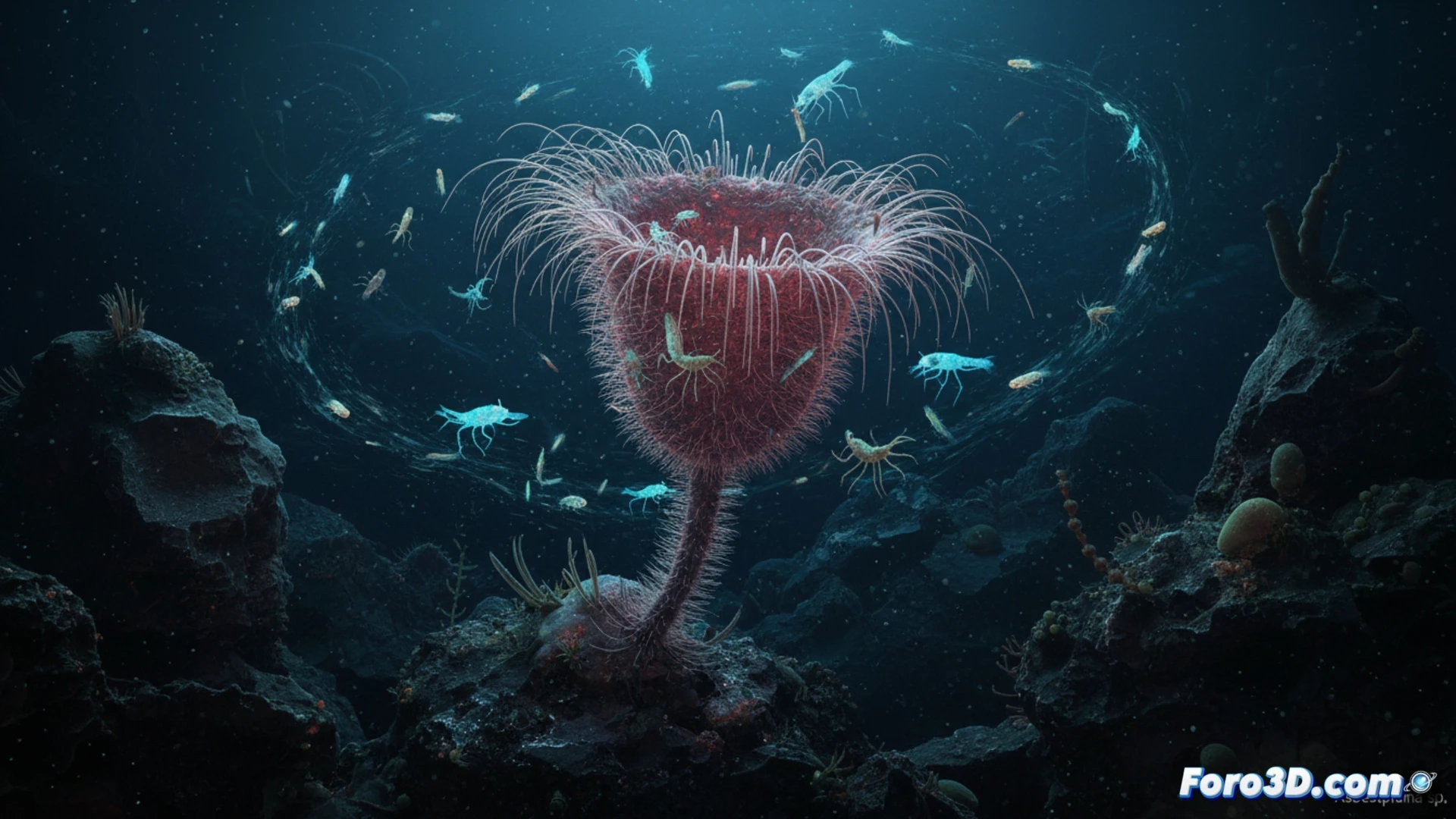
Digital Anatomy of the Goblet and Capture Mechanism 🧬
For the 3D model, we must prioritize the representation of its skeleton of siliceous spicules, which gives rigidity to the cup. The inner surface of the goblet should be modeled with microscopic adhesive filaments, visible only with an extreme level of detail in the normal mapping. The key animation is the capture: small crustaceans swimming towards the central cavity, becoming trapped in a net of hooks. The simulation must show how the sponge, slow but relentless, envelops the prey with migratory cells (archeocytes). It is crucial to contrast this model with that of a non-carnivorous siphon sponge, highlighting the absence of water pumping systems in Asbestopluma.
The Paradox of Lethal Beauty in the Benthos 🎯
Visualizing this sponge forces us to rethink benthic ecosystems. It is not a passive filter, but an ambush predator. The Clarion-Clipperton Zone, an area rich in polymetallic nodules, thus becomes a stage for silent hunting. When rendering the seafloor, we must include dim lighting (bioluminescence) and sediment planes to contextualize its camouflage strategy. This model not only documents a species but illustrates how the scarcity of nutrients in the abyss forces the evolution of surprising adaptations, transforming a simple cup into a perfect trap.
As a 3D modeler, what is the greatest technical challenge when recreating the porous structure and transparency of the Wine Glass sponge to achieve an accurate scientific visualization of its predatory morphology under abyssal lighting conditions?
(PS: if your manta ray animation isn't exciting, you can always add documentary music from channel 2)