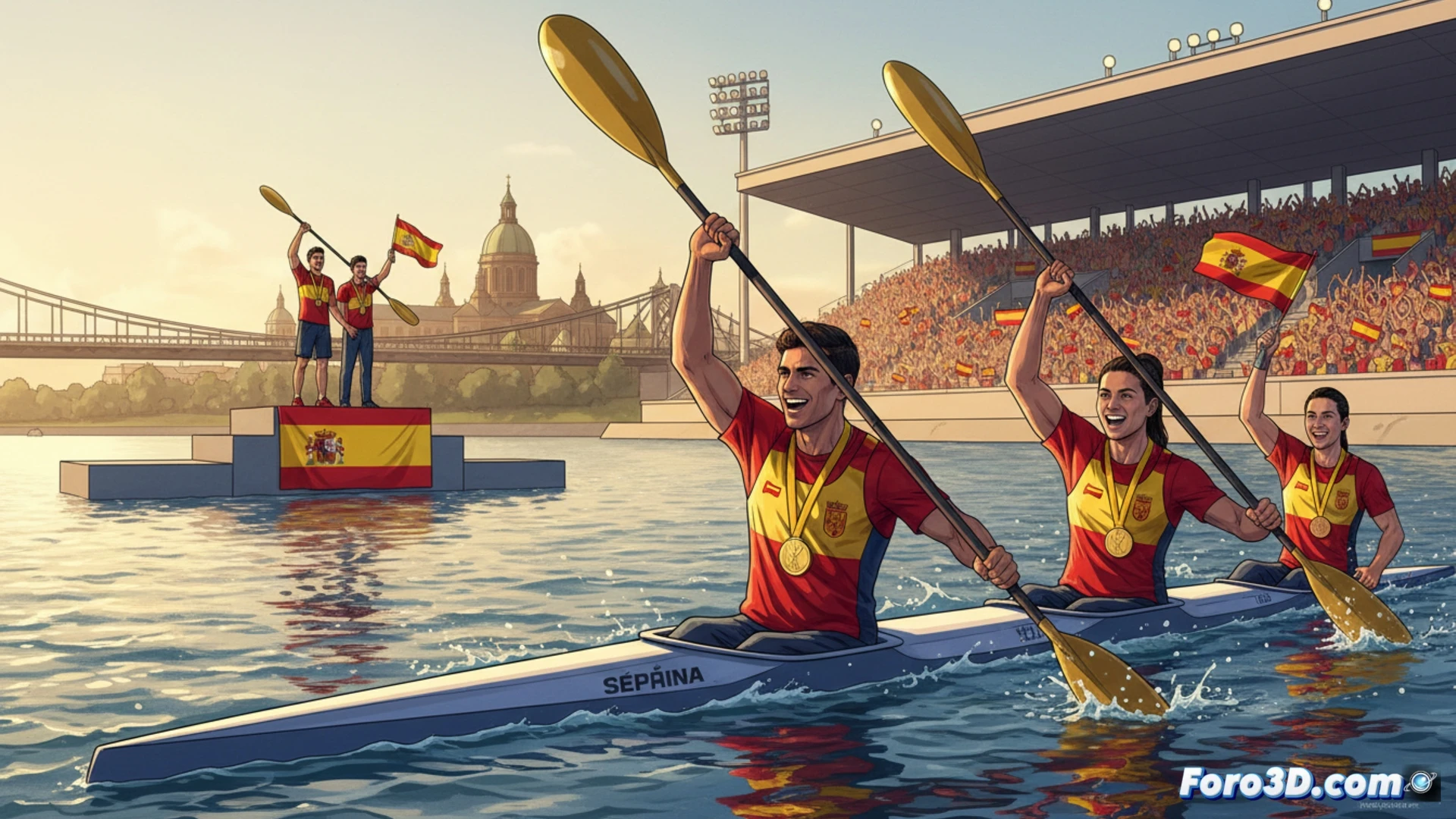
The Spanish canoeing team delivered a solid performance at the World Cup held in Szeged, Hungary. The national team managed to secure two gold medals and two bronze medals in an event that brought together the best paddlers on the planet. The results reinforce the strong form of the talent pool and the preparation for upcoming competitions.
Technical analysis: boats and paddle design in Hungarian waters 🛶
Performance in Szeged does not depend solely on physical condition. The boats used by the Spanish team incorporate carbon composite materials with a fiber distribution that optimizes torsional rigidity. The geometry of the blades, with an angle of attack adjusted to the conditions of the Hungarian channel, allows for more efficient traction in the first meters of the start. Stroke frequency measurement systems, synchronized with acceleration sensors, helped coaches adjust the cadence in the final 500 meters, key to securing the bronzes.
Spoiler: kayaks are not programmed with ChatGPT 🤖
Some might think the medals are because the paddlers carry an AI assistant in their helmet. Nothing could be further from the truth. The technology used in Szeged is limited to sensors on the blades and slow-motion video analysis. There were no drones giving instructions or a GPT whispering the strategy. Paddlers still have to row, sweat, and, above all, not crash into the buoys. We leave the artificial intelligence to the computers; on the water, the arms rule.