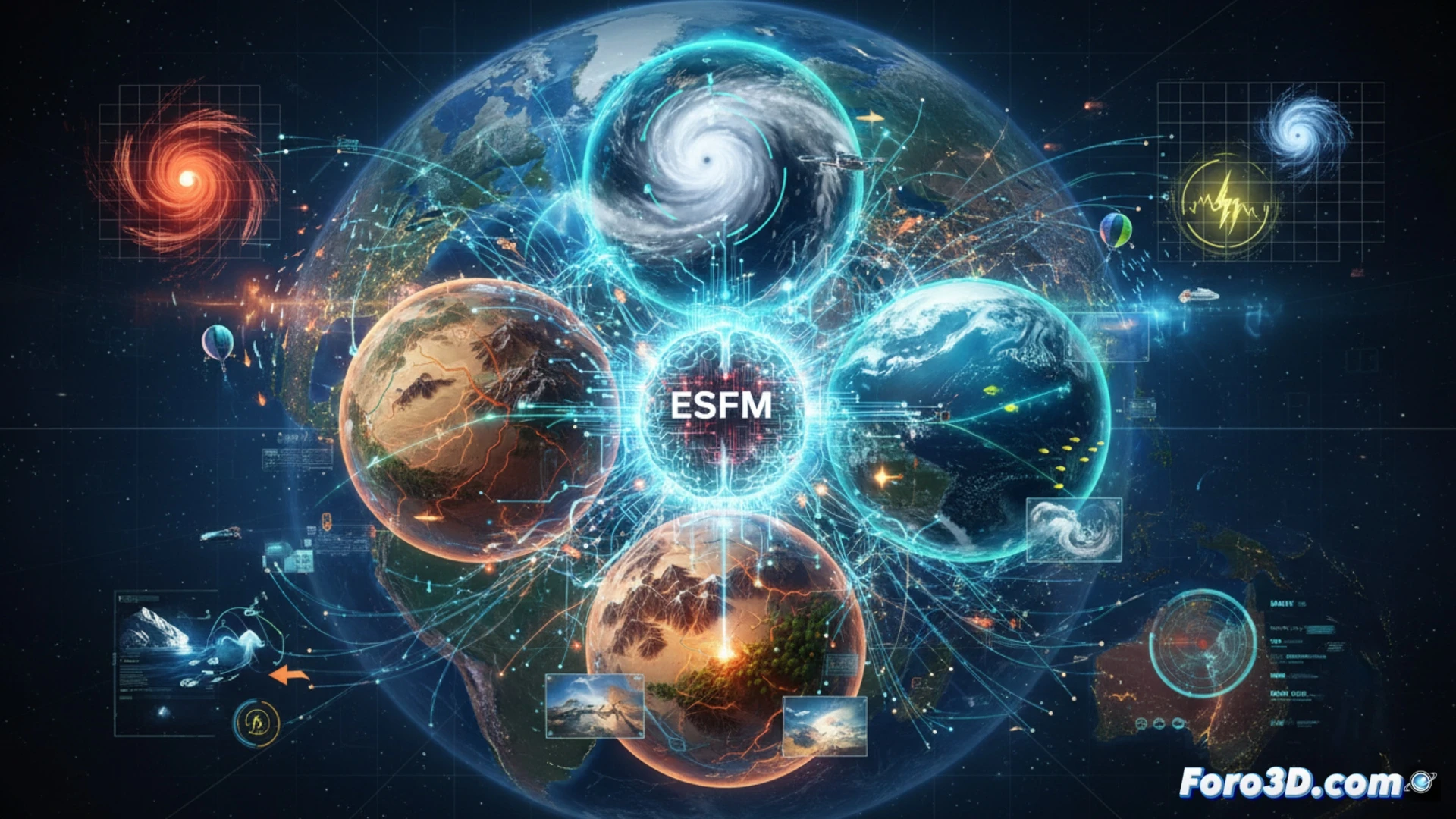
Researchers from the ETH Domain have presented the Earth System Foundation Model (ESFM), an artificial intelligence model that revolutionizes natural disaster prediction. Unlike traditional systems, which analyze the atmosphere in isolation, ESFM integrates atmospheric, hydrological, and terrestrial data. Its ability to learn the interactions between air, land, and water allows it to reconstruct incomplete satellite images and offer accurate forecasts even when key information is missing, a crucial advance for anticipating storms, droughts, and super typhoons. 🌍
Data reconstruction and simulation of extreme events 🌀
ESFM stands out for its ability to handle various types of data and close critical gaps in satellite information. Instead of treating climate processes separately, the model autonomously learns the fundamental connections of the Earth system. This is essential for 3D simulation of disasters, as it allows for generating more realistic models of phenomena such as the 2023 super typhoon Doksuri. By reconstructing missing data, emergency teams can visualize the evolution of a storm or drought in greater detail, improving the capacity to anticipate and mitigate damage to infrastructure and populations.
Implications for climate risk management ⚠️
ESFM represents a qualitative leap in disaster prediction, overcoming the limitations of traditional models that analyzed processes in isolation. By identifying complex patterns between air, land, and water, this tool allows understanding how extreme events that were previously difficult to anticipate develop. For disaster analysis professionals, ESFM offers a solid foundation for designing more effective prevention strategies, reducing uncertainty in scenarios where information is scarce, and improving response to climate emergencies.
What variables would you consider to model this disaster?