3D technology offers heritage restorers a precise tool to document, analyze, and replicate damaged elements before touching them. A clear example is the reconstruction of an eroded baroque cornice: the original piece is scanned, the missing part is modeled with software, and an exact mold is printed to cast in resin or mortar. Necessary programs: RealityCapture for photogrammetry, Blender or ZBrush for modeling, and PrusaSlicer to prepare the print.
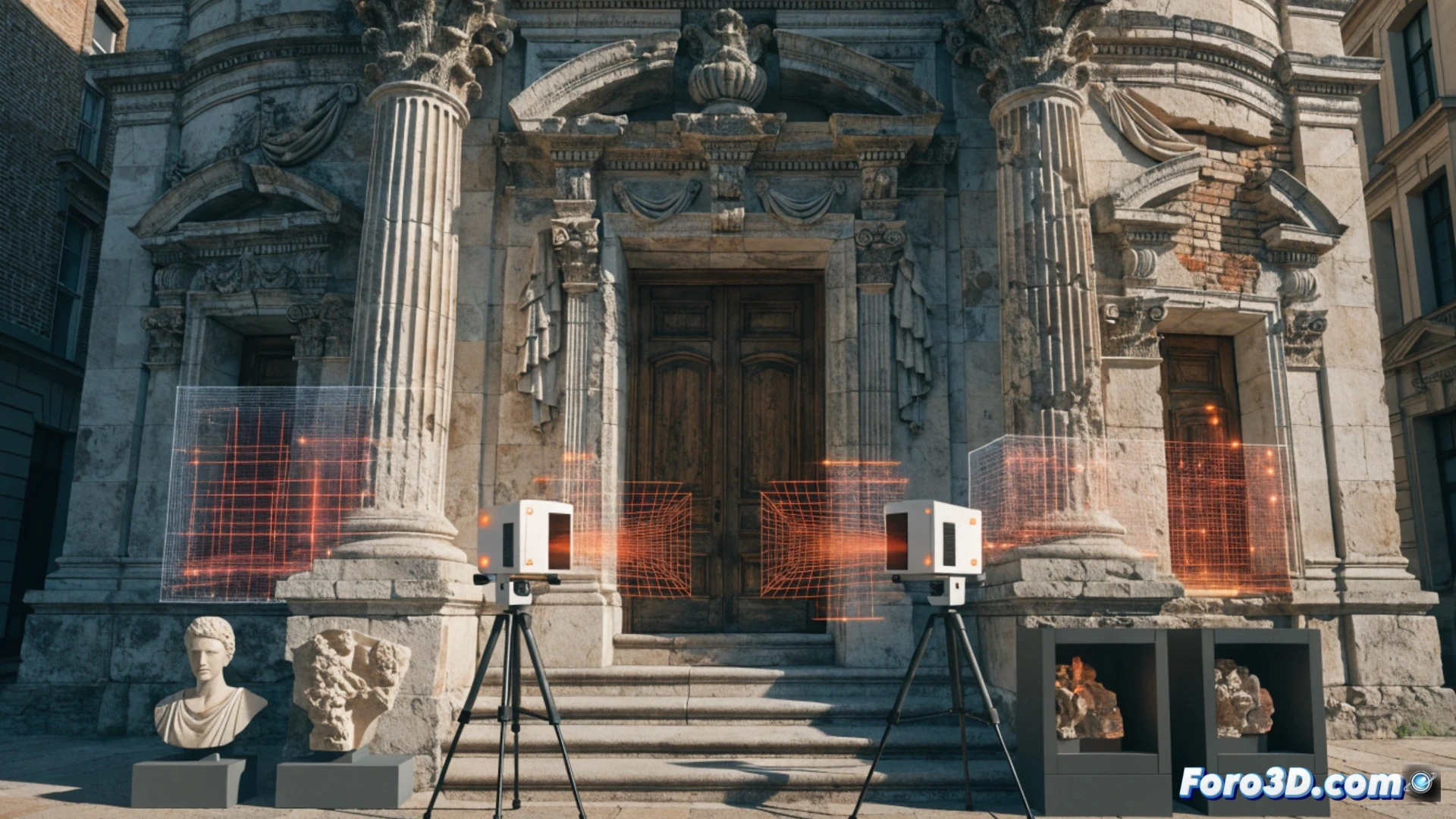
Photogrammetry and modeling: the digital restorer's tandem 🏛️
The process begins by taking between 50 and 200 photos of the object from all angles, using a DSLR camera or even a high-resolution mobile phone. RealityCapture processes these images and generates a point cloud that becomes a 3D mesh. Then, in Blender, gaps are filled or lost areas are reconstructed based on symmetries or historical references. The final file is exported as an STL for printing in resin or PLA, achieving pieces that fit with a tolerance of 0.1 mm, without the need for chisel or plaster.
When the software cries more than the original stonemason 😅
The funny thing is that now the restorer spends more time fighting with the RealityCapture license than carving stone. You sit down to scan a 17th-century capital and the program tells you that you need 8 GB of extra RAM. Then, while modeling, Blender crashes because the mesh has too many triangles. In the end, the laser scanner marks a crack that even the architect's eye didn't see, and you end up printing a support that looks like a giant dental prosthesis. That said, the result is so accurate that even the saint on the facade seems grateful.