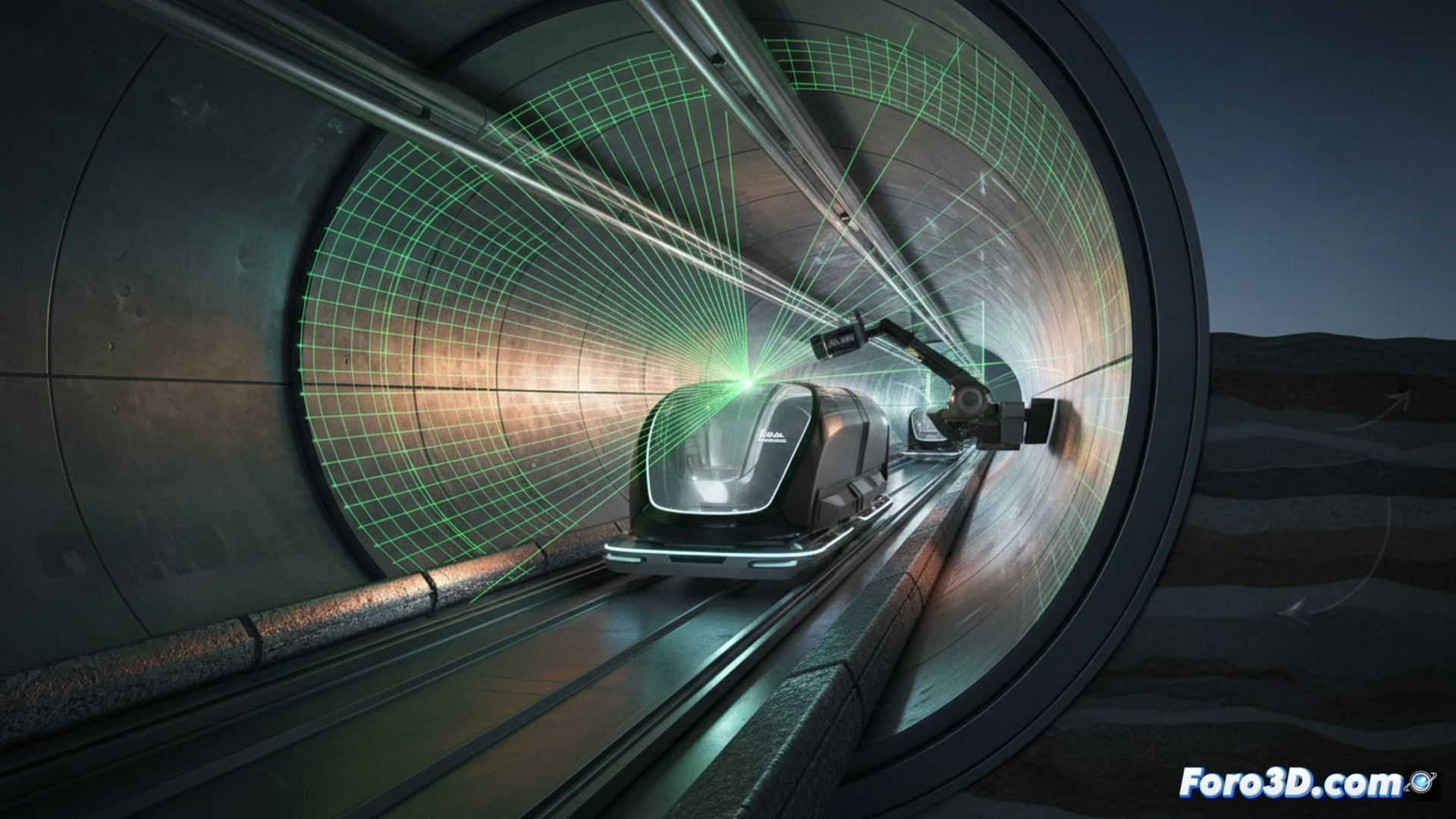
The recent rubbing incident in a Hyperloop capsule has brought to light a critical challenge for precision engineering: detecting alignment deviations in linear vacuum infrastructure. When a high-speed capsule grazes the tube walls, the margin for error is mere millimeters. The problem may be due to faulty thermal expansion joints or differential ground settlement. To discern the root cause, sub-millimeter 3D laser scanning capable of capturing the actual geometry of the conduit is required.
Technical workflow: from point cloud to diagnosis in OpenRail 🚄
The process begins with data acquisition using a high-precision terrestrial laser scanner, configured to obtain a point density of less than 1 mm. The raw point cloud is imported into Leica Infinity, where georeferencing and trajectory adjustment are performed. Subsequently, the data is exported to Bentley OpenRail to compare it with the original design BIM model. Here, an analysis of longitudinal and transverse deviations is carried out, segmenting the tube into 10-meter sections. If the deviations are cyclical and coincide with the location of the joints, the failure is thermal. If they are progressive and cumulative, they point to ground settlement. Finally, CloudCompare allows for a detailed analysis of the point cloud, calculating cloud-to-cloud distances and generating color maps that visualize critical contact zones.
The importance of geometric control in ultra-precision infrastructure 📐
This case demonstrates that 3D geomatics is not just a documentation tool, but an indispensable diagnostic system for infrastructure operating at the limit of mechanical tolerance. Without rigorous metric control, the origin of a failure could be erroneously attributed to the capsule or the levitation system. The real challenge lies in integrating precision surveying as a continuous sensor within the lifecycle of civil works, capable of alerting to millimeter movements before they become critical incidents. Sub-millimeter precision is, therefore, the new safety standard.
As a 3D surveying engineer, what sub-millimeter laser scanning protocol would you recommend to differentiate between permanent deviations due to material fatigue and temporary elastic deformations in the inner wall of the Hyperloop tube after a rubbing incident?
(PS: 3D surveying is like making a treasure map, but the treasure is an accurate model.)