The recent fall of a vehicle in a robotic vertical parking lot has highlighted the precision required for structural maintenance. The incident, documented through 3D laser scanning, revealed critical deviations in the vertical guides of the automatic elevator. These deformations, imperceptible to the naked eye but detectable at the millimeter level, were the root cause of the collapse. Forensic analysis with tools such as Faro Zone 3D and SCENE now allows for the reconstruction of the exact sequence of the failure.
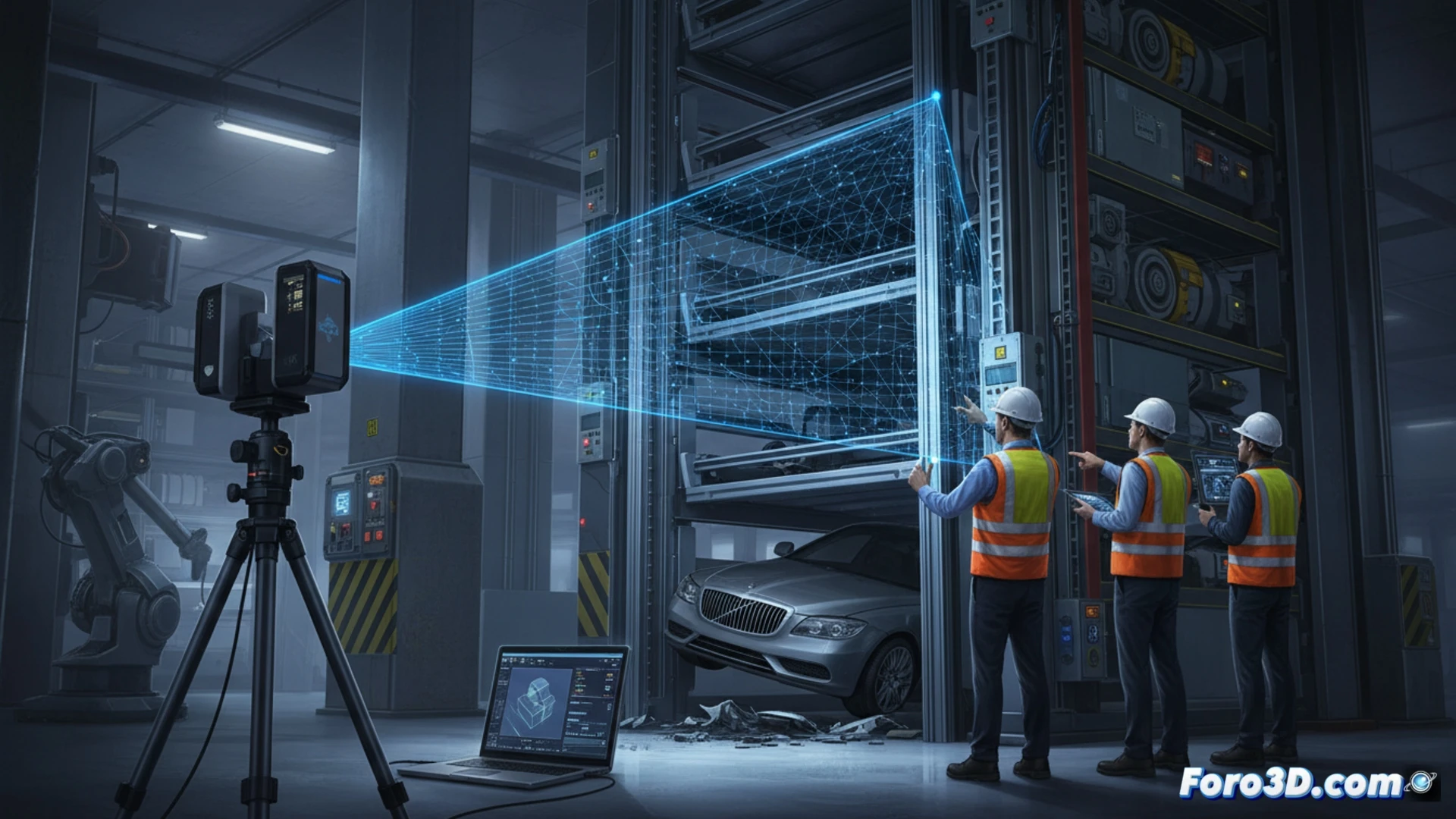
Forensic Flow: From Point Cloud to Structural Simulation 🏗️
The investigation process began with capturing the actual geometry of the guidance system using a Faro laser scanner. The data imported into SCENE allowed the point clouds to be aligned with the original manufacturing tolerance. Subsequently, in Faro Zone 3D, comparative measurements were performed that identified a deviation of 3.8 millimeters in the second-floor rail. This anomaly was modeled in SAP2000, where the dynamic load of the vehicle at the deviated point was simulated, confirming that the stress exceeded the yield strength of the steel. Finally, V-Ray generated a photorealistic visualization of the collapse, used for the judicial expert appraisal.
The Lesson of the Invisible: Data-Driven Prevention 🔍
This case demonstrates that safety in robotic infrastructure depends not only on electronics but also on the geometric integrity of its components. Periodic laser scanning, with analysis in Zone 3D, should become a standard for predictive maintenance. Detecting a deviation of three millimeters in time prevents not only material damage but also the loss of life. 3D forensic technology does not just investigate the past; it builds a safer future by establishing tolerance thresholds based on digital evidence.
What implications does the fact that an error of just a few millimeters, detected only through laser scanning, was the direct cause of the collapse of a platform in a robotic parking lot have for predictive maintenance protocols?
(PS: In scene analysis, every scale witness is a small anonymous hero.)