The kinetic facade of the Art Pavilion has suffered a critical failure: its movable panels lock up and collapse under wind action. This incident reveals a deep-seated problem in the design of dynamic systems for architecture. To diagnose the origin, the proposed 3D pipeline employs structured light scanning, capable of capturing micro-deformations in the joints and the progressive wear of actuators, allowing the detection of manufacturing errors that compromise structural integrity.
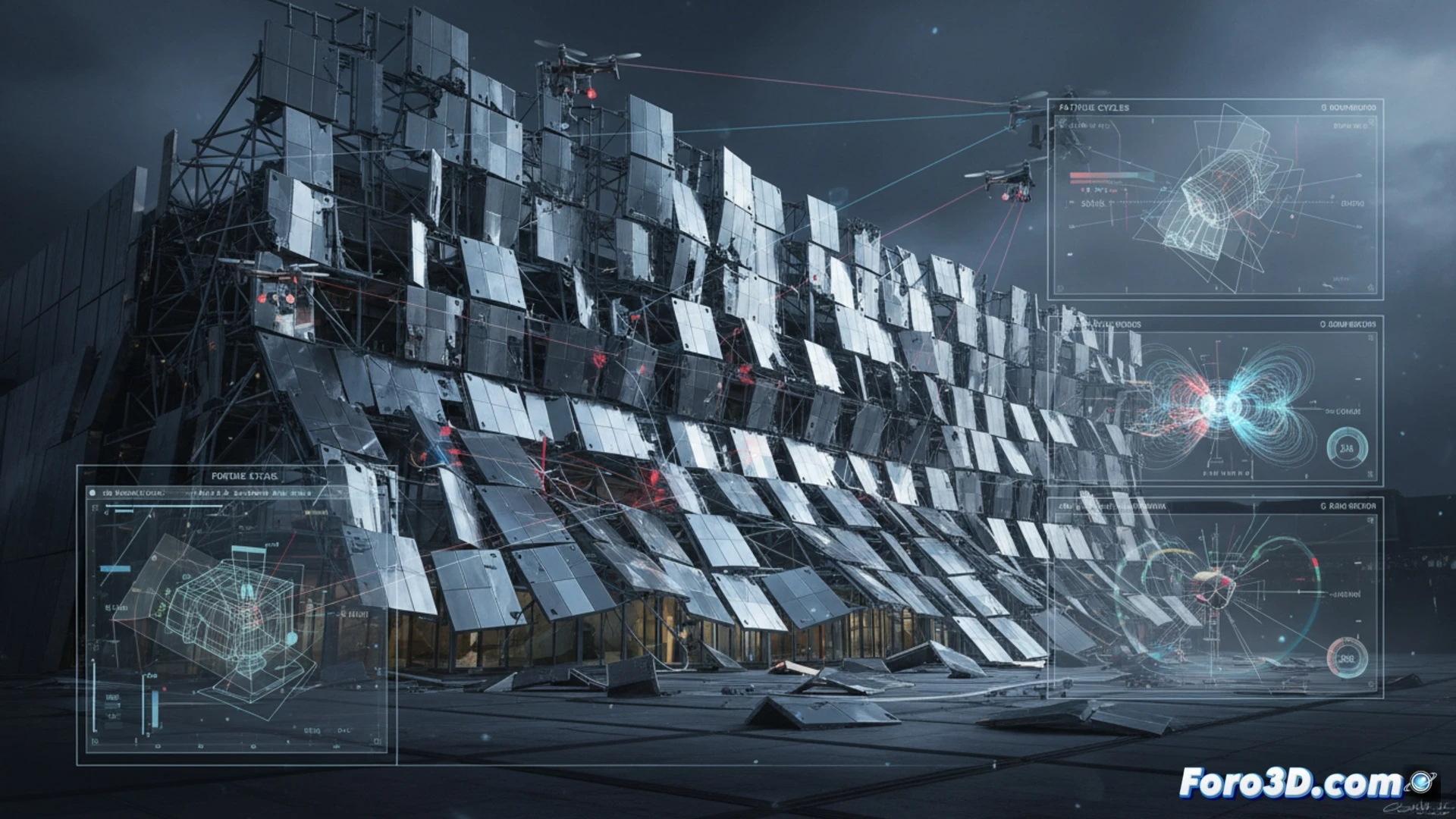
3D Pipeline for Detection of Micro-Deformations and Wind Stress 🏗️
The process begins with Artec Studio, which uses structured light to generate high-density point clouds on the actuators and joints. These geometries are exported to Grasshopper (Rhino) to analyze micrometric deviations from the original CAD model, identifying areas of incipient fatigue. The deformation data is integrated into Siemens NX, where wind stress is simulated through finite element analysis, predicting failure points under cyclic loads. Finally, Enscape visualizes the progressive deterioration of the facade, showing how micro-cracks evolve until the panels lock and fall, offering a digital twin of the wear.
Lessons for Fatigue Simulation in Materials 🔧
This case demonstrates that fatigue simulation should not be limited to ideal loads. The combination of real scanning and predictive simulation allows anticipating failures in kinetic systems exposed to variable environmental conditions. The pipeline described here turns an accident into an opportunity to validate fatigue models, adjusting manufacturing parameters and material selection. For the fatigue simulation niche, this methodology reinforces the need to incorporate empirical deformation data to refine lifespan predictions in dynamic architecture.
How can 3D structural scanning be integrated with fatigue simulation models to predict failure points in the mechanisms of kinetic panels exposed to wind and temperature cycles in large-scale facades?
(PS: Material fatigue is like yours after 10 hours of simulation.)