Vandalism on rock art heritage is a scourge that, until now, usually left irreversible damage. However, digital archaeology has taken a qualitative leap: we no longer only document the damage, but we can virtually reverse it and, furthermore, act as forensic experts. A recent case of graffiti on a petroglyph has been resolved using a workflow that combines high-precision scanning, micro-topographic analysis, and virtual restoration, demonstrating that 3D technology is the new ally of conservation. 🛡️
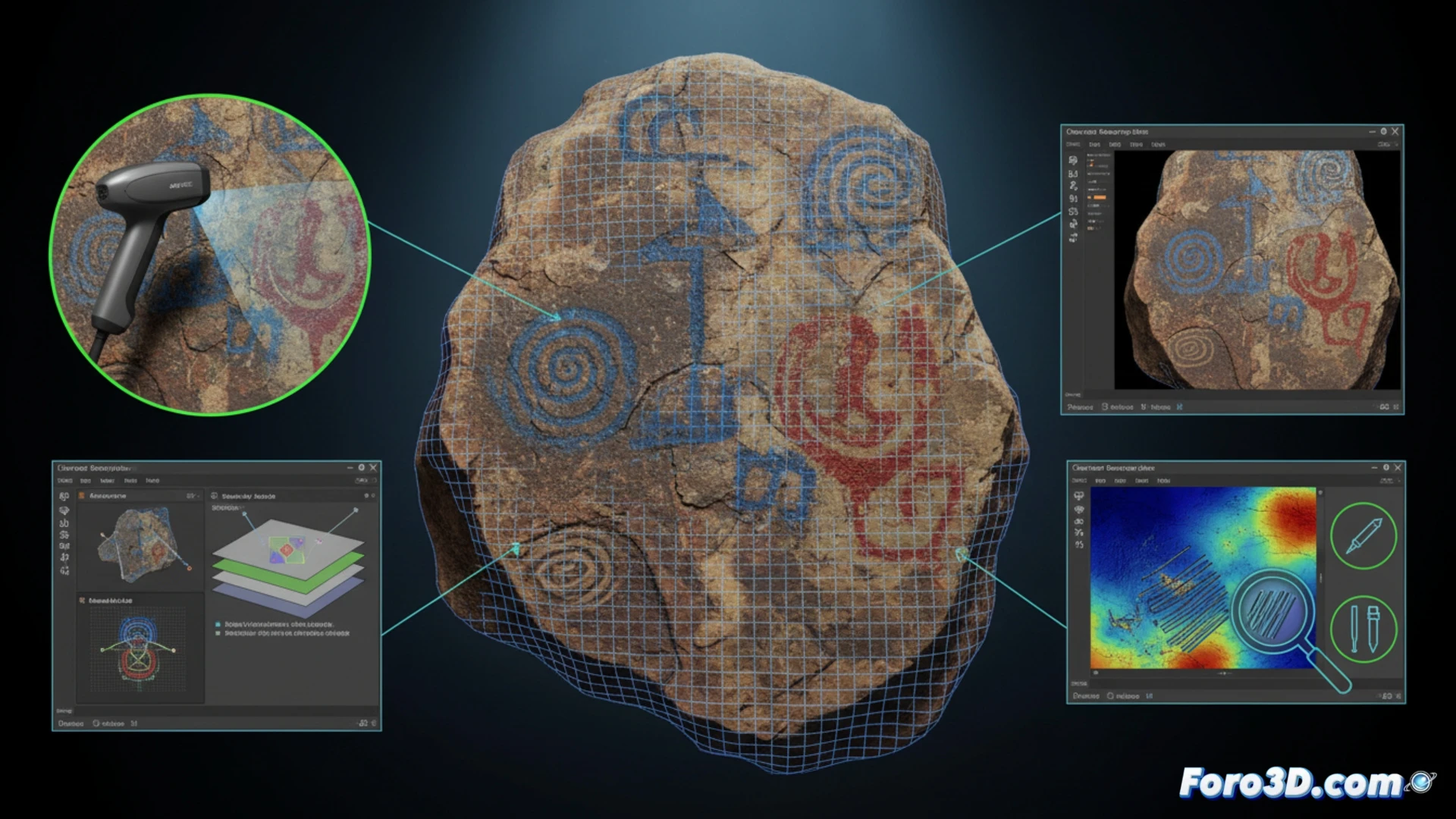
Technical workflow: from point cloud to virtual restoration 🔧
The process begins with capture using an Artec Space Spider scanner, whose submillimeter resolution allows recording both the original relief of the engraving and the added paint layer. The resulting point cloud is processed in CloudCompare, where we apply a segmentation filter based on height difference: the paint, being a surface layer, generates a minimal but detectable topographic offset. This offset is isolated using a plane subtraction algorithm, separating the vandalistic layer from the stone substrate. Subsequently, MeshLab allows refining the mesh, removing noise generated by the graffiti texture and reconstructing the original surface through interpolation of the engraving edges. The result is a clean mesh that is exported to Blender, where a photogrammetric texture from the pre-damage state is applied to visualize the complete restoration, generating a model that can be used as expert evidence or for 3D printing of replicas.
Micro-topography as incriminating evidence against vandalism 🔍
Beyond aesthetic restoration, the true forensic value lies in the analysis of micro-topography. By studying the roughness and depth of paint marks on the 3D model, researchers can infer the type of tool used: a fine-tip marker leaves a pattern of parallel grooves, while an aerosol creates a homogeneous layer with micro-droplets. This digital expertise, presented alongside the restored model, offers objective and quantifiable evidence that can be used in legal proceedings, elevating rock art conservation to a new level of legal and technical protection.
How can 3D scanning and digital forensic expertise be used not only to document damaged petroglyphs, but also to trace and legally attribute acts of vandalism to those responsible?
(PS: and remember: if you can't find a bone, you can always model it yourself)