The recent collapse of cells in an iron-air battery storage plant has brought into focus the mechanical fatigue induced by cyclic thermal expansion of the electrodes. Unlike typical chemical failures, this incident originated from accumulated plastic deformation in the anode matrix. To dissect the failure, a reverse engineering workflow was implemented, combining high-precision 3D scanning with finite element analysis (FEA), allowing the correlation of post-mortem geometry with residual stresses from the charge cycle.
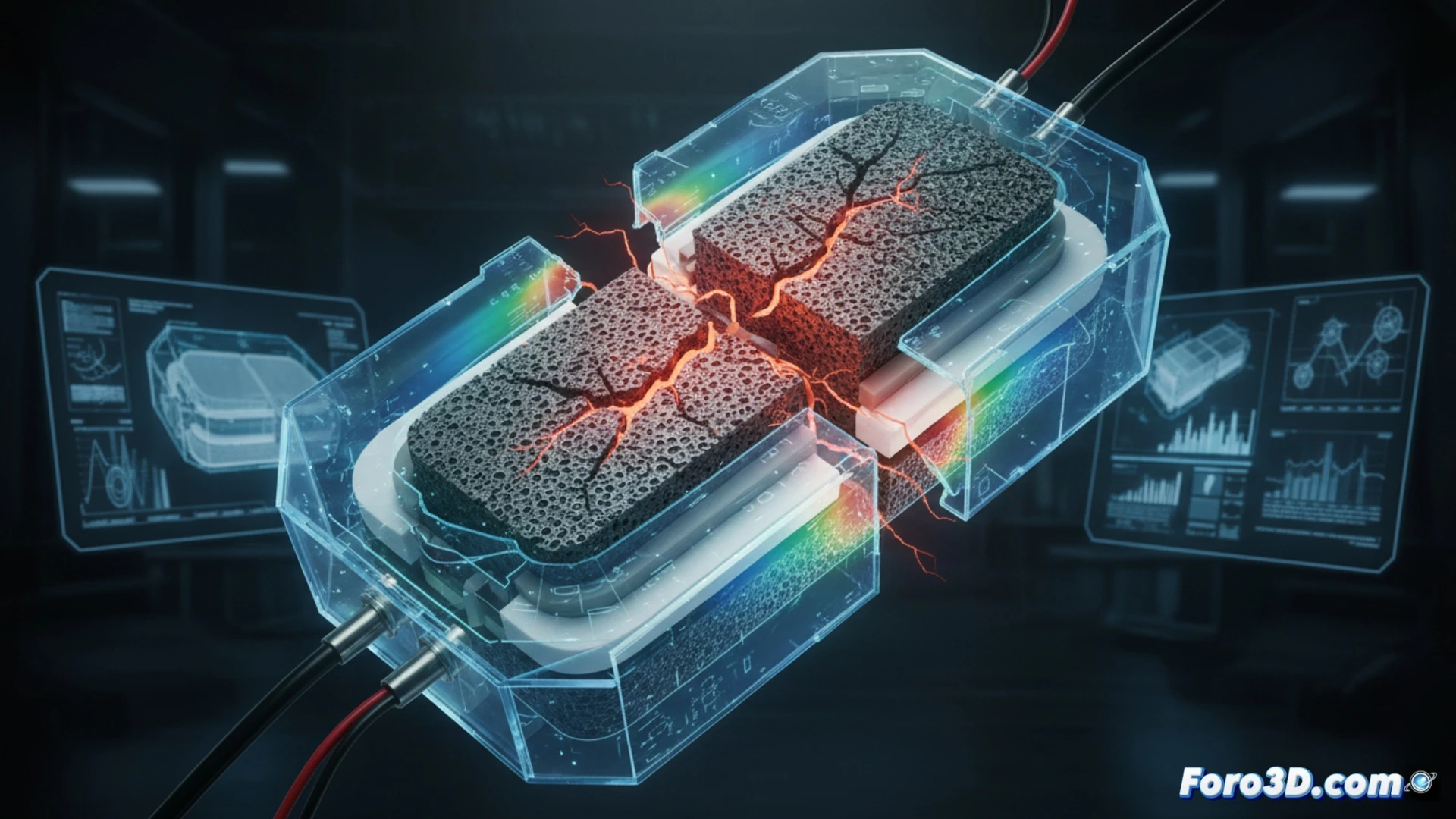
Workflow: From Point Cloud to Finite Element Validation 🔧
The process began with capturing the deformed geometry of the collapsed electrodes using Autodesk ReCap. The scan generated a high-density point cloud that was cleaned and meshed to obtain a solid model of the expanded surface. This model was imported into Abaqus, where cyclic thermal loads were applied to simulate the differential expansion between the iron and the air matrix. The simulation revealed critical stress concentration points at the cell edges, where fatigue exceeded the material's yield limit. Finally, SolidWorks was used to redesign the electrode geometry, adding stress relief features and optimizing expansion clearance, validating the new design against the load cycle data obtained in Abaqus.
Design Lessons: Thermal Expansion as a Fatigue Indicator 📊
The comparative graphical analysis between volumetric expansion and load cycles demonstrated that the failure was not sudden, but rather the result of progressive microstructural degradation. The ReCap data allowed calibrating the Abaqus model to reflect the actual deformation, revealing that the original design lacked the necessary tolerance for cyclic dilation. This case underscores that, in large-scale storage systems, fatigue simulation should not be limited to electrical components; the mechanical integrity of the electrodes, analyzed through 3D scanning and FEA, is critical to preventing catastrophic structural collapses.
How 3D scanning techniques and finite element analysis can be integrated to predict critical fatigue points in iron-air battery cells during repetitive charge and discharge cycles
(PS: Material fatigue is like yours after 10 hours of simulation.)