The mechanical and electrical interaction between the pantograph and the contact wire generates critical cyclic wear in high-speed railway lines. In this technical analysis, we explore how mobile 3D scanning enables the quantification of cross-sectional loss in copper-magnesium wires. The detection of surface irregularities, caused by recurring electrical arcs, becomes the foundation for modeling material fatigue and predicting structural failures in the catenary.
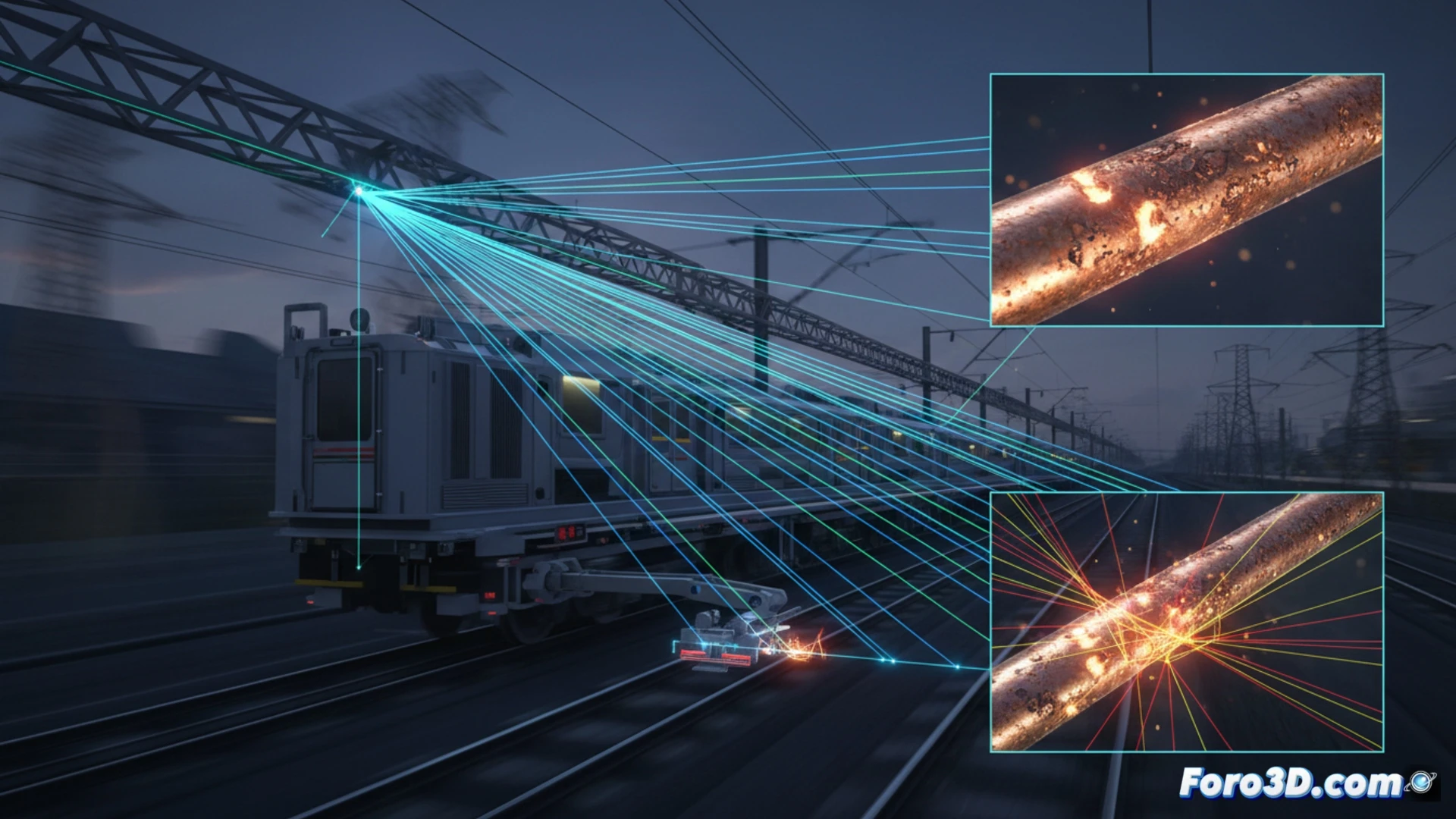
Data capture and analysis methodology 🔧
The process begins with the acquisition of point clouds of the contact wire using mobile scanners mounted on inspection vehicles. Raw data is processed in Leica Infinity to generate a high-precision geometry. Subsequently, PolyWorks enables detailed dimensional inspection, calculating the reduction in cross-sectional area and locating notches or grooves. This deformed geometry is exported to nCode, where fatigue simulation is executed. The software applies cyclic load histories, representing the repeated passage of the pantograph, to calculate the remaining service life of the wire and the stress concentration zones.
The digital twin as a predictive tool 🧠
The creation of a digital twin of the contact wire, updated with each inspection, transforms reactive maintenance into predictive maintenance. By integrating 3D scanning data with fatigue analysis in nCode, engineers can visualize wear evolution and simulate future load scenarios. This allows for optimizing maintenance windows, replacing catenary sections just before they reach their critical cross-sectional limit. The result is a reduction in service interruptions and a significant increase in reliability on high-speed lines.
How can the correlation between surface irregularities detected by 3D scanning and the remaining service life of the contact wire in high-speed catenaries subjected to cyclic fatigue be modeled?
(PS: Material fatigue is like yours after 10 hours of simulation.)