The opening of a new metro line has raised alarm in the digital archaeology community. The Arch of Trajan, a historical monument of incalculable value, now shows micro-fissures that did not exist before the construction work. Thanks to high-resolution 3D scanning, experts have been able to compare the pre- and post-construction state, precisely quantifying the propagation of cracks induced by low-frequency vibrations.
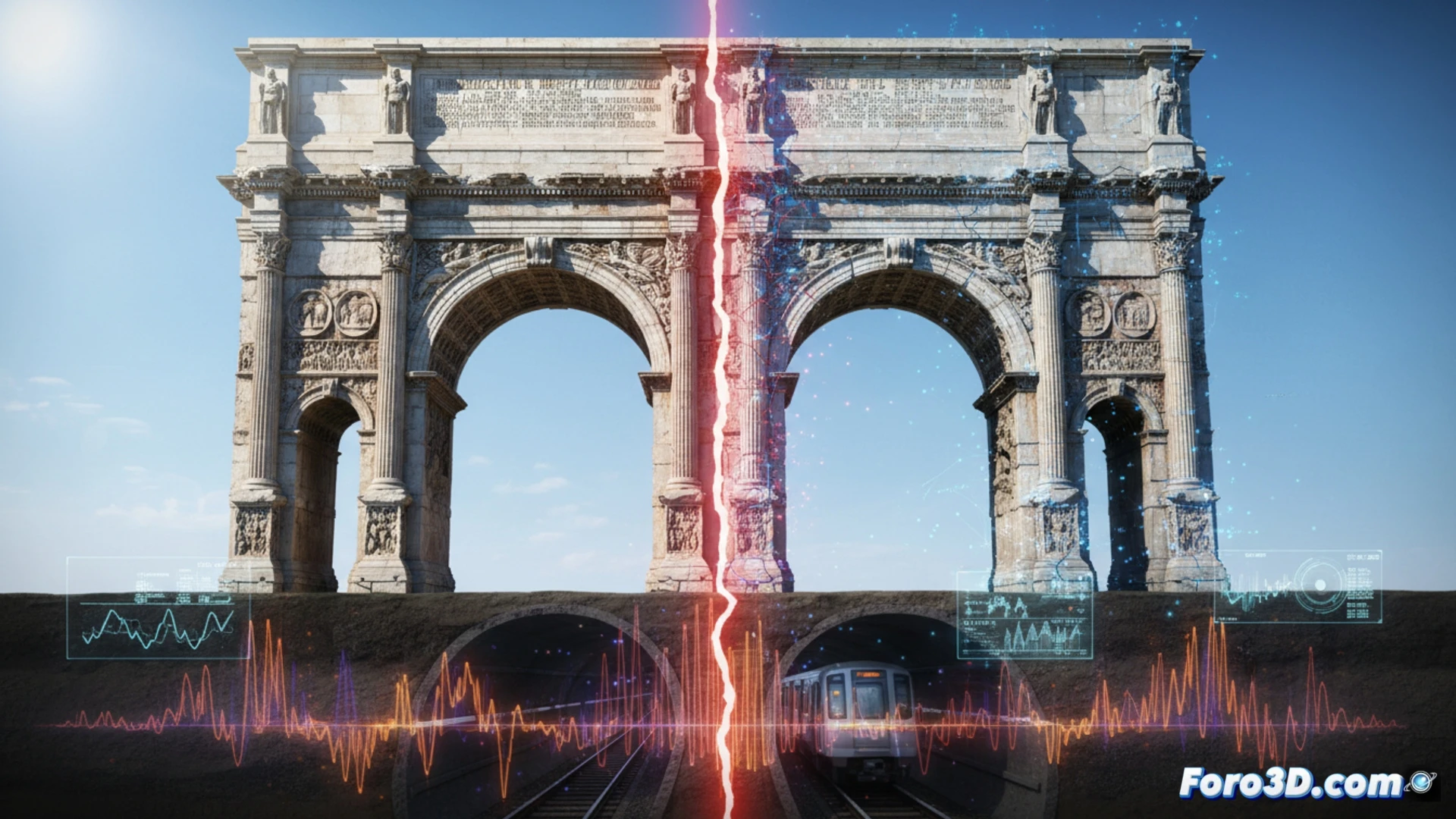
Technical workflow: From point cloud to finite element analysis 🏗️
The process begins with massive data capture via photogrammetry, processed in RealityCapture to generate a millimeter-scale point cloud of the arch. This digital model is exported to CloudCompare, where alignment and direct comparison between the original and current state are performed. The geometric difference reveals displacements in microns. This data is input into Abaqus for a seismic and vibrational finite element simulation. The software models the response of the stone material to the frequencies generated by the train's passage, identifying critical stress concentration points where micro-fissures originate.
Predictive conservation: Establishing damage thresholds for heritage 🏛️
Beyond simple crack detection, this analysis allows defining acceptable damage thresholds. By correlating the actual measured vibration with the simulation, engineers can predict the future behavior of the monument under repetitive loading conditions. This approach not only validates whether the current construction is safe but establishes a continuous monitoring protocol for future urban interventions, ensuring that historical heritage and modern infrastructure can coexist without compromising the structural integrity of the past.
Given that 3D scanning has already detected micro-fissures, what real-time monitoring protocols and at what minimum resolution do you consider necessary to differentiate between passive damage from historical vibration and an imminent structural collapse of the Arch of Trajan?
(PS: If you dig at a site and find a USB drive, don't plug it in: it could be Roman malware.)