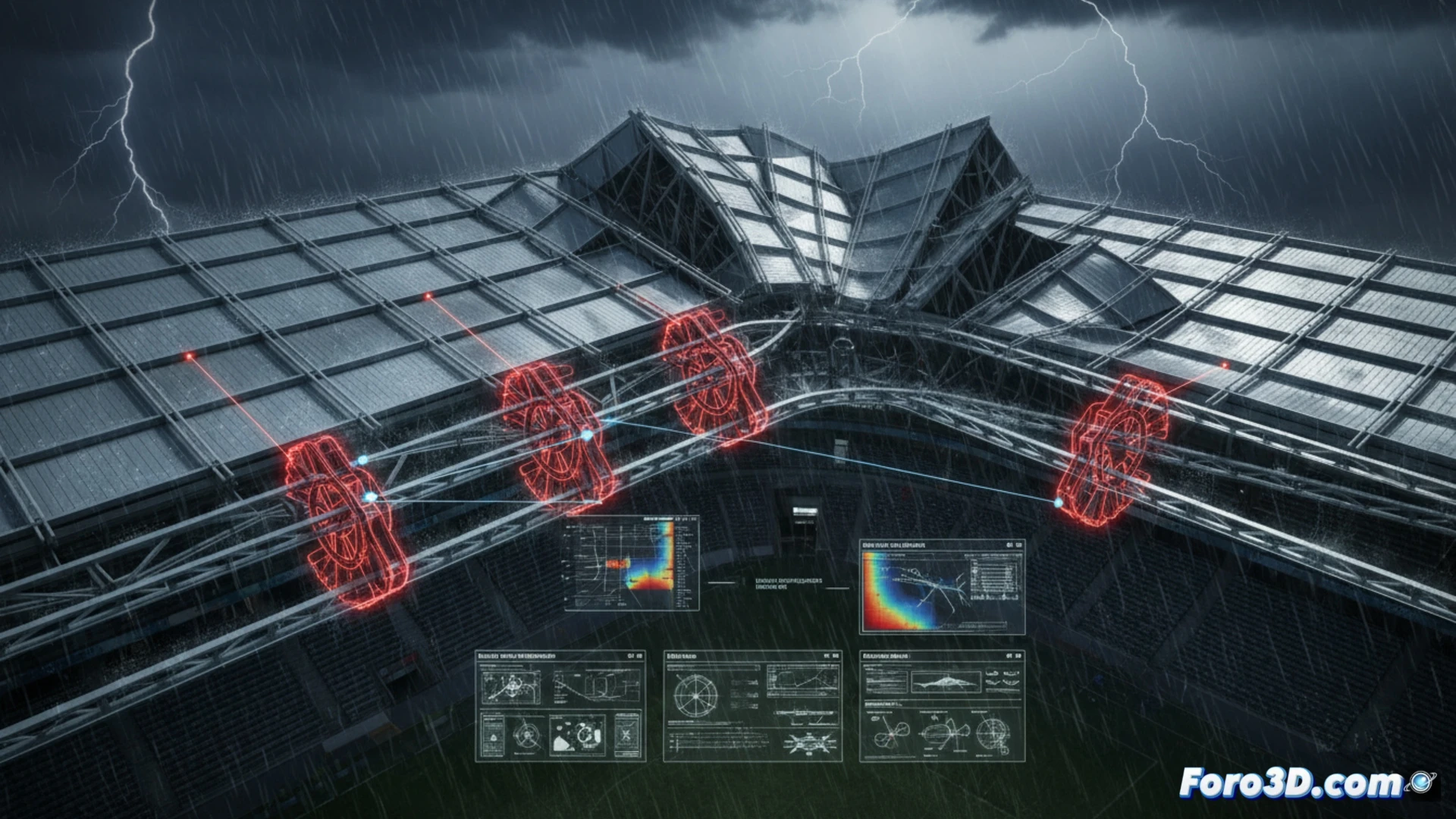
The roar of metal against metal was heard above the wind. The retractable roof of a multi-purpose stadium, designed to close in minutes, came to a sudden halt. A thunderstorm surprised the operators, but the real enemy was not the rain, but a thermal miscalculation. At 50 meters high, the traction carriages locked up and the guides deformed. To understand the disaster, forensic engineers turned to a fleet of drones and a digital twin.
Forensic Diagnosis at Height: From Drone to Kinematic Simulation 🚁
The team deployed drones equipped with high-resolution photogrammetry to capture the state of the rails and gears. The resulting point clouds were processed in Bentley ContextCapture, creating an accurate 3D model. By comparing this model with the original plans in CloudCompare, a misalignment of just 3 millimeters was detected at a rail joint. This difference, almost imperceptible to the naked eye, was the culprit. The data was exported to Autodesk Robot Structural Analysis and Cinema 4D for a kinematic simulation. The software revealed that the thermal expansion of the steel, when heated under the sun prior to the storm, had not been compensated for in the design of the carriage stops. When it cooled abruptly with the rain, the contraction of the metal generated stress that diverted the path of the traction wheels, causing the jam and deformation.
Lessons for Critical Infrastructure: Preventing Catastrophe 🛠️
This case demonstrates that the failure of a mega-structure does not always stem from a monumental error, but from millimeters forgotten in a specification table. The combination of 3D scanning with drones and kinematic simulation not only solved the mystery but also established an inspection protocol. Now, the predictive maintenance of these roofs includes dynamic thermal models to adjust rail tolerances according to the season. Forensic technology prevented a potential future catastrophe, turning a jam into an engineering lesson.
How did 3D scanning identify the sub-millimeter margin of error that caused the retractable roof jam, and what lessons does it leave for the design of critical structures facing extreme weather conditions?
PS: Simulating catastrophes is fun until the computer crashes and you are the catastrophe. 😅