For decades, the enormous stone jars scattered across the Plain of Jars in Laos have been an enigma for archaeology. These vessels, up to three meters tall and dated to the Iron Age (500 BC - 500 AD), seemed to have a funerary purpose, but the lack of conclusive evidence prevented confirmation. A recent study has used digital documentation techniques to reveal their true function: they were funerary urns. This finding not only solves a mystery but also demonstrates how 3D technology is revolutionizing the understanding of our cultural heritage.
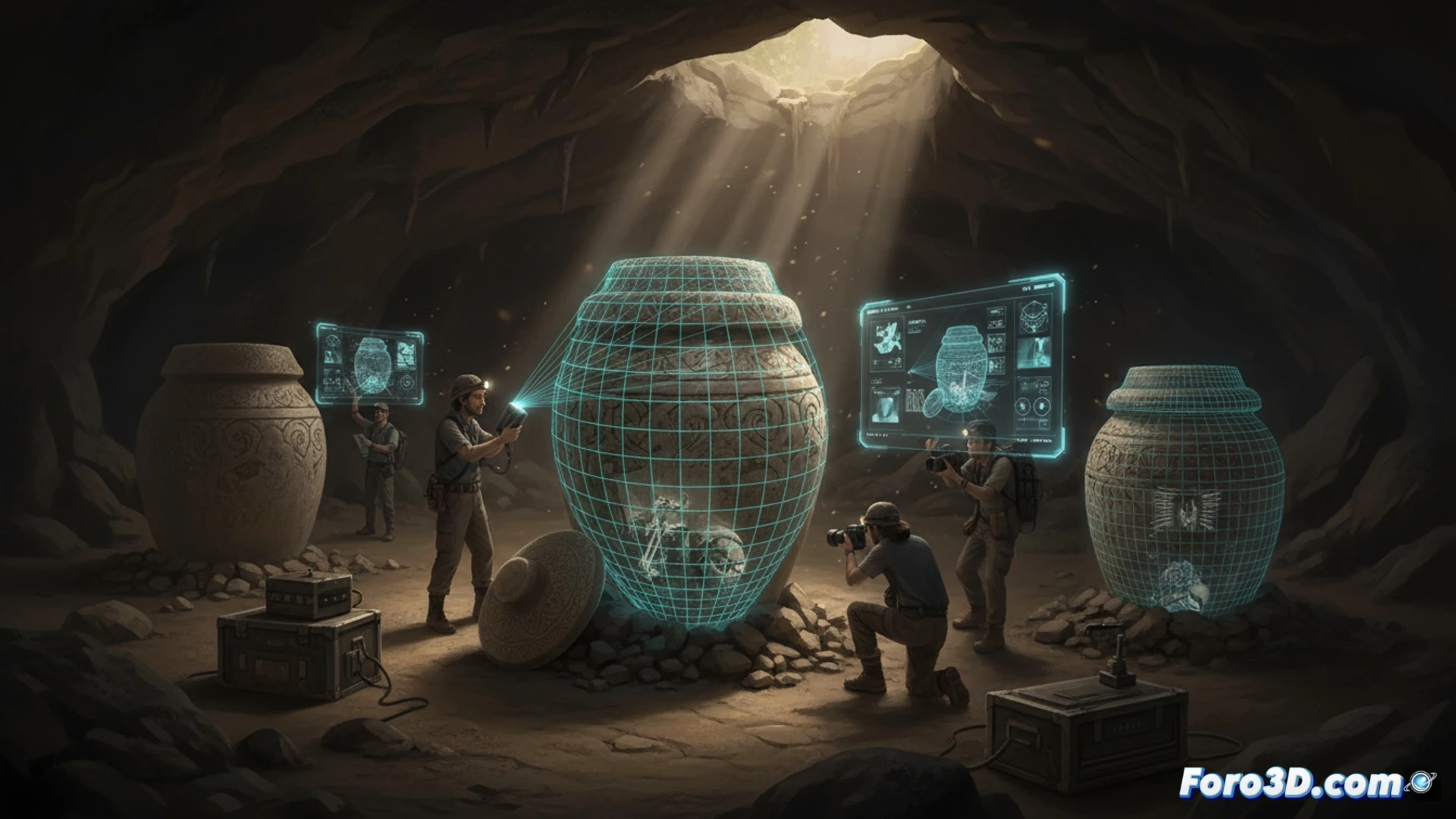
Photogrammetry and sediment analysis on the Plain of Jars 🏺
The research team combined 3D scanning and photogrammetry to create high-resolution digital models of each jar and the surrounding landscape. This process allowed for precise mapping of the vessels' arrangement and their orientation relative to ancient trade routes and settlements. Simultaneously, sediments and organic remains inside the jars were analyzed using radiocarbon dating and spectrometry techniques. The results confirmed the presence of human bones and decomposition residues, indicating that the jars housed bodies after a process of cremation or exposure. The virtual reconstruction of the environment suggests these were not random locations, but a carefully planned funerary landscape.
The value of digital archaeology in solving enigmas 🔍
This case exemplifies how digital archaeology allows going beyond traditional excavation. 3D modeling not only digitally preserves the jars against potential damage but also facilitates the virtual recreation of funerary rituals, from the deposition of remains to the relationship with trade routes. By integrating spatial and chemical data, archaeologists can reconstruct the social organization of Iron Age communities. Technology thus becomes an indispensable tool for deciphering the past, demonstrating that even the oldest mysteries can be resolved with digital precision.
How 3D scanning influences the reinterpretation of previous theories about the ritual or funerary function of the Laos jars.
(PS: If you dig at a site and find a USB stick, don't plug it in: it could be Roman malware.)