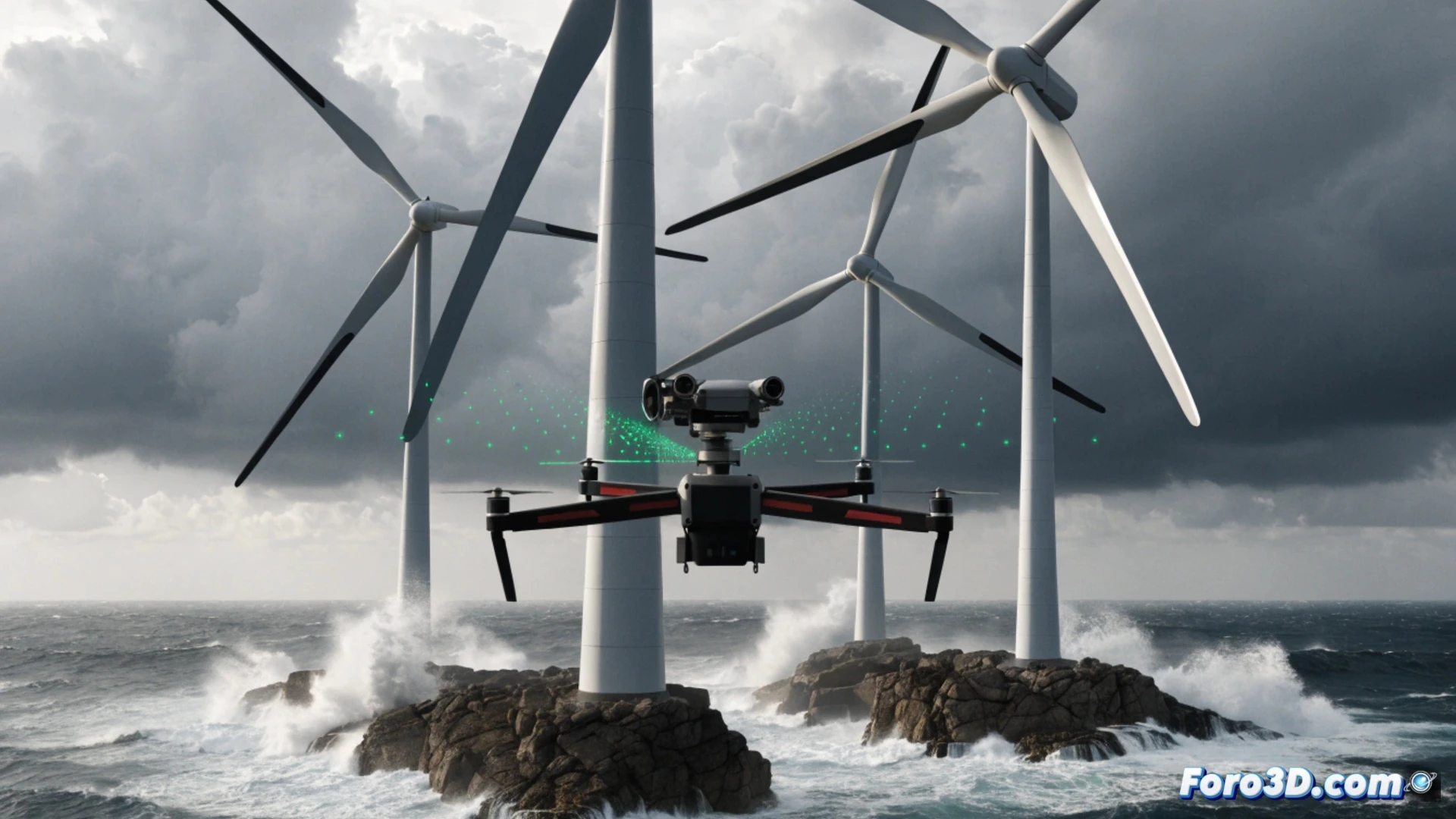
The job of a wind turbine technician involves working at considerable heights and with precision components. 3D technology enables detailed inspections of blades and towers from the ground, using drones with laser scanners. This reduces risks and speeds up diagnostics. A clear example is the detection of micro-cracks in blades through photogrammetry, avoiding the need to climb up and inspect every centimeter by hand.
Key software for 3D maintenance in wind turbines 🛠️
Specialized software is needed to process the captured data. Autodesk Recap allows converting point clouds into editable models. CloudCompare is useful for comparing the current state of a blade with its original design and detecting deformations. For load and fatigue simulation, Ansys Mechanical helps predict failures. The workflow begins with a drone equipped with LiDAR, continues with modeling, and ends with a damage report.
When the 3D scanner discovers your favorite blade has more cracks than your patience 😅
The veteran wind turbine technician, used to hanging from a harness with a hammer and a clinical eye, now receives a report that says: blade number three has 47 micro-cracks. Their natural reaction is to curse the program, the drone, and the intern who piloted it. But in the end, they save two hours of climbing in the rain only to discover the problem was a bird stain. 3D technology doesn't lie, but sometimes it's a good idea to bring the technician a sandwich so they forgive the software.