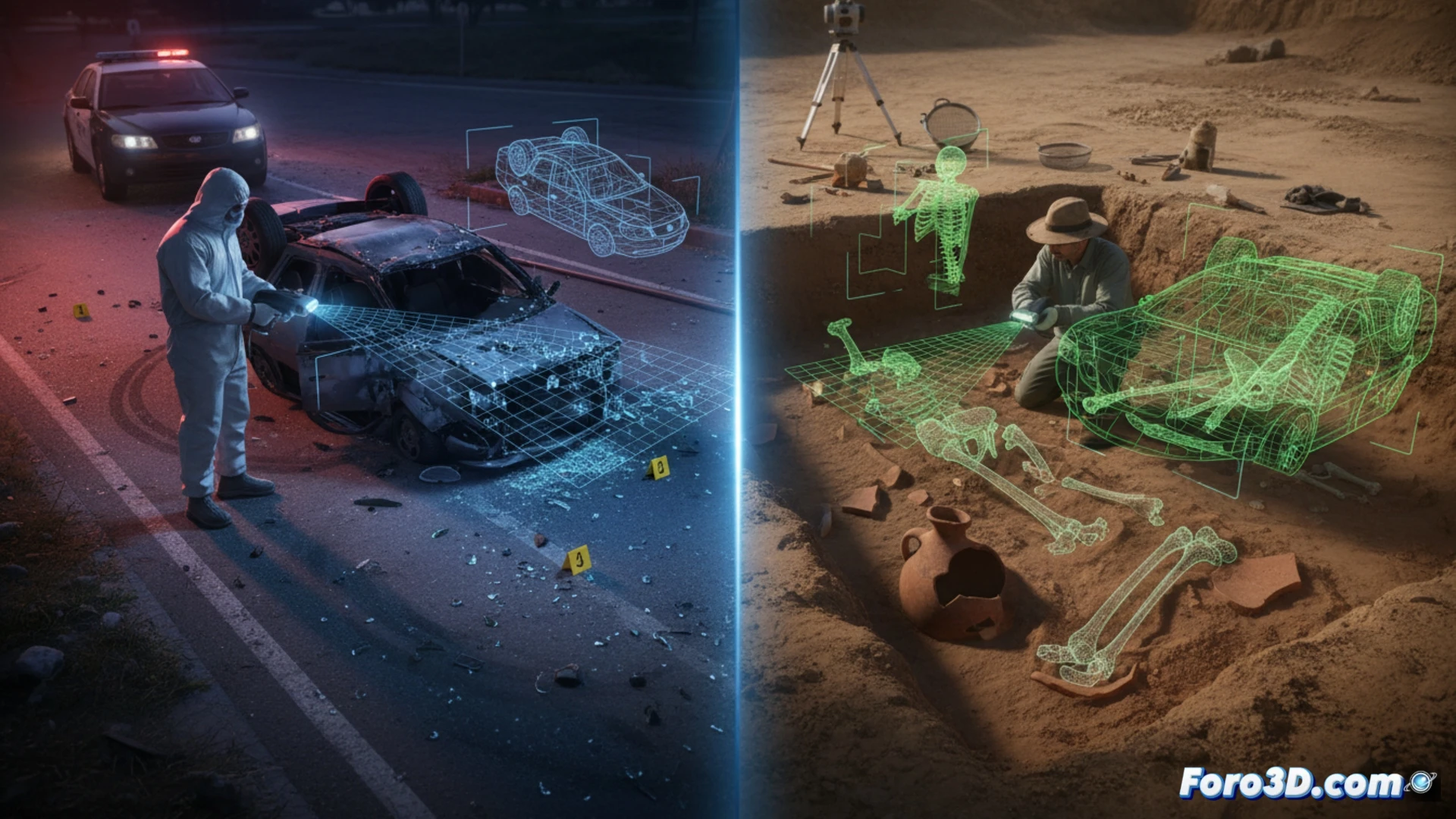
3D technology has become a key tool for researchers in various fields. It allows precise documentation of crime scenes, archaeological sites, or accidents without altering evidence. A clear example is the forensic reconstruction of a traffic accident, where 3D scanning captures the exact position of vehicles and fragments on the ground, facilitating subsequent analysis.
Software and hardware for forensic documentation 🛠️
To capture the scene, laser scanners like the FARO Focus or photogrammetry with DSLR cameras are used. Key software includes RealityCapture for processing point clouds and generating 3D models, and CloudCompare for measuring distances and analyzing deformations. Blender is also used to animate reconstructions and present findings in court. These programs allow working with precise data and exporting it to standard formats.
The day the 3D scanner found the lost key 🔍
Every investigator knows that key evidence always appears right after packing everything up. With 3D scanning, at least you can blame the software for not rendering that tiny piece properly. Of course, when the expert asks why the scene looks like a low-budget movie set, you already have the point cloud to prove that you didn't make anything up. Technology doesn't fail, only those who use it do.