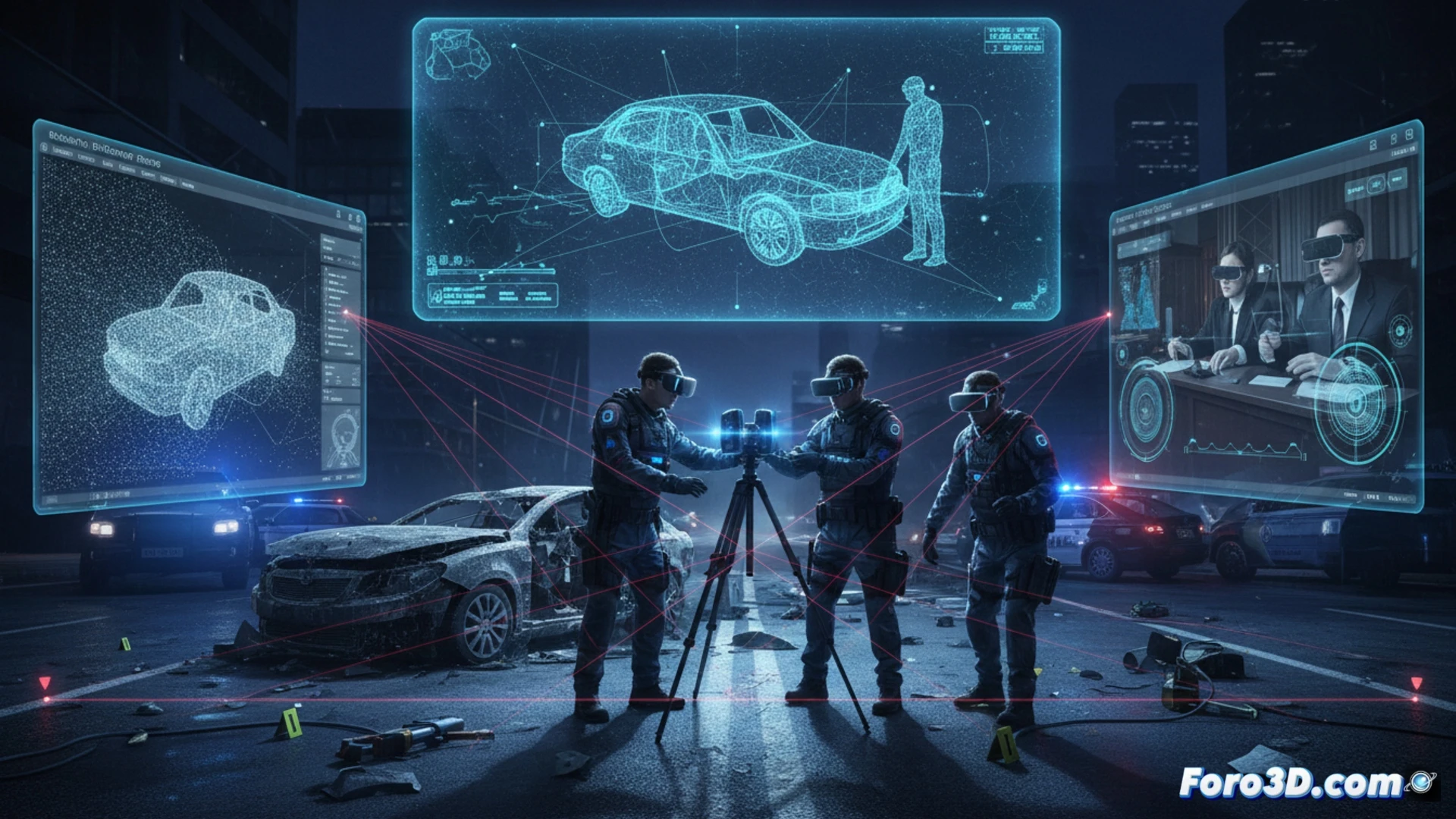
3D technology allows prosecutors to reconstruct crime scenes with millimeter precision, preventing human memory or hand-drawn sketches from leaving doubts in court. A clear example is the recreation of a traffic accident: a laser scanner captures the exact position of vehicles, skid marks, and damage. Programs like RealityCapture or Agisoft Metashape process point clouds to generate interactive models that the court can explore in 3D.
Forensic modeling: from point to actionable data 🛠️
The forensic workflow begins with a scanner like the Leica RTC360 or a drone with photogrammetry (DJI Phantom 4 RTK). Raw data is cleaned in software like CloudCompare or Autodesk ReCap. Then, it is imported into Blender or Cinema 4D to animate projectile trajectories or simulate a victim's fall. Tools like FARO Zone 3D allow calculating distances and angles directly on the 3D mesh, generating expert reports that are exported to interactive PDF. The judge can rotate the model on their tablet.
The 3D prosecutor: now also a 3D modeler (and janitor) 😅
The fun begins when the prosecutor discovers that, in addition to interrogating witnesses, they must spend three hours cleaning point clouds of noise generated by a fly that flew by. Or when the defense attorney asks: And who calibrated the scanner? Your 15-year-old nephew?. In the end, the 3D model is so detailed that even the defendant's grandmother can see the coffee stain left by the forensic technician at the scene. Technology that doesn't lie, but forces you to be a technician, a lawyer, and sometimes, a digital janitor.