The recent arrest of two individuals in Zaragoza for the homicide of a man found in La Almunia de Doña Godina illustrates the complexity of modern criminal investigation. The body was located in a rural area, triggering an operation that culminated in the arrests at Delicias station. In this context, 3D scanning technology becomes a key tool for meticulously documenting the crime scene and transit spaces, ensuring the preservation of spatial evidence.
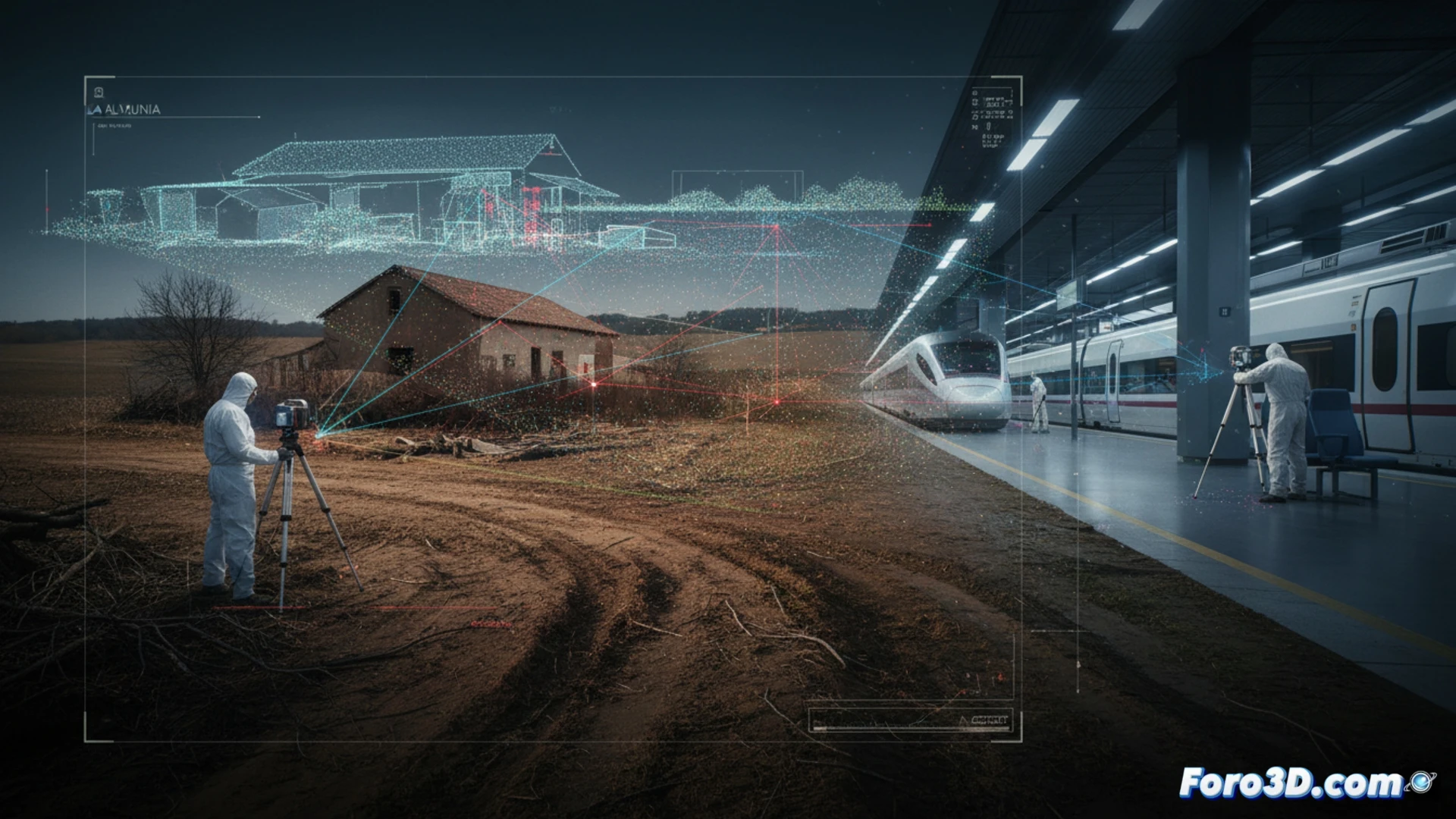
Forensic Pipeline: From Rural Photogrammetry to Urban Laser Scanner 🕵️
The forensic workflow in this case would begin with the digitization of the discovery site in La Almunia using aerial photogrammetry with drones, capturing hundreds of high-resolution images to generate a detailed point cloud of the terrain. Subsequently, at Delicias station, a terrestrial laser scanner (TLS) would be applied to model the platforms and access points in 3D, allowing the reconstruction of the suspects' trajectories. This data is integrated into virtual recreation software such as Blender or 3ds Max, where it is synchronized with the timestamps of security cameras. The result is an interactive forensic model that allows investigators to analyze the sequence of events from any angle, contrasting the statements of the detainees with the actual geometry of the space.
Virtual Reconstruction as Judicial Evidence ⚖️
Beyond mere documentation, 3D reconstruction offers undeniable evidentiary value. By merging the scans of the rural area with the station model, it is possible to verify whether the movements of the detainees are physically consistent with travel times and available lines of sight. This methodology not only speeds up the investigation but also provides the judge with an objective visual representation, reducing the ambiguity of testimonies and strengthening the digital chain of custody of spatial evidence.
What specific procedural and evidentiary advantages does 3D scanning offer over traditional forensic photography in reconstructing a crime scene like that of La Almunia, especially when the chain of custody of evidence items must be preserved?
(PS: In the forensic pipeline, the most important thing is not to mix evidence with reference models... or you'll end up with a ghost in the scene.)